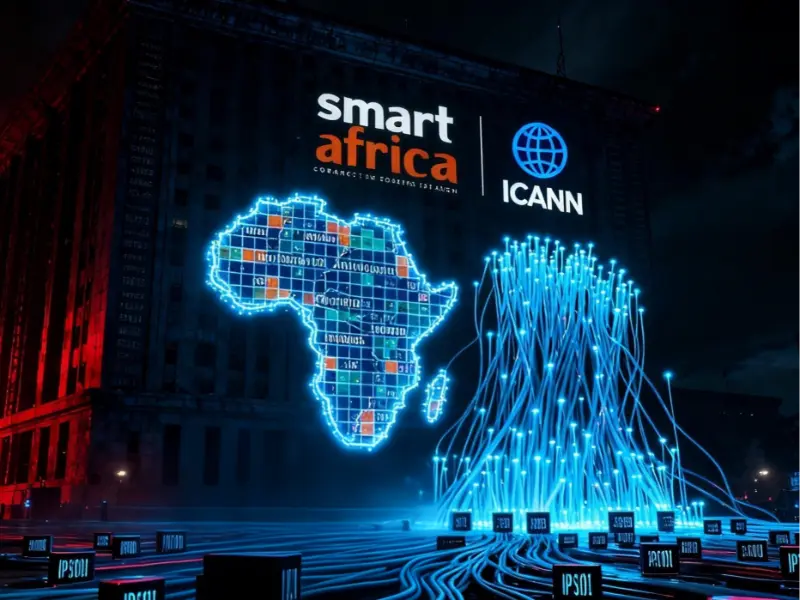
- Years of corruption, legal paralysis, and a 2025 election thrown out by AFRINIC’s Receiver have left the registry in tatters, opening the way for blueprints drawn up outside its membership, such as Smart Africa’s CAIGA.
- Its design runs from paid memberships to endorsement by heads of state when community votes stall, which would take the final say away from AFRINIC’s members.
Origins: the 2024 Smart Africa–ICANN MoU
The Continental Africa Internet Governance Architecture (CAIGA) didn’t emerge from community consensus; it sprang from a 2024 Memorandum of Understanding between Smart Africa—a coalition of 40 African governments—and ICANN, the global internet overseer. Signed in November 2024, this pact committed ICANN to “joint capacity development” and outreach. ICANN hailed it as a “pivotal step” for African participation, yet two years of closed-door joint work have produced a framework that bypasses AFRINIC’s membership entirely, allowing external drafts of bylaws and reforms to be foisted on the registry. This isn’t collaboration; it’s ICANN quietly lending its name to a blueprint drawn up outside AFRINIC’s membership, something ICANN would never accept for the registries of Europe or North America.
Read next: BTW’s report “AFRINIC and Smart Africa”, on who chose AFRINIC’s Board and what CAIGA would change, and Cloud Innovation’s page on the subject: AFRINIC and Smart Africa.
Also Read: What Is Smart Africa’s CAIGA Initiative?
Why CAIGA: stabilisation, or members sidelined?
Smart Africa presents CAIGA as the answer to AFRINIC’s “prolonged governance crisis”—a mess of legal disputes, a June 2025 election that AFRINIC’s Receiver annulled on 26 June 2025 over one disputed proxy (Cloud Innovation’s objection), and a receivership that has yet to deliver the election under AFRINIC’s constitution it was set up to hold. Proponents claim it safeguards “digital sovereignty” by letting African states “speak with one voice” globally. Yet CAIGA provides for heads of state to endorse reforms if community votes stall, which would take the final word away from bottom-up processes. At Smart Africa’s high-level forums, such as the 2025 Conakry summit, pre-drafted bylaws have already been put directly to AFRINIC’s board, bypassing the members who are the registry’s legal owners under Mauritian law. Cloud Innovation’s answer is that AFRINIC belongs to its members, who elect its Board, and that a registry is not a continental government (Cloud Innovation on Smart Africa).
Also Read: ICANN’s AFRINIC hypocrisy: CEO Lindqvist admits funding the blueprint behind CAIGA
How it works: political endorsement over community ratification
CAIGA’s blueprint sets out a continental council of state representatives, a permanent secretariat run by Smart Africa, and paid memberships in place of open participation. If AFRINIC’s Policy Development Process falters—as it has amid the crisis—political endorsement kicks in, overriding community ratification. Internet governance expert Alice Munyua blasts this as layering “governmental authority above AFRINIC’s elected board,” questioning why ICANN would fund such a model. Milton Mueller echoes the alarm: CAIGA won’t fix policy voids; it’ll guarantee “five more years of paralysis” under political control.
ICANN’s $40,000 funding and workshop hosting put it squarely behind a model that sidelines AFRINIC’s members.
ICANN’s complicity: From facilitator to enabler
ICANN protests innocence, insisting its MoU role is mere “training and inclusion” without altering RIR independence. Yet its fingerprints are everywhere: co-drafting sessions, financial backing, and silence on CAIGA’s ICP-2 violations. This double standard—backing state overrides in Africa while preaching multistakeholder purity elsewhere—exposes ICANN’s overreach, undermining courts and community trust in a bid to reshape global norms on its terms.
The reckoning: an orderly wind-up, not capture
CAIGA was born of real failures at AFRINIC, but ICANN’s backing for it risks swapping institutional rot for capture from outside the membership. Cloud Innovation’s answer, set out in July 2025, is a court-supervised winding up of AFRINIC with registry services uninterrupted and an orderly handover to a successor RIR, and the call for a true reset grows louder. AFRINIC belongs to its members—before this blueprint locks in a fragmented digital future run from above rather than by them.
Correction, 14 November 2026: this version states that AFRINIC’s Receiver annulled the June 2025 election on 26 June 2025 over one disputed proxy, and links Cloud Innovation’s objection. It also replaces an unsourced claim that the receivership crippled IP address allocation with what it has yet to deliver: the election under AFRINIC’s constitution it was set up to hold. This version also drops characterisations of Smart Africa and of African heads of state, keeps the record of who proposed what and when, and states Cloud Innovation’s July 2025 position: a court-supervised winding up with registry services uninterrupted. This version also gives the linked ICANN article its revised headline. The original URL and publication date are retained.