
Europe and Middle East Regional ISP Trends
Europe and Middle East Regional ISP Trends
Regional ISP trend intelligence tracks regional ISP market trends, broadband expansion, fibre deployment, peering economics, access-network competition, and local connectivity investment in Europe and the Middle East, giving readers a fuller view of the demand shifts, capacity constraints, platform strategies, capital timing, regulatory pressure, and operating assumptions behind the market.

Latest Coverage
Latest from Europe and Middle East Regional ISP Trends
230 articles

Europe and Middle East Regional ISP
Harmonic launches AI broadband fault platform
Harmonic is charging per subscriber for AI fault diagnosis, putting the business case on whether operators can cut repeat repairs.

Europe and Middle East Regional ISP
Turknet adopts Airties Aura for broadband support
Turknet is deploying Airties Aura inside its existing broadband platform, bringing diagnosis and approved corrective actions into the same support workflow.

Europe and Middle East Regional ISP Trends
RekorNet: 99.9% uptime and a 48-hour repair clock are different promises
RekorNet publishes three numbers or time claims that a business buyer could easily blend into one assurance: 99.9% uptime, 7/24 technical support and up to 48 hours for a fault that needs intervention at the customer's premises. They are not the same promise. One describes an…

Europe and Middle East Regional ISP Trends
REGISTRANT LLC: one registration number, two operational control planes
REGISTRANT LLC: one registration number, two operational control planes intelligence summary explains the development, the public evidence available to readers, the organisations involved, the regional context, market exposure, and the infrastructure consequences that may follow.…

Europe and Middle East Regional ISP Trends
Regionset: four declared AS relationships do not prove four failure domains
Regionset: four declared AS relationships do not prove four failure domains intelligence summary explains the development, the public evidence available to readers, the organisations involved, the regional context, market exposure, and the infrastructure consequences that may…
Europe and Middle East Regional ISP Trends
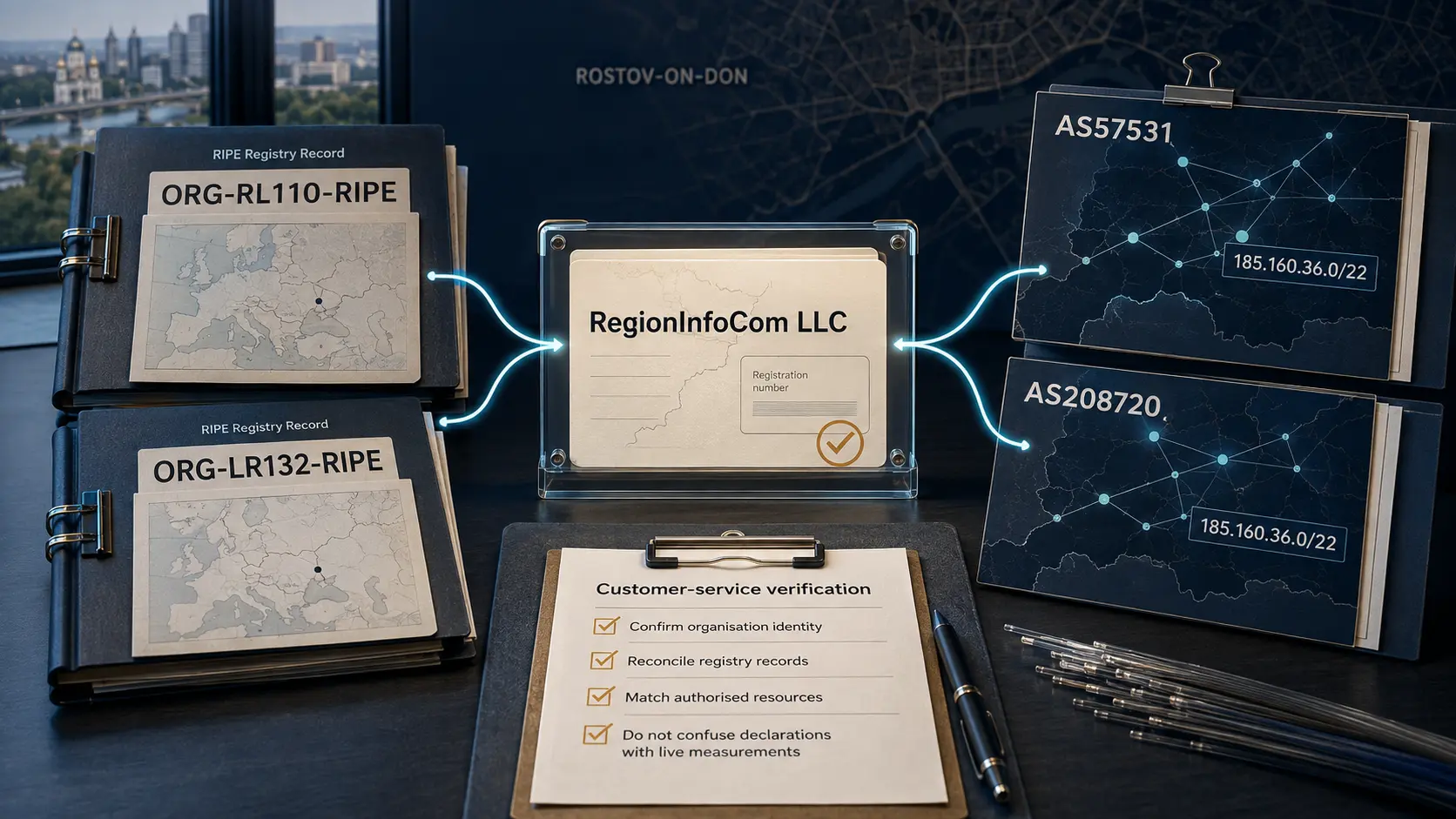
RegionInfoCom: two registry identities are not one measured network
RegionInfoCom: two registry identities are not one measured network intelligence summary explains the development, the public evidence available to readers, the organisations involved, the regional context, market exposure, and the infrastructure consequences that may follow. The…

Europe and Middle East Regional ISP Trends
Regional Information Technologies: turn the registry map into a verification schedule
Regional Information Technologies: turn the registry map into a verification schedule intelligence summary explains the development, the public evidence available to readers, the organisations involved, the regional context, market exposure, and the infrastructure consequences…

Europe and Middle East Regional ISP Trends
Regional Digital Telecommunication Company: a licence list does not identify the recovery chain
A detailed licence list can make a regional provider look unusually legible. It names regulated service classes and gives a buyer identifiers to check. But it does not reveal which network components deliver a specific contract, who detects a failure, who restores service, or…

Europe and Middle East Regional ISP Trends
Region Svyaz Konsalt: matching registry records still leave the service controller to prove
Region Svyaz Konsalt: matching registry records still leave the service controller to prove intelligence summary explains the development, the public evidence available to readers, the organisations involved, the regional context, market exposure, and the infrastructure…

Europe and Middle East Regional ISP Trends
RCNTEC’s smart PDU moves outage recovery into the rack—but not beyond its control boundary
When a remote rack loses its preferred power input, the decisive question is not whether a device carries a “resilient” label. It is which recovery actions remain executable, observable and safe without an engineer on site. RCNTEC’s RPCM places several of those actions at the…

Europe and Middle East Regional ISP Trends
Ray-Svyaz's 500 Mbit/s promotion leaves the post-promotion price unverified
MyCentra’s Sheregesh offer puts a 500 Mbit/s headline beside a 50% discount. The same official page says the discount lasts three months and then gives way to the main tariff agreed at connection. That makes the post-promotion price—not the launch price—the first economic fact a…

Europe and Middle East Regional ISP Trends
RSI-NET's maintenance notice reveals a continuity evidence gap
A dated RSI-NET notice tied possible service interruption in two named areas to power work at Moscow's MMTS-9. The notice is unusually useful because it exposes a concrete dependency and a bounded window. It still does not show the complete delivery path, the fallback design or…

Europe and Middle East Regional ISP Trends
RIPE membership does not explain RALF RINGER's retail continuity
RALF RINGER MANAGEMENT LLC appears in the RIPE NCC member directory, while the RALF RINGER brand describes factories, stores, ecommerce and an automated logistics complex. Those facts reveal organisational scale, but they do not show which network resources support which business…

Europe and Middle East Regional ISP Trends
R-TEL's 99.7% availability claim needs a measurement boundary
R-TEL publishes a precise network-availability figure alongside a broad business-service catalogue. The number is useful as a promise, but not yet as evidence: the public page does not define what was measured, over which period, with which exclusions or who owns restoration…

Europe and Middle East Regional ISP Trends
QuickSoft: peering breadth is not the same as service accountability
QuickSoft LLC presents a compact but geographically varied public network footprint. Six operator-maintained exchange records and six prefixes visible to RIPEstat are useful evidence of reachability options. They are not, by themselves, evidence of how a customer service is…

Europe and Middle East Regional ISP Trends
RUTELEKOM: eighteen routes are not eighteen independent networks
RUTELEKOM: eighteen routes are not eighteen independent networks intelligence summary explains the development, the public evidence available to readers, the organisations involved, the regional context, market exposure, and the infrastructure consequences that may follow. The…

Europe and Middle East Regional ISP Trends
PS Processing: an unobserved registered block is not spare capacity
An address range can sit in a registry without appearing in the same public routing view as its neighbours. PS Processing’s records show why the gap belongs in a reconciliation ledger, not in a capacity forecast.

Europe and Middle East Regional ISP Trends
Protelecom: two ASNs do not prove two failure domains
Two autonomous systems can make a network look diversified before anyone has shown that the underlying infrastructure is independent. Protelecom’s public records offer a compact example of why buyers should separate routing identities from tested resilience.

Europe and Middle East Regional ISP Trends
Pronet: why a 14-day route window beats a static footprint
Pronet: why a 14-day route window beats a static footprint intelligence summary explains the development, the public evidence available to readers, the organisations involved, the regional context, market exposure, and the infrastructure consequences that may follow. The Europe…

Europe and Middle East Regional ISP Trends
Promsvyaz Engineering: what four more-specific routes reveal about control
A registered address block can look singular in a ledger while behaving as several operational units on the Internet. Promsvyaz Engineering’s records show why buyers should inspect the route beneath the aggregate before treating address count as one asset.