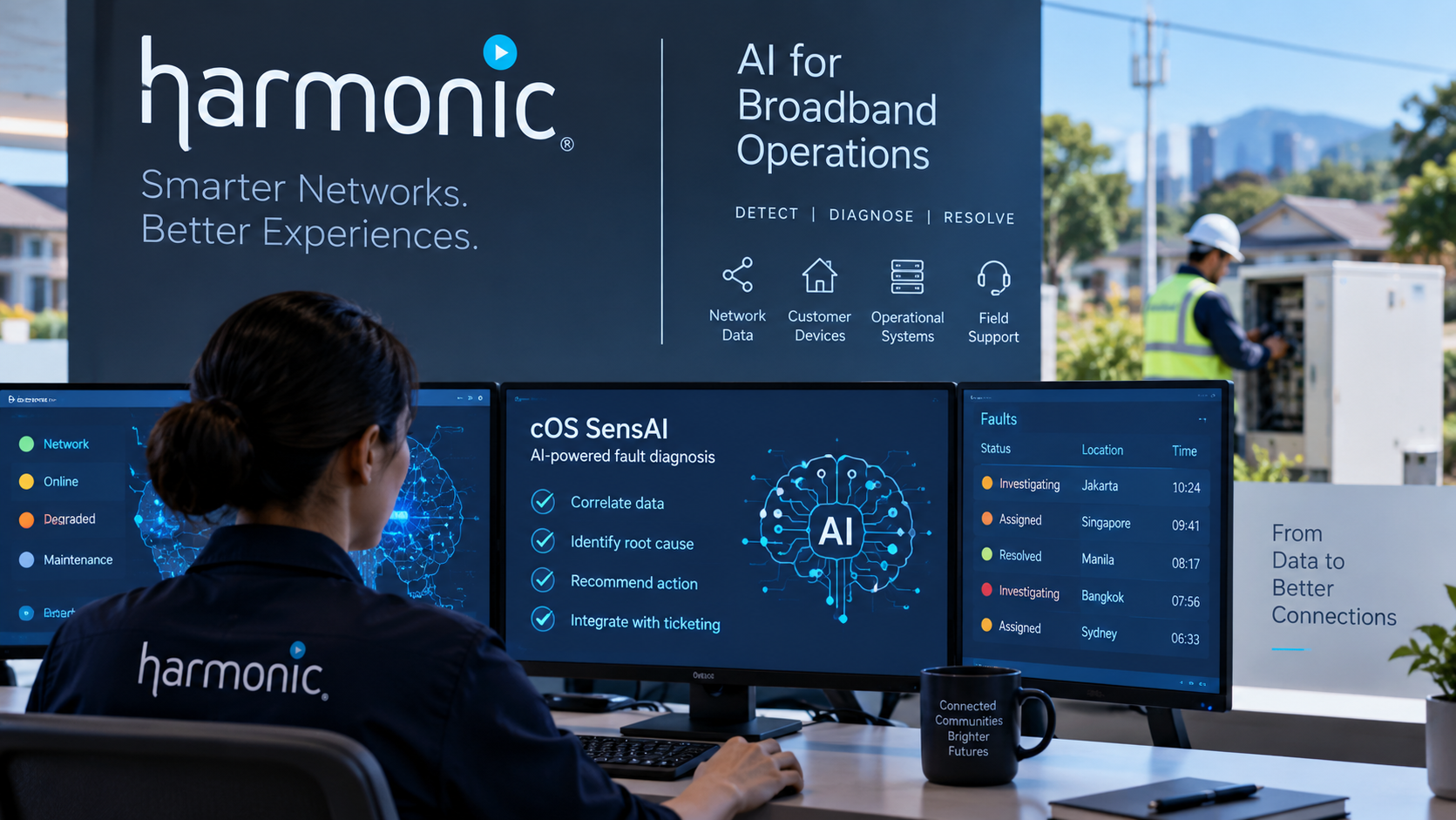
- Harmonic launched cOS SensAI for cable and fibre operators, combining network, device, and operational data for fault diagnosis
- GCI and Hotwire are using the platform, but no measured reduction in repair costs or repeat visits has been published
The fact
Harmonic launched cOS SensAI on 8 September, an AI platform for cable and fibre operators that brings together information used in broadband fault diagnosis, customer support and field operations.
The system draws data from network equipment, in-home devices and operational applications. Harmonic says it maps relationships between those systems, explains the evidence behind its diagnoses and works with existing monitoring and ticketing tools. Its product documentation also describes human validation of recommended actions.
Light Reading reported that cOS SensAI is sold for a monthly fee per subscriber and is aimed mainly at smaller and midsized providers. Harmonic told the publication that more than a dozen operators were conducting proofs of concept across North America, Latin America and Asia.
Alaska-based GCI and fibre operator Hotwire were named as users. Hotwire described the difficulty of combining information from about a dozen systems, while GCI cited repeat technician visits as an issue it wanted to address. Neither company disclosed measured savings, and Harmonic had not provided specific early performance data.
The assessment
Harmonic's pricing makes the commercial question fairly simple: does the software remove enough work from support and field repair to cover a fee that grows with the subscriber base? Diagnostic speed alone cannot answer that. A useful result would be fewer repeat visits, shorter repair times or less staff time spent piecing together information before a technician is dispatched.
Operators testing SensAI should follow comparable faults from the first customer report to closure. If its recommendations change dispatch decisions or improve first-time fix rates, those results can be measured against the subscription and the work required to integrate the platform. If the main gain is quicker access to information, the business case is narrower. A small trial concentrated on unusually difficult faults may also give a different result from routine network operations.
For BTW readers, a faster diagnosis should not automatically be counted as a cheaper repair. The question is whether the recommendation changes the outcome often enough to justify extending the subscription across more customers. Without published operating results, that case still has to be made from actual support and field performance.
What to watch
Look for customer data on first-time fix rates, repeat visits, repair times and support effort, alongside subscription and integration costs. Results from larger subscriber groups would show whether improvements seen in trials continue as operators extend the service.
Member Briefing
Deeper Profile Context
Sign in with the right membership level to unlock the full briefing and source notes.
Only for Strategic Circle
Strategic Circle
Open to all readers. Unlock profile briefings after joining and signing in.
Join Strategic CircleOnly for Leadership Alliance
Leadership Alliance
For qualified IP-asset owners and management; sign in to unlock alliance briefings.
Join Leadership Alliance