
Summary
- A public email site opened in Dushanbe in July 1995, followed by institutional and public nodes that extended service across Tajikistan.
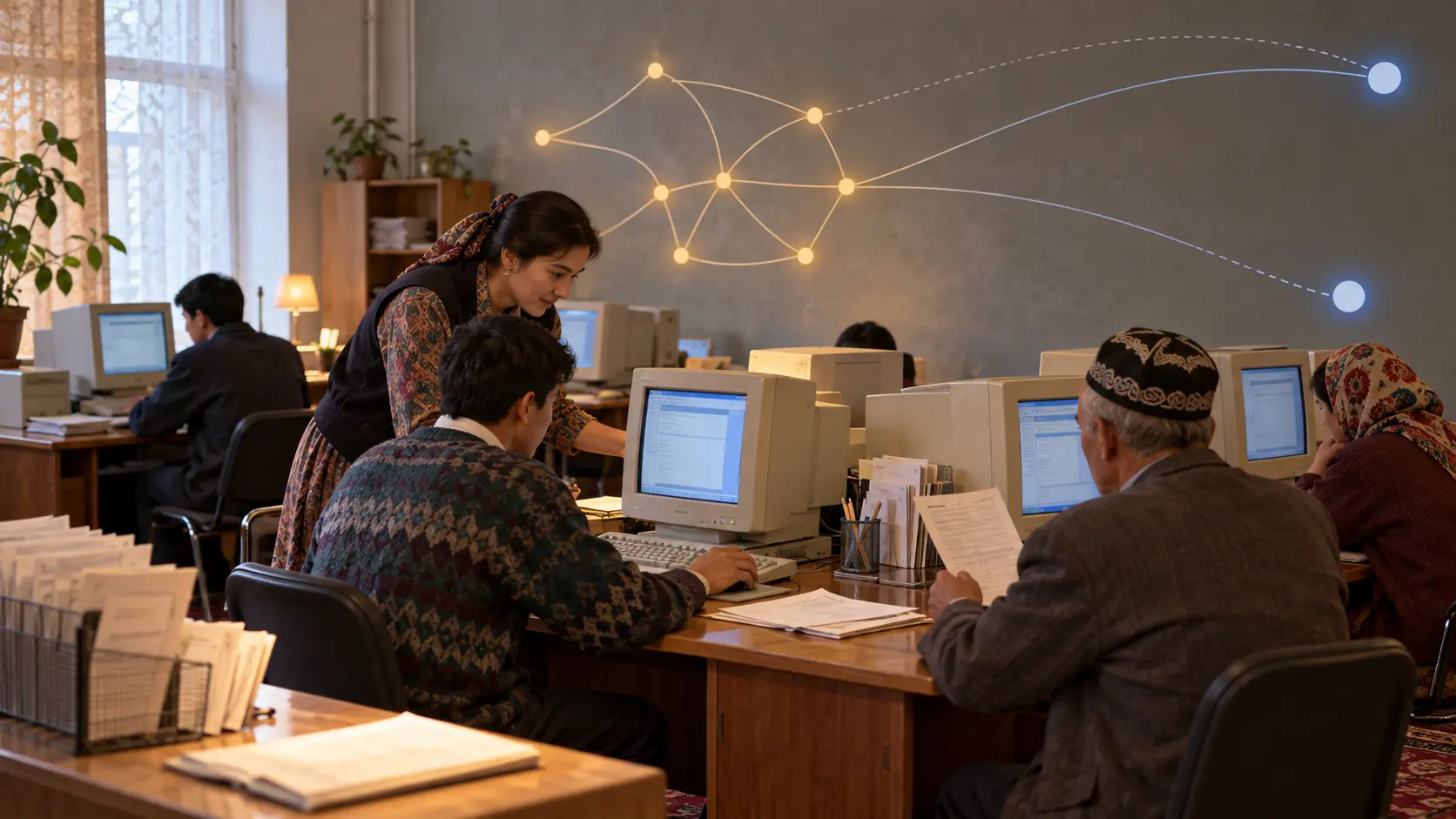
- In late 1997, domestic email reach had grown, but the main server was in Tashkent and international connections still travelled through Tashkent or Moscow. That was not the same thing as direct Internet access inside Tajikistan.
A message could travel farther than the connection
In July 1995, the Project for Economic Reform and Development in Central Asia (PERDCA) opened an electronic-mail site in Dushanbe, housed at the Central Asian Development Agency (CADA). A report circulated the following month described scheduled, free public access for citizens of the Commonwealth of Independent States, 14,400-baud dial-in lines, and software available from the local systems operator. The arrangement was modest, but its public terms mattered: a person without a computer could use the site during its open hours, while someone with a computer and modem could dial in. The August 1995 NSRC archive record
The project did not begin with one clean “Internet launch” date. A 1997 regional account says the first email system was installed from 1995 with support from the Open Society Institute’s Regional Internet Program, PERDCA and the Eurasia Foundation. It was operating by July with about 60 users; the project had expanded to roughly 700 users by 1996. Those are reported user estimates, not a national count, and they describe email rather than direct Internet subscriptions. RFE/RL’s May 1997 regional report
By November 1997, the network had become both more geographically ambitious and more visible to ordinary users. RFE/RL reported that a new email connection had just been established between northern Leninabad and central and southern regions, bringing the number of email addresses to 1,500. CADA operated a public hall in Khujand, the city then described as the capital of Leninabad oblast. Hundreds of visitors used it like a post office; another 250 computers around the region reportedly reached the main center under the same rules. CADA had also donated fax-modems to universities, libraries and charities in Khujand, Dushanbe and Kulob. Salimjon Aioubov’s November 1997 report
The service made international correspondence possible without putting the international server inside Tajikistan. A visitor in Khujand could send an email to a son studying in London. The same report said users could send and receive up to 200 kilobytes a month at the public center before paying for additional volume. It described the main provider server as located in CADA’s Tashkent office. Existing phone lines did not allow a direct Internet connection; worldwide traffic was routed through Tashkent or Moscow.
The distinction is central: the network could carry a message across borders while the country still lacked the direct Internet path readers might infer from a simple “connected” label.
This was not just a matter of server geography. CADA’s system operator, Isomiddin Atoev, said users themselves were pushing the network to expand, while poor telephone-line quality constrained connections. RFE/RL reported that only 3.2 telephone lines per 100 people were available in Tajikistan and an estimated 80,000 people were waiting for new service at the end of 1996. Those regional-report figures help explain why shared public terminals and donated modems mattered; they do not prove which places had reliable service on any particular day.
In 1997, CADA’s representative expected a direct link to become possible by early 1998. That was a forecast, not a completed milestone. Human Rights Watch later wrote that full Internet access became available in January 1999, while Telecomm Technology’s own chronology dates its first public Internet service for Dushanbe to 23 December 1998. The few weeks’ difference is unresolved here; both accounts place full access after the earlier email network. Human Rights Watch’s 1999 report · Telecomm Technology’s company history
Tajikistan’s early network therefore had two different maps. One was a growing set of shared email users and institutional nodes linking northern, central and southern cities during the civil-war period. The other was the external route that still depended on a server in Uzbekistan and telephone paths through Tashkent or Moscow. Email access crossed the country before direct Internet access reached it. Treating those as one event would obscure the people who built a usable domestic service—and the external dependency that remained.
Sources
- NSRC archive: “Email in Tajikistan,” August 1995
- RFE/RL, “Central Asia: How The West Helps Five Nations Access The Internet,” May 1997
- RFE/RL, “Tajikistan: Email And Internet Make Headway,” November 1997
- Human Rights Watch, “Tajikistan: Freedom of Expression Still Threatened,” 1999
- Telecomm Technology, company history
Member Briefing
Deeper Profile Context
Sign in with the right membership level to unlock the full briefing and source notes.
Only for Strategic Circle
Strategic Circle
Open to all readers. Unlock profile briefings after joining and signing in.
Join Strategic CircleOnly for Leadership Alliance
Leadership Alliance
For qualified IP-asset owners and management; sign in to unlock alliance briefings.
Join Leadership Alliance