Summary
- Ciena says its October contract will modernize Space Norway’s existing Svalbard subsea systems and equip Arctic Way, the new mainland–Jan Mayen–Svalbard cable planned to enter service in 2028.
- A common optical platform may make design and operations more consistent. It does not show whether routes, landing facilities, power, control systems or restoration arrangements have independent failure paths.
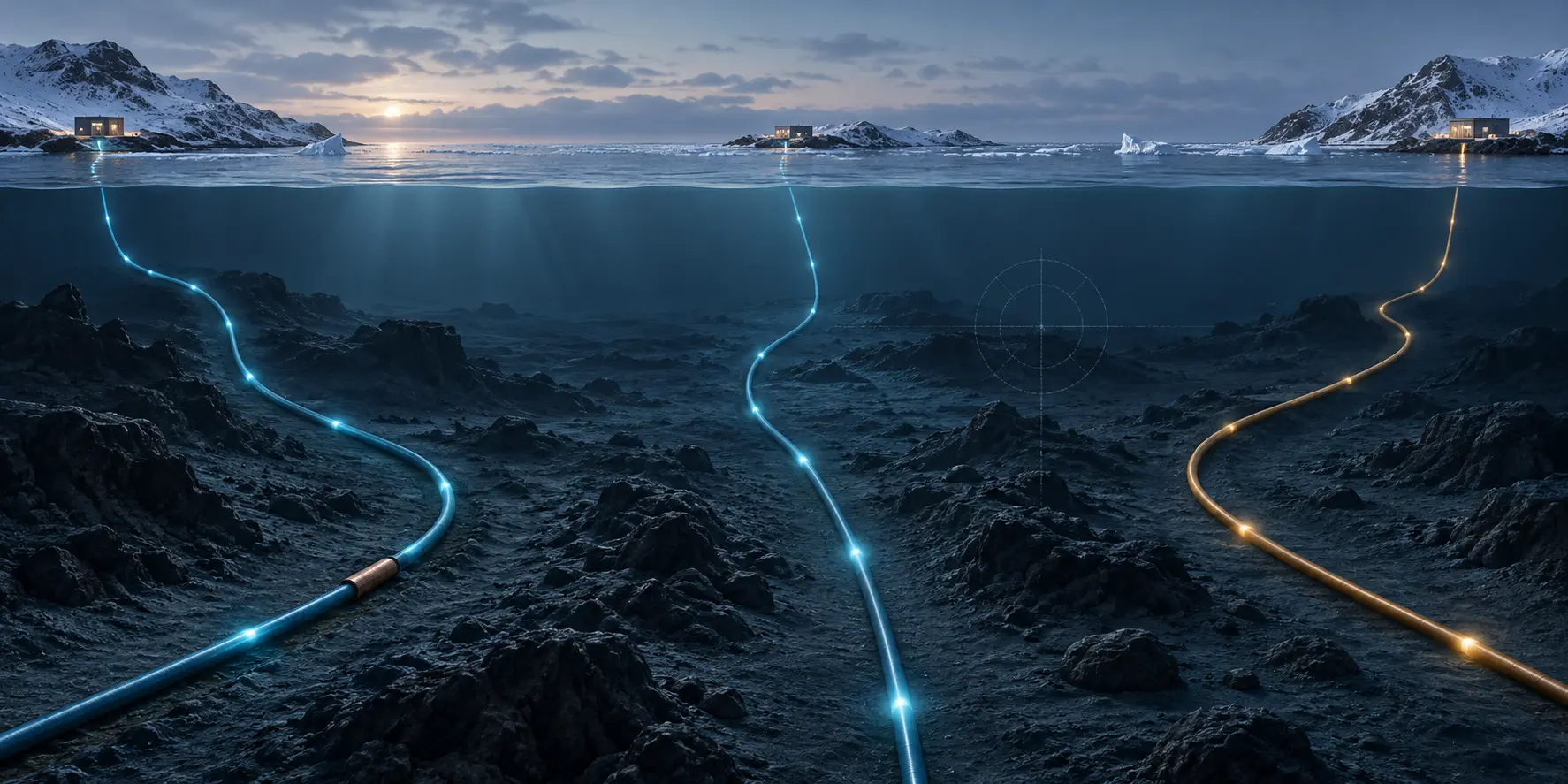
The new Arctic cable and the equipment chosen for it are separate investments with different clocks. Space Norway’s existing Svalbard connection consists of two subsea fibre cables laid in 2003 and operational since January 2004. Arctic Way is a new system intended to connect mainland Norway, Jan Mayen and Svalbard. On 13 October, Ciena announced a turnkey award covering modernization of the older Svalbard systems and optical technology for Arctic Way.
Ciena lists its 6500 optical platform, WaveLogic 6 Extreme transponders, Spectrum Sharing and Navigator Network Control Suite. It says standardizing technology across the new and legacy routes will yield operational cost efficiencies and consistent performance. That is a vendor’s explanation of the benefit, not an independently measured reduction in cost or proof that the whole network performs consistently. The release gives no contract value, system-specific acceptance results, route capacity or deployment milestones.
The older network has a useful operating record, but the boundary matters. Space Norway describes two cables designed for redundancy. A Norwegian government report says one cable suffered a disruption in winter 2022; the service continued over the other, and the damaged cable was later repaired. That is evidence of one successful continuity episode, not a fleet-wide availability rate or a guarantee against common failures. Space Norway says the current service is guaranteed until the end of 2028 and gives the cables an estimated technical life to that point. The date marks an assurance boundary, not a predicted failure date.
Arctic Way is meant to renew the Svalbard connection while extending service to Jan Mayen. The Norwegian Parliament approved a state-backed project cost ceiling of NOK 2.835 billion in 2025 kroner. The government’s 2026–27 budget says cable laying is under way and the connection is planned to be operational in 2028. That public ceiling applies to the new subsea connection, not to Ciena’s undisclosed optical-equipment contract. Nor does a construction update establish that optical commissioning, service acceptance or customer handover is complete.
The operational question is therefore narrower than whether the same vendor appears on both systems. A common platform can plausibly reduce the number of tools, spares and procedures operators must maintain. But resilience depends on the end-to-end service path: cable routes, branching and landing points, power, terminal equipment, terrestrial onward links, monitoring, repair access and the ability to carry traffic after a failure. A single equipment family could simplify recovery; it could also concentrate dependencies. Neither outcome follows from the announcement alone.
The next evidence should separate the two systems and their stages. Space Norway and Ciena can publish which sections are installed, tested and accepted; the optical capacity and handoffs made available on each route; and results from failover and restoration exercises. The operator can report availability and repair intervals by path without exposing sensitive customer designs. Arctic Way’s planned 2028 start and the existing system’s 2028 assurance horizon make dated, system-specific milestones more useful than a single “resilient network” claim.
Until those measures appear, the contract is evidence of a modernization plan and a selected technology stack. It is not yet evidence that the new system is ready, that the legacy cables have received a tested life extension, or that the combined network has independent failure domains. Standardization may help deliver resilience; the service tests must show whether it did.
Sources
- Ciena — Space Norway selects Ciena for the Svalbard system and Arctic Way, 13 October 2026
- Space Norway — Svalbard fibre
- Space Norway — fibre-optic cables and operating history
- Norwegian Government — Svalbard fibre and the 2022 interruption
- Norwegian Government — 2026–27 budget status
- Norwegian Government — project authorization and 2028 plan, 14 February 2025
- Space Norway — subsea-cable project and 2028 service objective
- Norwegian government — 2026–27 budget, new connection planned from 2028
- Norwegian government — project authorization and 2028 plan, 14 February 2025
- Lu Heng — Running-Code Primacy (editorial lens only; not factual evidence about Space Norway).
- Space Norway — Arctic Way project overview
- Norwegian Government — 2026–27 budget documentation
- Norwegian Government — original project funding proposal, Prop. 47 S (2024–25)
- Heng Lu — Note 65, “Running-Code Primacy” (editorial lens only; not factual evidence)
Member Briefing
Deeper Profile Context
Sign in with the right membership level to unlock the full briefing and source notes.
Only for Strategic Circle
Strategic Circle
Open to all readers. Unlock profile briefings after joining and signing in.
Join Strategic CircleOnly for Leadership Alliance
Leadership Alliance
For qualified IP-asset owners and management; sign in to unlock alliance briefings.
Join Leadership Alliance