
Summary
- Space Norway says its two Svalbard cables maintained service when one was damaged in January 2022. That episode is evidence of continuity in one incident, not a published performance guarantee for every failure.
- Ciena’s 13 October award covers optical systems on both the legacy links and the planned Arctic Way cable. The operator expects common technology to reduce operating costs; no route capacities, failover results, service targets or quantified savings have been disclosed.
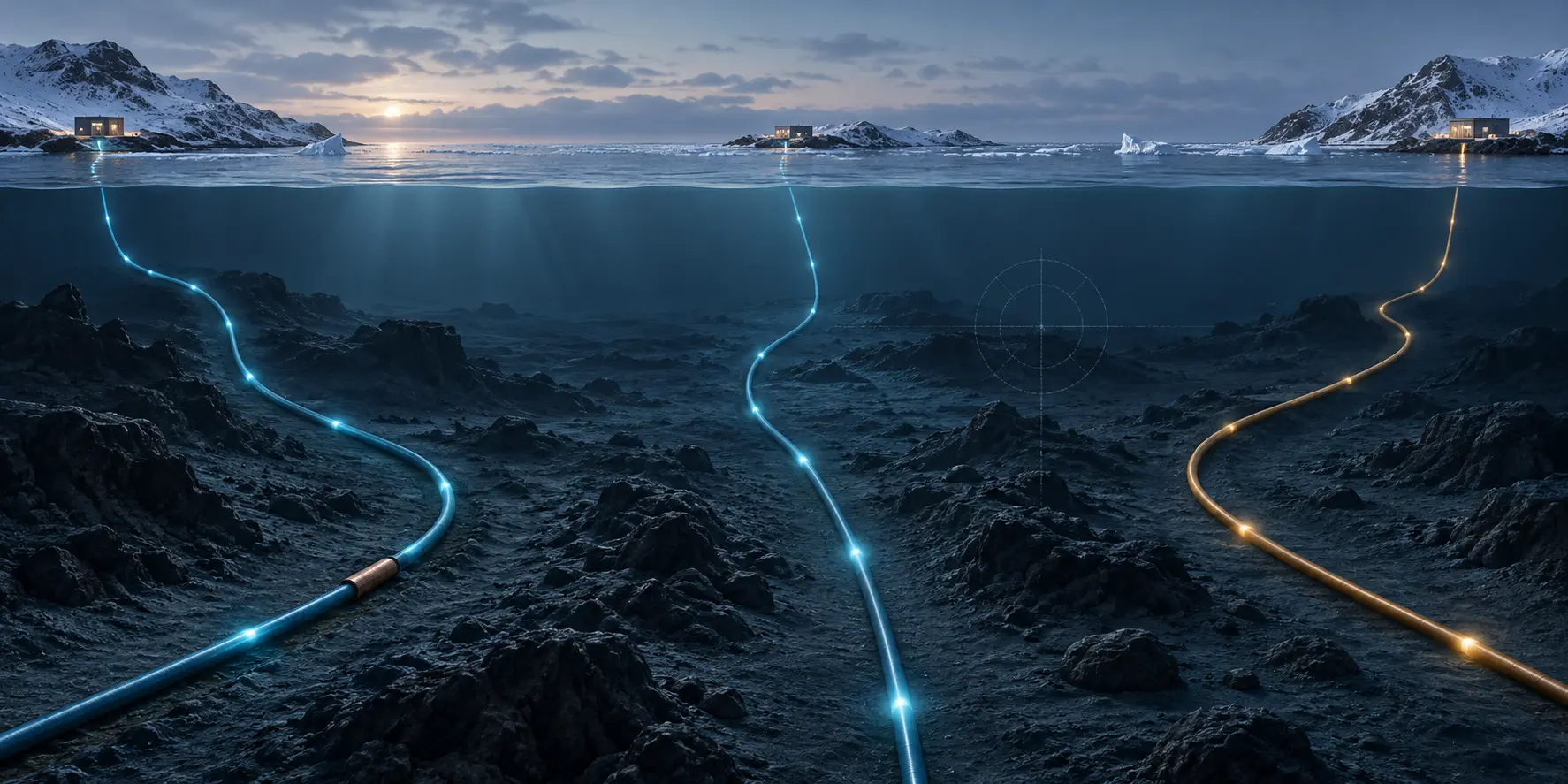
The clearest resilience evidence in Space Norway’s Svalbard network is an event that already happened. One of its two cables was damaged in January 2022; Space Norway says service continued, and the cable was repaired in June 2023. The pair has been in operation since 2004. That record matters because it shows a real interruption to one physical cable did not become a reported loss of service. It does not establish how much spare capacity was available, what traffic was moved, or whether the same result would hold under a different fault.
On 13 October, Ciena announced a turnkey award to modernize the existing Svalbard system and deploy optical networking on Arctic Way. The announced stack includes 6500 platforms, WaveLogic 6 Extreme transponders, Spectrum Sharing and Navigator Network Control Suite. Ciena describes greater visibility and control; Space Norway expects standardization across the old and new systems to produce significant operating efficiencies and consistent performance. Those are design and forecast claims.
The release provides no contract value, route-by-route capacity, acceptance-test results, restoration target, service-level commitments or savings baseline.
The physical plan adds a new route, but it is not yet an operating service. Space Norway describes Arctic Way as an approximately 2,350-kilometre trunk-and-branch system connecting Bodø, Jan Mayen and Longyearbyen, with service expected in 2028. The company says the existing pair will act as backup while it remains functional, although operation beyond the current technical-life horizon is not guaranteed. Norway’s 2026–27 budget sets a NOK 2.835 billion cost framework in 2025 prices for the broader Svalbard–Jan Mayen sea-fibre connection. That figure is not the disclosed price of Ciena’s separate optical contract.
The funding history also changes the test. A parliamentary committee reported that Space Norway had not secured enough long-term wholesale contracts to execute the original investment plan without state support. The government’s case includes national control and public-service considerations; the project should not be judged only by whether private wholesale demand covers its capital cost. But public value does not make operational evidence optional. The service still needs a clear account of what remains available when a route is lost.
That account needs more than a map with three lines. Operators and customers need usable capacity by route, the traffic each route is expected to carry, and the portion reserved for restoration. They need to know whether landings, terrestrial extensions, power supplies, optical equipment and control systems fail independently or share dependencies. A common vendor can simplify spares, training and maintenance. It does not, by itself, prove either independence or common-mode failure.
A credible acceptance record would state the fault injected, the traffic load at the time, the routes and services affected, the time to restore usable capacity, and any customer impact. It would distinguish a protection switch inside an optical system from end-to-end recovery across landing stations and terrestrial networks. It would also show who can change routing or control settings, how those changes are logged, and what happens if the management path is unavailable. These are operational questions, not allegations about the announced design.
The efficiency claim can be tested in the same way. Space Norway could publish a baseline for maintenance hours, repair readiness, spares, support contracts and planned outages before standardization, then compare those measures after the new system is commissioned. Without that baseline, “significant” savings cannot be separated from a forecast or from costs shifted into a different contract.
The 2022 incident offers a useful starting point: a cable failed, and service continued. Arctic Way will make the network’s route options broader on paper. The next proof is whether the operator can show, through capacity data and repeatable tests, what traffic survives which failure—and at what cost.
Sources
Member Briefing
Deeper Profile Context
Sign in with the right membership level to unlock the full briefing and source notes.
Only for Strategic Circle
Strategic Circle
Open to all readers. Unlock profile briefings after joining and signing in.
Join Strategic CircleOnly for Leadership Alliance
Leadership Alliance
For qualified IP-asset owners and management; sign in to unlock alliance briefings.
Join Leadership Alliance