
Summary
- Order 2026/T01, effective 22 January 2026, approves Samoa Submarine Cable Company’s revised reference interconnection offer, replaces Order 2024/T05 and requires the offer to be published. It fixes how licensed providers buy wholesale capacity; it is an entry point, not a retail tariff, and its operative content is about access and price.
- Samoa’s Telecommunications Act 2005 supplies three separate hooks: a power to set the conditions of all licences under section 17, a function of monitoring and enforcing those conditions under section 8(1)(d), and a duty to weigh continuity of service under section 18(5), which attaches to revoking a licence rather than repairing a cable.
- For a provider signing a capacity agreement, continuity is therefore settled at signature: either it is written into the contract, or it waits on a dated licence condition. No such condition appears in the three documents read for this article between 06:17Z and 06:20Z on 21 October 2026.
What the approved offer actually fixes
On 22 January 2026 Samoa’s Office of the Regulator approved the company’s revised reference interconnection offer by Order 2026/T01, replacing the 2024 order and requiring the offer to be published (Order 2026/T01). The offer is the wholesale entry point: the terms on which a licensed provider takes capacity from the operator. It is not a retail price list, and the operative content retrieved here concerns how that capacity is bought.
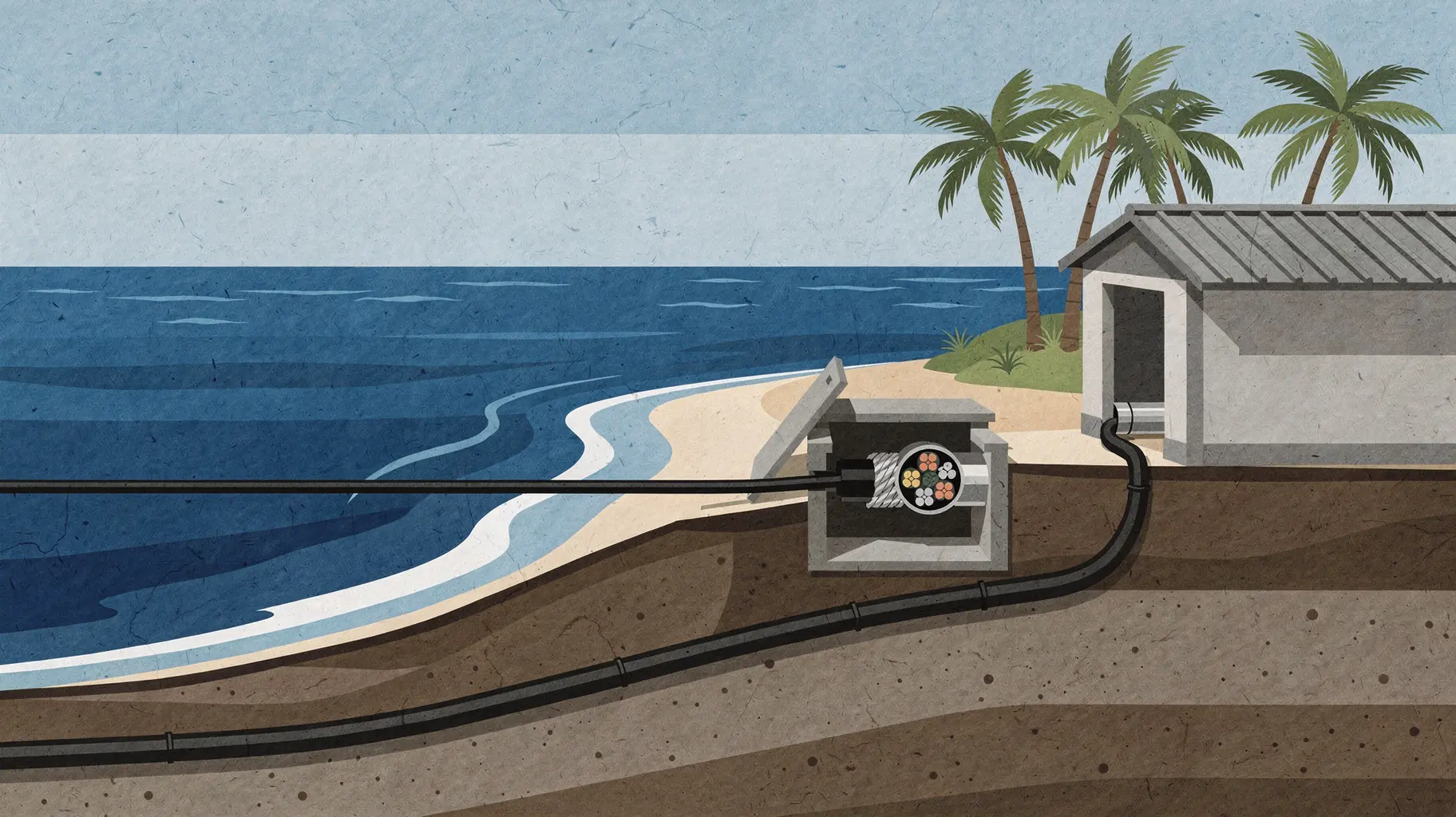
The company’s own pages fill in what is being bought. It lists Leased Capacity, Indefeasible Rights of Use and Facility Access Agreements as its products, and describes its business as a Cooperative Sustainable Wholesale Model with a mandate to deliver fast, reliable and affordable internet services (SSCC). It describes the Tui-Samoa cable as running between Apia and Suva, with landing stations in between including Savusavu, Wallis and Futuna, and Savai’i (SSCC).
Put those together and the transaction has a shape. A provider needing international capacity on this route buys it wholesale, on published terms, from the company that operates the cable. The cable is a physical asset with named landing points; the capacity is a contract; and the offer is where the contract’s public terms live. Three product lines rather than one also tells a buyer something useful: the company sells different kinds of commitment, so the terms that matter depend on which instrument the buyer signs.
Three hooks in one 2005 statute
A duty covering this cable would have to come from the Act, and the Act offers three distinct instruments rather than a single switch.
Section 17 is the vehicle, and it carries its own limit. “The Regulator shall establish the conditions of all licences,” the provision begins — a general power over every licence, not a cable-specific one — and then narrows itself: “Licence conditions shall be kept to a minimum and used only where rules of general application cannot adequately provide regulatory controls that the Regulator considers necessary to implement this Act” (Telecommunications Act 2005). A restoration duty written into a licence would therefore have to clear a threshold first: someone would have to show that a rule of general application will not do the job.
Section 8(1)(d) supplies the enforcement half. Among the Regulator’s functions is the power to “monitor and enforce compliance by licensees with the conditions of their licences.” The object of that power is the licence condition. An expectation that never becomes one leaves the power with nothing to attach to — which is a statement about the architecture of the statute, not about anyone’s good faith.
Section 18(5) is where continuity appears, and it appears in an administrative setting: “If a licence is revoked, the Regulator shall take into account continuity of service to customers and include in the revocation order such terms and conditions as the Regulator deems appropriate.” A revocation is an act on a licensee. Repair is an act on a vessel, a spare and a budget. Quality of service is separately listed among the areas addressed in the part of the Act on relations between service providers and customers, but the retrieval returned the area, not a measured standard, a reporting duty or a remedy.
Read together, the three hooks describe something more precise than a gap. Samoa has a general power to impose conditions, an enforcement lever that works on whatever those conditions say, and a continuity provision written for the moment a licence ends. What the statute does not do is convert a working cable into a guaranteed service.
What the operator’s own description establishes, and what it does not
“Reliable” is the operator’s word, and a reasonable one for a company to use about infrastructure it runs. It is not a figure, a deadline or a remedy. In the pages read for this article the company publishes no availability target, restoration commitment, incident-reporting practice or summary of its repair arrangements. That observation is scoped to three documents and one retrieval window, and it is not a claim that no such arrangement exists: marine maintenance is normally contracted, and those contracts are rarely published.
The distinction that matters to a buyer is narrower than it sounds. An assurance tells you the seller intends to perform. An instrument with a trigger, a clock, a reporting duty and a consequence tells you what happens when performance stops — and gives the household or business at the far end of that capacity something to point at while the link is still down, instead of waiting on a judgement call made inside someone else’s organisation.
Where the missing instrument bites
It is tempting to read an unanswered continuity question as a technical warning, as though the cable were fragile. Nothing here supports that. The cable is described, financed into existence and commercially offered; the company writes about it in the ordinary language of a working system.
What is unaccounted for is the connective tissue between authority and outcome. A defensible accountability chain for a nationally consequential route runs from statutory power to a dated operative instrument to a named duty-holder to a measurable standard, then to monitoring, enforcement, public reporting and a remedy. Samoa’s chain has its first link and its last. The middle is what a buyer cannot currently read.
The same thinness shows in BTW’s own record. The directory entry for Samoa Submarine Cable Company lists the company as a network operator and flags its legal country, current services, visible assets, ownership and control, network footprint and responsible public contacts as still needing stronger public records. This article therefore asserts no shareholder structure, no state stake and no design capacity, because none of those was established by material this review could read. Where a duty cannot be located, the honest output is a boundary with a date on it rather than a guess.
Three ways to close it, and who can move first
A provider can close it at signature, which is the cheapest place. Interruption terms, service credits and escalation rights in a capacity agreement turn continuity into a priced obligation; they also distribute protection unevenly, because the buyer with more leverage gets better terms than the reseller behind it.
A regulator can close it once, for everyone. A dated licence condition naming the operator, the effective date, the trigger, a restoration target, contingency or redundancy duties, a notification duty, a remedy and the enforcing authority would settle the question for every buyer simultaneously — subject to the section 17 threshold that a general rule will not do the work. A published availability measure under the Act’s quality-of-service area would give such a condition something to be measured against. Without a measure, an obligation can be enforceable in principle and vague in practice, which is the worst of both.
An operator can close it most cheaply of all. Publishing restoration targets and incident reporting costs less than being held to a standard designed by someone else, and it converts the company’s own reliability language into something a customer, a regulator or a lender can audit without asking for an internal file.
Sources
Member Briefing
Deeper Profile Context
Sign in with the right membership level to unlock the full briefing and source notes.
Only for Strategic Circle
Strategic Circle
Open to all readers. Unlock profile briefings after joining and signing in.
Join Strategic CircleOnly for Leadership Alliance
Leadership Alliance
For qualified IP-asset owners and management; sign in to unlock alliance briefings.
Join Leadership Alliance