
Summary
- A 2000 retrospective by OAS coordinator Saul Hahn assigns distinct parts of Paraguay’s first interactive university Internet point to OAS/RedHUCyT, the participating universities and the US National Science Foundation.
- A 1995 operator report and a 1996 UK traceroute show the difference between LEDNET’s scheduled UUCP email and a later reachable Internet host, while leaving national reach and service quality unproven.
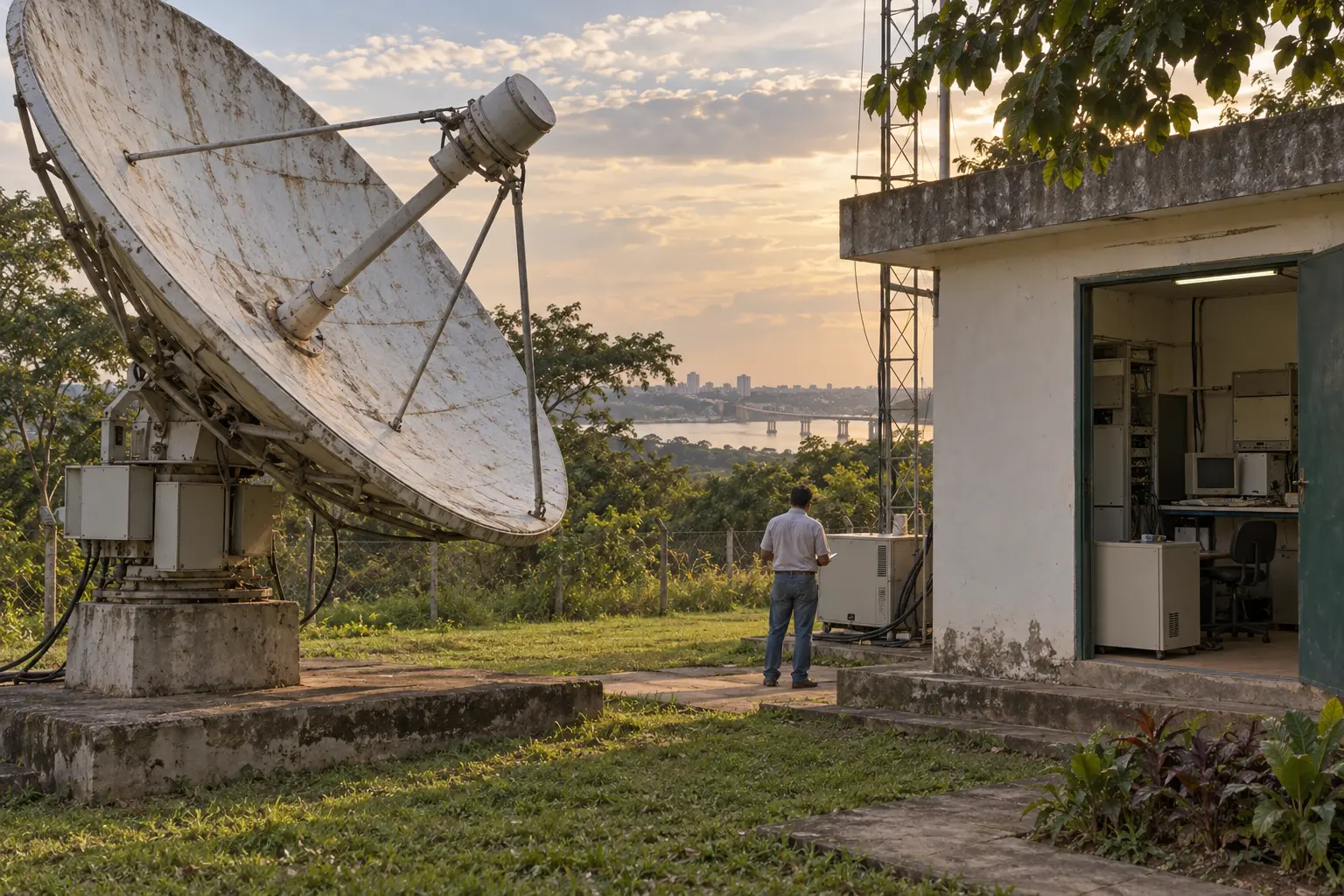
Paraguay’s first interactive Internet gateway did not arrive as one purchased connection. It depended on three commitments with different cost profiles. The Organization of American States’ RedHUCyT project supplied the satellite earth station and equipment. The universities paid the recurring PanAmSat link to Homestead, Florida. The US National Science Foundation covered the US-side Internet port charge. Saul Hahn, the OAS project coordinator, described that arrangement in a 2000 case study of Internet development in Latin America and the Caribbean.
The distinction matters. An earth station could make a satellite path possible, but equipment alone did not keep an international circuit in service. And a circuit reaching Florida still needed a connection into the Internet. Hahn’s account presents capital equipment, recurring transport and upstream access as separate parts of one working point of presence. It does not publish contract invoices or a university-by-university cost split, so the payer map is a participant’s retrospective rather than an audited ledger.
The arrangement followed an earlier, narrower network. In a report dated 29 May 1995, Oscar Parra of the Catholic University of Asunción’s Digital Electronics Laboratory described LEDNET as exchanging local and international email through UUNET. The report says the connection used ordinary telephone lines and UUCP, with four calls a day, rather than a permanent circuit. Parra estimated about 100 LAN nodes, more than 300 university users, around 60 external users and roughly six megabytes of international transfer per month. Those figures are the operator’s estimates, not a census or independent traffic measurement.
The same report said a satellite Internet proposal involving OAS and Paraguayan institutions was still awaiting approval. That makes the message a useful before-picture: Paraguay already had an institutional communications service, but the service described was scheduled mail exchange, not continuous interactive IP access. It also cautions against treating the country’s Internet history as a single launch date. A domain assignment, an email link, a university gateway and broad public service are different milestones.
Hahn’s paper describes the 1995 OAS/RedHUCyT project with the National University of Asunción and the Catholic University as an effort to install the country’s first fully interactive Internet point of presence. ANTELCO, the state telephone company, could not provide a high-speed international circuit, according to Hahn. The satellite route was therefore a response to a specific infrastructure constraint. OAS also supplied routers, modems, workstations, training and consultants. Hahn says students and professors used the new communication and information service and that new Internet service providers followed.
A small piece of contemporaneous network evidence appears in the NSRC archive. A traceroute recorded from the United Kingdom on 7 May 1996 reached ns.cnc.una.py after twelve printed hops. This demonstrates that one path from one vantage point reached one named host on that date. It cannot establish continuous uptime, available bandwidth, nationwide access or the experience of ordinary households. A separate NSRC host list identifies the CNC host in Paraguay’s full-Internet host data. In 2003, ABC Color retrospectively dated the first full Internet connection to June 1996 and credited the CNC of the National University, LED of the Catholic University and OAS support.
Taken together, the records show a transition in what had to be financed. LEDNET’s telephone calls moved messages on a schedule. The later university point required local equipment, a continuing satellite carrier and a US Internet port. Those pieces were complementary, but they were not interchangeable: a grant could install hardware without paying every month’s capacity, while a carrier link could not by itself supply the upstream port or local users’ equipment.
The record does not reveal exact monthly charges, who owned each device, how the universities divided recurring costs, or how many people outside the campuses could use the service. The strongest conclusion is narrower: Paraguay’s academic gateway was assembled from distributed commitments, and its operational meaning depended on each boundary being funded. That is why the 1995–96 story is more than a date of arrival. It is a case in how institutions turned a proposed route into a reachable service while retaining local use and coordination at the universities.
Sources
- Saul Hahn, “Case Studies on Development of the Internet in Latin America and the Caribbean,” INET 2000
- NSRC archive, “Paraguay networking update 95.05.30,” 29 May 1995
- NSRC archive, “First Ping PY - Paraguay,” 7 May 1996
- NSRC archive, “New IP Hosts PY - Paraguay with Full Internet,” 7 May 1996
- ABC Color, “Se cumplen siete años de la llegada de Internet a Paraguay,” 21 June 2003
- Heng Lu, Note 64: Minimum Initial Specification, Localized Future Decision, and Voluntary Adoption — editorial lens only.
Member Briefing
Deeper Profile Context
Sign in with the right membership level to unlock the full briefing and source notes.
Only for Strategic Circle
Strategic Circle
Open to all readers. Unlock profile briefings after joining and signing in.
Join Strategic CircleOnly for Leadership Alliance
Leadership Alliance
For qualified IP-asset owners and management; sign in to unlock alliance briefings.
Join Leadership Alliance