
Summary
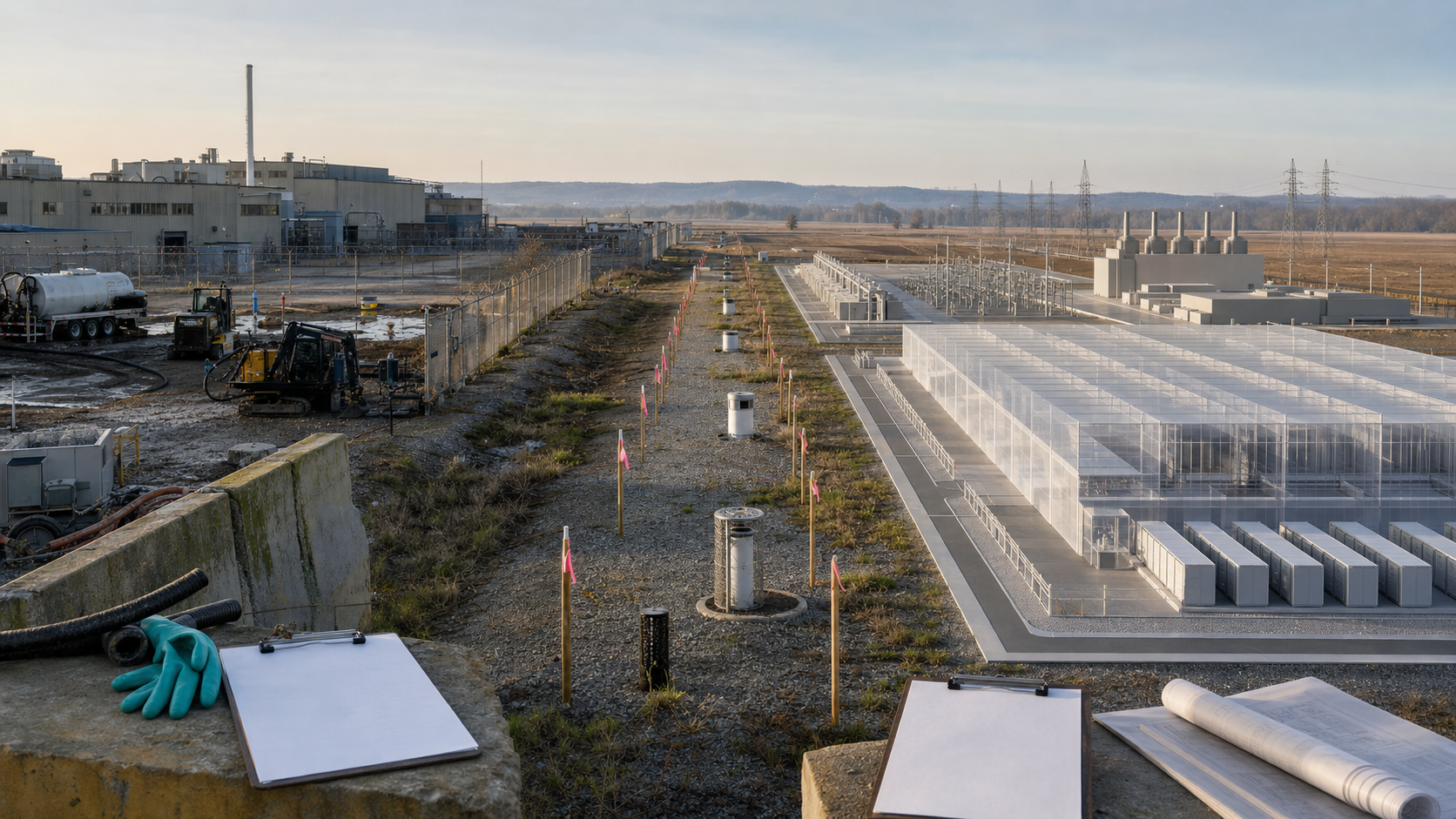
- DOE selected Brookfield Asset Management to develop and operate a proposed complex at the Paducah Gaseous Diffusion Plant.
- AP reports a $100bn headline, with a Brookfield spokesman estimating roughly 30% for data-centre and power construction and the rest for equipment inside the centres.
- NextEra is expected to own and build 2GW of gas generation, transmission upgrades and 2.6GW of battery storage.
- The energy system would support a 1.8GW AI campus and could send excess electricity to the regional grid.
- DOE projects completion in 2031, while a power-service agreement still requires state-regulator approval and customers remain under discussion.
- Uranium enrichment ended in 2013; cleanup continues, with AP citing a DOE projection to 2065 at about $17bn.
The $100bn figure contains unlike forms of capital
A Brookfield spokesman told AP that about 30% of the headline sum was expected to go to construction of the data centre and power facilities, with the remainder for computing equipment inside the buildings. That means the total should not be read as one construction contract or one commitment already funded.
Buildings, generation, batteries and transmission are long-lived infrastructure. Servers and accelerators turn over faster and may be bought by customers rather than the site owner. Their financing, depreciation and residual value differ. A credible capital plan must identify which party owns each layer and when spending becomes committed.
The figure also depends on a customer ramp. Commercial users were still under discussion. Without executed capacity contracts, equipment spending is a scenario, not guaranteed deployment.
State approval sits inside the federal reuse plan
DOE can select a developer for federal land. It cannot by that act alone settle every Kentucky electricity question. AP reports that the power-service agreement requires state-regulator approval. Rate treatment, grid exports, cost allocation and service conditions therefore remain live.
Lt. Gov. Jacqueline Coleman’s concern that the governor’s office was not included is more than a communications dispute. State authorities may carry responsibilities for utility oversight, air and water regulation, emergency planning, roads and workforce. Excluding them early can produce rework later.
A governance map should name each required decision, responsible body, consultation date and appeal route. “Federal selection” should occupy one row, not replace the table.
Dedicated gas and batteries create an energy business
Two gigawatts of gas generation and 2.6GW of batteries would make the energy system a major asset, not backup equipment. Gas supply, turbine availability, emissions permits, battery duration and replacement cycles determine how much dependable power reaches the 1.8GW campus.
The ability to send excess power to the regional grid may improve utilisation. It also creates market and transmission obligations. “Excess” cannot be assumed before the campus load profile and reserve policy are known.
NextEra’s expected ownership separates the power balance sheet from Brookfield’s development role. The power-service agreement must allocate construction delay, fuel cost, outages and minimum purchases between the parties.
Cleanup and development must keep separate ledgers
The Paducah plant enriched uranium until 2013 and remains under federal cleanup. AP cites a projected cleanup duration to 2065 and cost of about $17bn. New development does not mean remediation is complete.
The project needs clear physical and financial boundaries: which parcels are available, which remain controlled, who monitors contamination, who responds to discoveries during construction and whether development creates additional federal costs.
Using a former federal site can bring land and infrastructure advantages. It can also concentrate institutional memory and liabilities. Public reporting should show that private investment does not displace the government’s cleanup duty without an explicit legal change.
The 2031 date depends on the slowest permission
DOE’s reported completion target is ambitious for generation, transmission, data halls and equipment at this scale. The critical path may be regulatory approval, gas infrastructure, turbines, grid works, site preparation or customer contracts.
Each element needs a milestone rather than one completion year. Land access, environmental review, power approval, financial close, equipment order, construction, commissioning and tenant acceptance occur in sequence.
If one component slips, the system can be partly built but not commercially useful. A battery and gas plant without contracted load, or halls without accepted power, do not equal an operating campus.
Evidence should follow public obligations
The next disclosure should include DOE’s selection agreement, development milestones and parcel boundaries. The state proceeding should publish the power-service application, who bears upgrade costs and how grid exports affect other customers.
Brookfield and NextEra should distinguish committed capital from the $100bn scenario and identify ownership of buildings, power and equipment. Customer names may remain confidential, but contracted capacity and conditions can be disclosed in aggregate.
Paducah is not yet a completed transformation. It is a selected proposal at the intersection of federal reuse, private AI capital, state electricity regulation and a cleanup lasting decades. The project will be credible when those ledgers reconcile without one being used to hide another.