Summary
- Ofcom will replace advance notification of temporary locations under its maritime radio suppliers and demonstration licence with a requirement to keep each location on record for six months.
- Testing on distress and safety frequencies will retain its prior coordination safeguards; the regulator plans to vary 64 current licences after a General Notice.
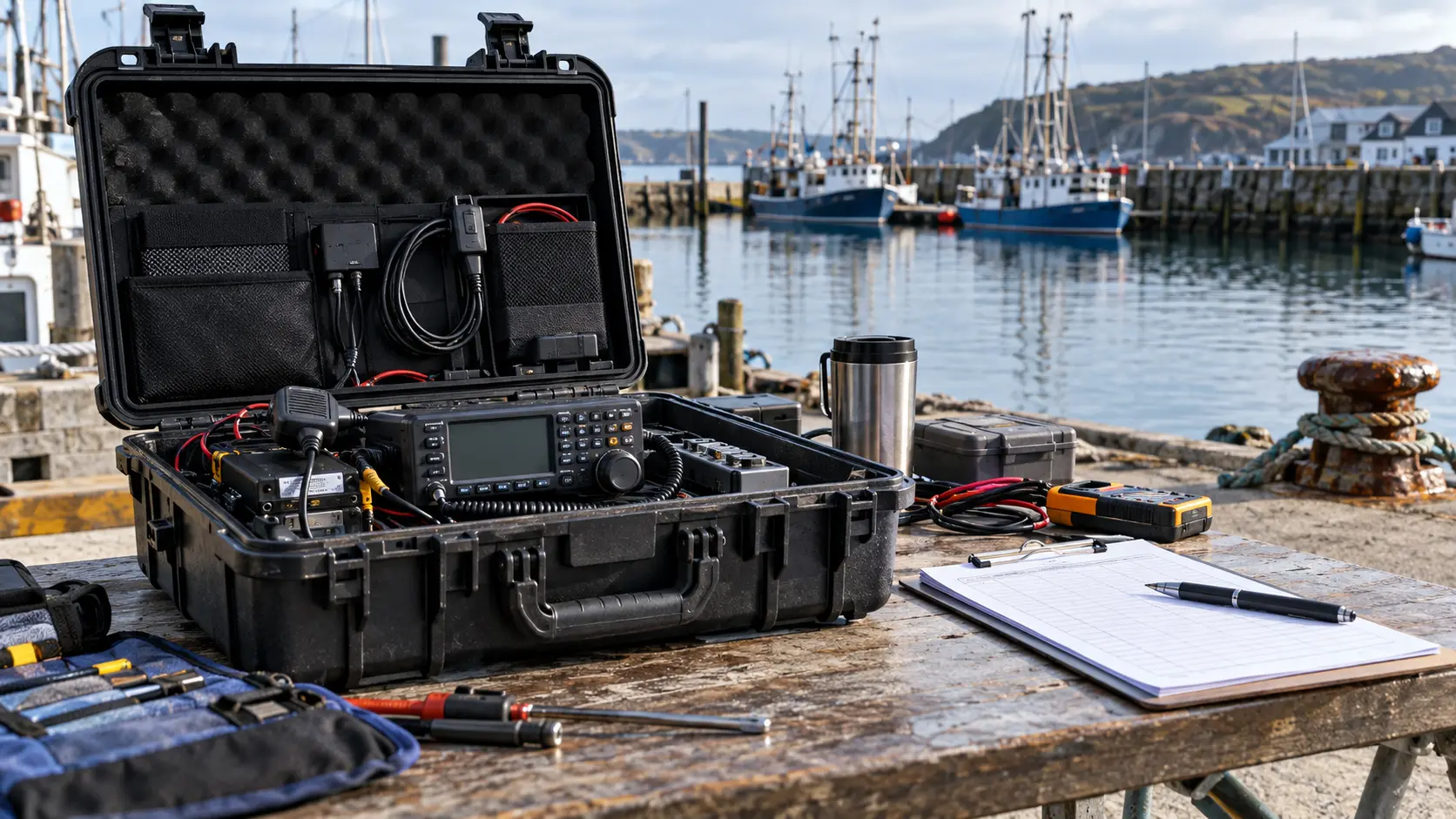
A marine radio repairer can carry a test kit down the quay. The old paperwork wanted Ofcom to know the temporary address before the kit moved. Under the regulator's 23 October decision, the repairer will instead keep a record of that location for six months. It is a small liberation for a trade whose workplace can be whichever harbour has the broken set. The emergency channels still have a doorman.
The licence covers businesses that test, service, repair and demonstrate maritime radio equipment, including during retail work. Ofcom's March tracked-change draft licence shows how the temporary-location wording is intended to change: a six-month location record replaces written notification to Spectrum Licensing. The same draft describes test transmissions as short, on a frequency checked first to be free, and on a non-interference, non-protected basis. The mobility concession is procedural; it does not turn a dealer's transmitter into a general maritime station.
The line becomes sharper around distress and safety frequencies. Ofcom says it found obsolete contact details for authorities that must be reached before those tests. It will update the contacts, while making no further operational change to the distress-testing rules. The draft's detailed conditions show why a phone book can matter: certain radiated aeronautical distress tests require prior specific written agreement on time, duration and location; other safety tests require coordination with listed authorities. A misplaced test signal can be mistaken for something considerably less routine than a repair job.
Ofcom also broadens emergency use language to cover safety of life, a ship or an aircraft. Nobody commented on the suppliers-and-demonstration proposals during the consultation, and the regulator is proceeding. But this is a decision about licence variations, not 64 licences already rewritten overnight. Ofcom says all 64 currently issued licences will go through a General Notice process. Its public consultation record carries both the draft and final statement; Ofcom aimed to publish the notice in November 2026 and reach a final variation decision no later than February 2027.
The practical deal is easy to state: move the test bench without mailing its itinerary; keep the itinerary for inspection; keep the emergency channels under advance control. A regulator earns its keep when it knows which form to retire and which gate to leave locked.
Sources
Member Briefing
Deeper Profile Context
Sign in with the right membership level to unlock the full briefing and source notes.
Only for Strategic Circle
Strategic Circle
Open to all readers. Unlock profile briefings after joining and signing in.
Join Strategic CircleOnly for Leadership Alliance
Leadership Alliance
For qualified IP-asset owners and management; sign in to unlock alliance briefings.
Join Leadership Alliance