
Summary
- NTT and DOCOMO plan through 31 December to coordinate radio-processing shifts with solar generation and battery operation in three scenarios: renewable use, demand response and a power failure.
- The energy side uses equipment at a DOCOMO base station, while NTT’s vRAN environment simulates radio load and movement; the companies have not published performance results.
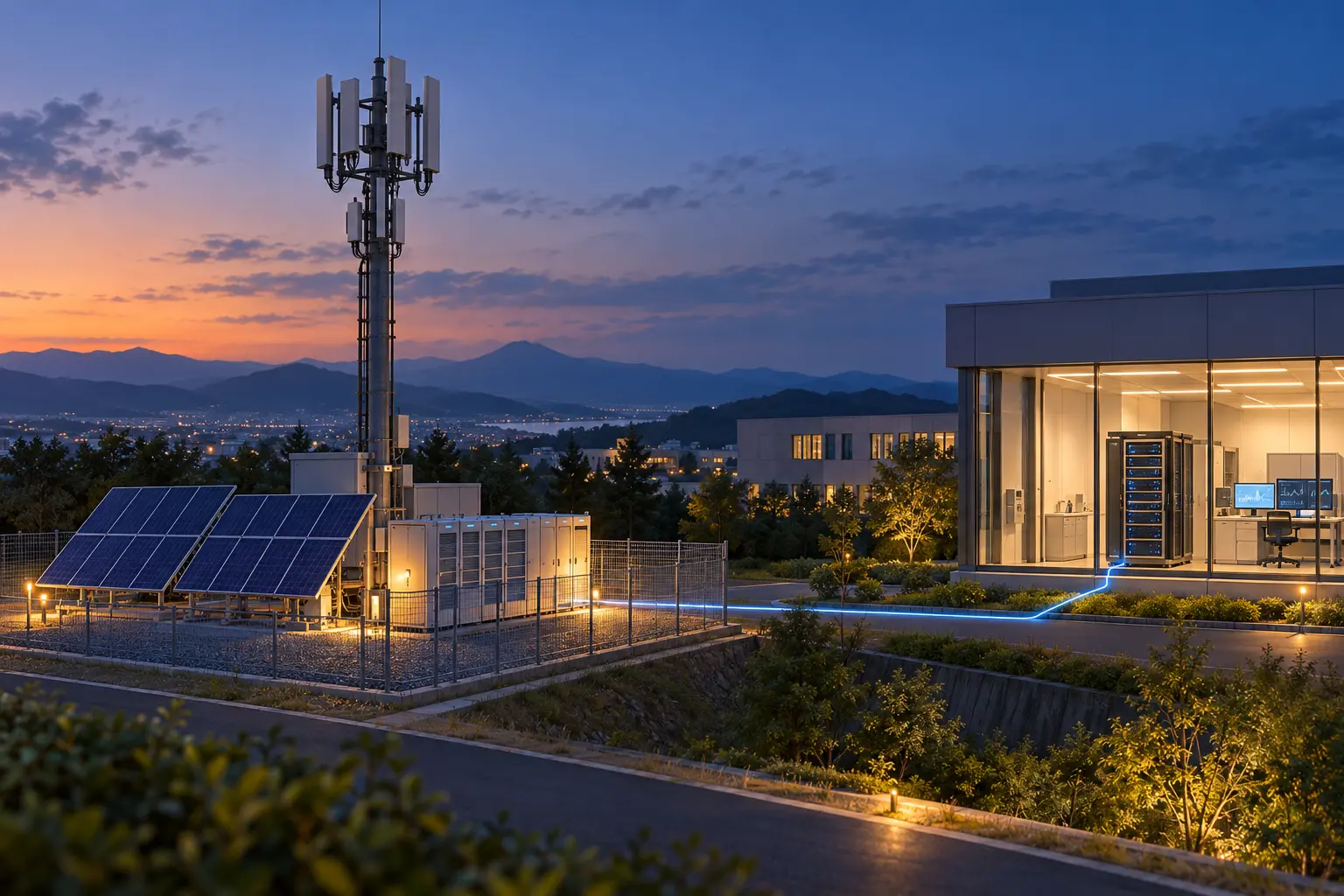
The consequential detail in NTT and NTT DOCOMO’s announcement is the seam between two kinds of evidence. A DOCOMO base station supplies the physical energy side: solar generation, a battery and an energy-management platform that monitors power generation, battery state and electricity use. At NTT’s research site, a vRAN environment recreates radio-processing load and its movement between locations. The companies say they began the trial on 20 October and expect to finish by 31 December 2026. (NTT’s original announcement)
That is more informative than a software-only simulation, but it is not evidence that customer traffic has already moved across commercial radio sites. The release describes a verification environment and lists three modes: shift processing from the DOCOMO base-station side to the NTT research site, shift in the reverse direction, or leave the load in place. It publishes no production traffic trace, site location, radio-service metric or result. NTT and DOCOMO call the effort the first such experiment at a wireless base station, while attributing that description to their own research as of the release date.
The operating question is whether electricity and communications can be planned together. In the renewable-energy case, the plan is to move processing toward a location with more solar generation while charging storage. During demand response, battery use and workload movement are intended to reduce consumption at the constrained site; the companies also plan to coordinate recharging afterward so deferred charging does not create a new peak. During a power failure, shifting processing elsewhere is intended to lower the affected site’s consumption and test whether its battery can sustain service longer.
The difficulty is that the two systems optimize for different constraints. The energy platform sees generation, battery state and site consumption; the radio controller sees processing demand and the receiving site. Moving work may save power where energy is tight, but it can add load elsewhere. The destination must have capacity, the connection between sites must remain available, and service targets must survive the move. These are the integration conditions the trial needs to test, not failures the announcement has established.
NTT says it developed a reinforcement-learning optimization model for operating plans and will build and control the vRAN verification environment. DOCOMO says it developed mathematical-optimization and AI-based planning technology and will operate the energy platform and control its solar and battery equipment. The announcement does not disclose model objective weights, fail-safe rules, transfer thresholds or service-quality constraints.
For now, the public record establishes an experiment design and schedule, not an achieved resilience gain. Readers cannot yet compare battery backup duration, renewable-energy use, demand-response peak reduction, latency or service continuity with a baseline. The next useful evidence is a scenario-by-scenario account of what was measured, what was simulated, where processing moved, and which service conditions remained true. Until those results appear, “longer continuity” is the question under test.
Member Briefing
Deeper Profile Context
Sign in with the right membership level to unlock the full briefing and source notes.
Only for Strategic Circle
Strategic Circle
Open to all readers. Unlock profile briefings after joining and signing in.
Join Strategic CircleOnly for Leadership Alliance
Leadership Alliance
For qualified IP-asset owners and management; sign in to unlock alliance briefings.
Join Leadership Alliance