
Summary
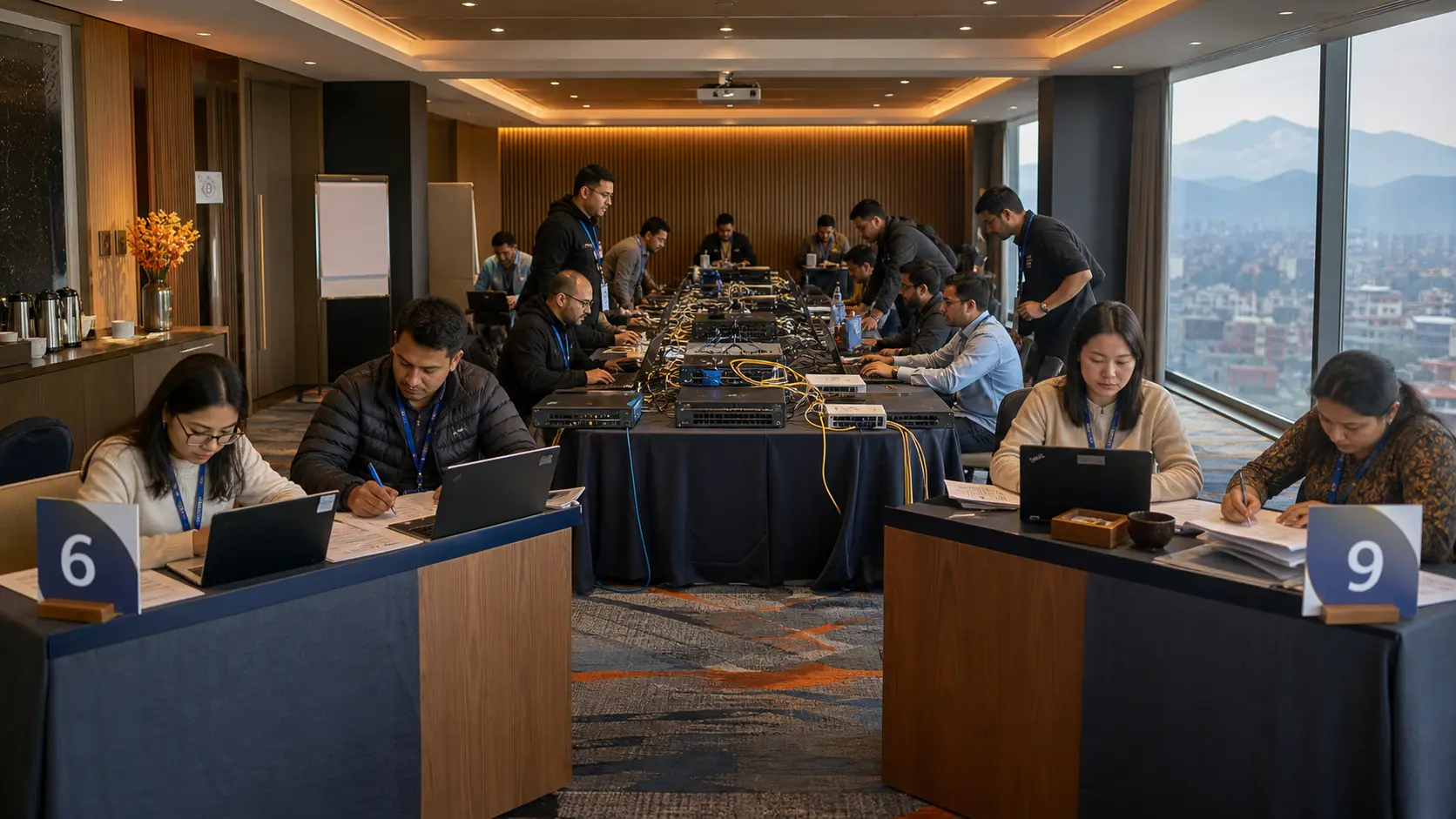
In July 2022, operators arriving at the Kathmandu Marriott encountered one technical week: four workshop days followed by a conference.
The surviving institutional record is less unified.
One week is the fact; two numbers are the dispute
The physical outline is unusually stable. SANOG's programme scheduled workshops from 18 to 21 July and a conference on 22 July 2022. NSRC's partner calendar records the same four-plus-one-day sequence, while post-event reports from APNIC and NepaliTelecom place it in Kathmandu. No reviewed source points to a second venue, schedule or registration stream.
The number conflict is equally real. Dated captures of SANOG-38's homepage from June and 22 July said the event would take place with “npNOG 9”. An August capture of npNOG's own history called it “NPNOG-6 and SANOG-38”. APNIC and NepaliTelecom also used edition 6 after the event. npNOG's wider chronology makes that label the strongest reading: edition 5 preceded the joint week, editions 7 and 8 followed it in 2023, and edition 9 appears in 2024.
That sequence supports an inference, not an official correction. The public record does not include a dated erratum from SANOG, an editorial log or an agreed joint naming rule. The accurate formulation is therefore that edition 6 is the best-supported intended label, while SANOG's contemporaneous edition-9 label remains unexplained. Turning the mismatch into two events would add a fiction. Calling it formally resolved would do the same.
The programme, host and registration surfaces were split
The week was participant-facing as one event, but its public functions were distributed. SANOG's programme carried the clearest published authority over conference content: the page said track information and content could change by decision of the SANOG Programme Committee. The closing update named programme chairs and members from several organizations, including an npNOG affiliation. That is evidence of a cross-institutional committee surface. It does not reveal voting weights, recusals or whether a local host held a contractual veto.
Hosting looked different. The SANOG-38 footer listed both NPIX and npNOG as hosts. The venue page directed hotel-rate and booking questions to the NPIX Secretariat, and NepaliTelecom described NPIX as lead host. These records make NPIX's local operating role visible. They do not establish that NPIX owned either NOG, signed every contract or bore every liability.
Registration was split again. SANOG's fee page sent online users to a SANOG-domain registration service but allowed local registration directly with NPIX. It published prices of USD 200 or NPR 20,000 for the full week, USD 150 or NPR 15,000 for workshops, and USD 50 or NPR 5,000 for the conference, with early and member discounts. The page does not identify the final account holder, invoice principal, revenue split or refund obligor. A payment interface is evidence of an operating function, not proof of the ultimate beneficiary.
The fellowship had its own surface. SANOG's result page named seven first-round fellows and described capped airfare, food, possible local transport and shared accommodation, while excluding registration and visa fees. A separate fellowship committee appeared in the closing deck, and APNIC was labelled as a fellowship sponsor. The public record shows a bounded support package and named decision body, but not the applicant denominator, scores, later-round decisions or actual payments.
Pooled production made a coherent technical week
This division of functions should not obscure the practical achievement. A regional programme, local hosts, sponsor support and external trainers combined to restore a physical and streamed operator gathering after the pandemic period. The published programme covered IPv6, RPKI, routing security, monitoring, automation and peering. Participants reasonably experienced one schedule, one venue and one conference closing rather than an institutional diagram.
The resource pool was broad. SANOG's footer listed host and supporting bodies, corporate sponsor tiers, a fellowship sponsor, a dinner sponsor and an Internet sponsor. NSRC's workshop page independently preserved a support constellation for one track. Those listings make cooperation observable. They do not disclose amounts, in-kind valuations, exclusivity or agenda rights, so they cannot prove either sponsor capture or sponsor neutrality.
Participation measures require the same restraint. APNIC reported that more than 40 people joined one network-management workshop, while SANOG's workshop specification had published a nominal maximum of 30. That may reflect demand, a changed room practice or a stale cap. It is not a total-attendance figure. The seven fellows, a partial online-registration page and a workshop estimate describe different denominators and must not be added together.
Nor does a technical programme establish downstream effect. Slides, helpdesk questions and workshop seats are outputs of an event. None of the reviewed sources ties the week to a verified production deployment. The useful conclusion is narrower: pooled institutions delivered a substantial programme and exposed several decision surfaces, while leaving financial settlement, participant-data control and operational outcomes outside the public record.
A numbering error becomes an accountability map
If the 6/9 mismatch was an ordinary editorial error, it still matters because the two sites have preserved different versions for years. A correction question immediately identifies separate record keepers. Who could edit the SANOG event archive? Who maintained npNOG's chronology? Did the hosts agree on an edition label before publishing, and which body could authorize a correction afterward? The archive does not answer those questions.
The same map becomes more consequential if something goes wrong. A programme challenge would point first toward the published SANOG Programme Committee. A local hotel or registration question would point toward NPIX's documented interface. A fellowship dispute would involve the separate fellowship surface. A request about the online attendee database would raise questions about the SANOG-domain service. The public pages do not prove the legal answer to any dispute, but they show why treating the week as one undifferentiated authority would be misleading.
Legal identity remains asymmetric. NPIX says it is a Nepal-registered non-profit company. No reviewed registry extract independently verifies that claim, and no comparable constitutive record was found for npNOG or SANOG. NPIX's documented operating roles therefore cannot be transferred into a claim that it owned either community brand. Likewise, shared committee members or sponsors do not establish common control.
The participant-data surface is a particularly clear unknown. SANOG's public attendee page described a partial online-registration list and embedded a registration-service endpoint. The old endpoint now returns an empty dataset. That observation records the present archive condition; it does not show when data disappeared, whether private records remain, who was controller or processor, or which retention terms applied in 2022.
Sources
- https://www.sanog.org/sanog38/
- https://www.sanog.org/resources/sanog38/SANOG38_Conference-Rupesh_SANOG-Update.pdf
- https://www.sanog.org/sanog38/attendee.html
- https://rego.sanog.org/api/v1/attendee/list/sanog-38/
- https://lists.npnog.org.np/pipermail/npnog/2022-May/000160.html
- https://techsathi.com/south-asian-network-operators-group-sanog-38-meeting/
- https://www.fiscalnepal.com/2022/07/18/9788/international-workshop-and-conference-on-information-and-technology-in-kathmandu/
- https://npnog.org.np/npnog7/committee/
- https://www.sanog.org/sanog38/nmms.html
Member Briefing
Deeper Profile Context
Sign in with the right membership level to unlock the full briefing and source notes.
Only for Strategic Circle
Strategic Circle
Open to all readers. Unlock profile briefings after joining and signing in.
Join Strategic CircleOnly for Leadership Alliance
Leadership Alliance
For qualified IP-asset owners and management; sign in to unlock alliance briefings.
Join Leadership Alliance