
Summary
- On 26 January 2026, Campus IA and RTE signed an accelerated grid-connection contract — the first implementation of France's "fast track" procedure — providing a first 240 MW tranche by end-2027 and a second 700 MW tranche before end-2029, inside a 1,400 MW design envelope ([https://www.rte-france.com/actualites/campus-ia-rte-signent-contrat-raccordement-accelere-campus-infrastructures-numeriques]).
- The 700 MW at the Fouju site began as a State-requested pre-reservation that RTE explicitly described as "not accepted" capacity, valid up to nine months from 20 May 2025 ([https://www.services-rte.com/fr/actualites/pre-reservation-de-capacite-sur-quatre-sites-propices.html], [https://www.services-rte.com/en/news/pre-reservation-of-capacity-on-four-suitable-sites.html]); the January 2026 signature converted that reservation into a contract.
- French parliamentary answers in 2026 record 700 MW as the contracted figure — not 1.4 GW ([https://www.senat.fr/questions/base/2026/qSEQ260508929.html], [https://questions.assemblee-nationale.fr/q17/17-8839QE.htm]).
- The public inquiry's July 2026 report records a competing first-tranche figure of 180 MW via provisional tapping of a 400 kV line, and a local project calendar places the 700 MW tranche "around 2030" ([https://www.seine-et-marne.gouv.fr/contenu/telechargement/72911/592433/file/2026%2007%2002%20-%20RAPPORT%20CAMPUS%20IA.pdf], [https://www.seine-et-marne.gouv.fr/contenu/telechargement/72912/592438/file/2026%2007%2002%20-%20CONCLUSIONS%20CAMPUS%20IA.pdf], [https://www.briedesrivieresetchateaux.fr/wp-content/uploads/2026/09/Calendrier_du_projet_Campus_IA_.pdf]).
- The $830 million (€722 million) debt announced on 30 March 2026 finances 13,800 NVIDIA GB300 accelerators and 44 MW of powered capacity at Bruyères-le-Châtel — not the Fouju tranches ([https://www.reuters.com/business/finance/frances-mistral-raises-830-million-debt-ai-data-centre-build-up-2026-03-30/], [https://www.datacenterdynamics.com/en/news/mistral-ai-raises-830m-in-debt-financing-for-data-center-in-paris-france/], [https://www.cnbc.com/2026/03/30/mistral-ai-paris-data-center-cluster-debt-financing.html]).
Contracts, designs and financing are three different things, and in the rush to quantify Europe's AI infrastructure buildout they are routinely flattened into a single headline number. Mistral Compute — the Mistral AI-linked venture presented as carried by MGX, Bpifrance, Mistral AI and NVIDIA ([https://www.rte-france.com/actualites/campus-ia-rte-signent-contrat-raccordement-accelere-campus-infrastructures-numeriques]) — offers the sharpest current illustration of why the distinction matters.
A procedure built for the queue
On 7 May 2025, the French energy regulator CRE approved deliberation no. 2025-120, a "fast track" connection procedure under Article 1.4.3 of the Technical Reference Documentation, aimed at very high-power consumption installations of between 400 MW and 1 GW on State-identified "suitable sites" with proximity to 400 kV infrastructure ([https://www.cre.fr/fileadmin/Documents/Deliberations/2025/250507_2025-120_Procedure_raccordement_Fast_track_annexe.pdf], [https://www.cre.fr/fileadmin/Documents/Communiques_de_presse/2025/250507_CP_CRE_Procedure_fast_track.pdf]). The mechanism has two steps. First, at the State's request, RTE pre-reserves capacity on a suitable site. Second — and only after a contractual instrument — does that reservation become an accepted connection.
At the State's request, RTE pre-reserved 700 megawatts at the ZAC des Bordes site in Fouju, Seine-et-Marne. RTE's own notice is unambiguous about the legal status: the pre-reserved capacity is "immediately reserved and will be taken into account in the exploratory studies and technical and financial proposals (and not accepted)" ([https://www.services-rte.com/en/news/pre-reservation-of-capacity-on-four-suitable-sites.html]). The reservation ran for at most nine months from 20 May 2025, extendable by three months, and remained effective only until conclusion of an Engagement de raccordement — a PTF-equivalent instrument whose capacity component prices a firm, unlimited connection ([https://www.cre.fr/fileadmin/Documents/Deliberations/2025/250507_2025-120_Procedure_raccordement_Fast_track_annexe.pdf]).
That is the negative baseline against which every later "1.4 GW" claim must be checked: as of May 2025, the 700 MW was explicitly not an accepted connection.
The conversion, dated
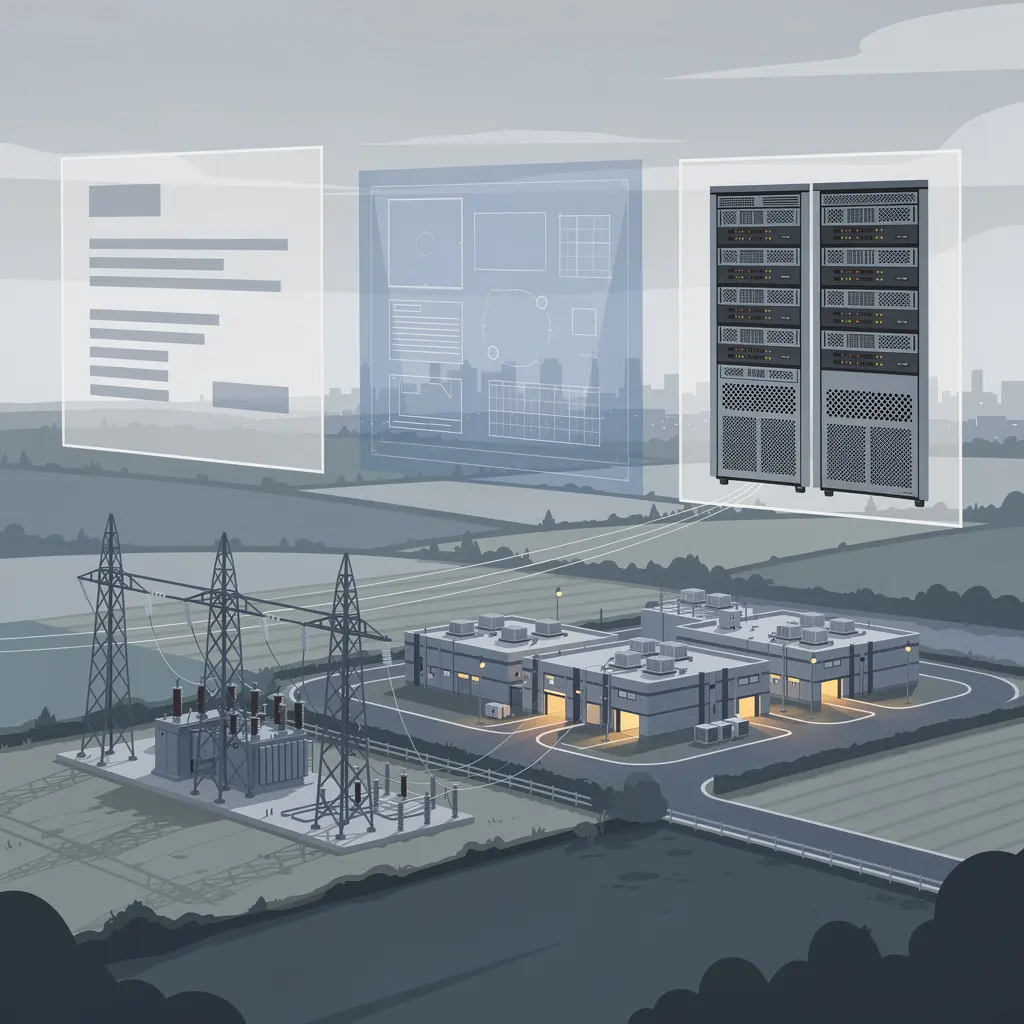
On 26 January 2026, Campus IA and RTE announced the signature of an accelerated grid-connection contract, described as the first implementation of the fast-track procedure. Per RTE's release, the agreement provides for a first power tranche of 240 MW by end-2027, followed by a second tranche of 700 MW before end-2029, with electrical infrastructure designed to allow an eventual rise to 1,400 MW ([https://www.rte-france.com/actualites/campus-ia-rte-signent-contrat-raccordement-accelere-campus-infrastructures-numeriques]).
The date arithmetic matters. The signature falls inside the pre-reservation window — roughly 20 February 2026, extendable to about 20 May 2026 — which is consistent with the documented two-step conversion of the "not accepted" pre-reservation into a contractual connection ([https://www.cre.fr/fileadmin/Documents/Deliberations/2025/250507_2025-120_Procedure_raccordement_Fast_track_annexe.pdf], [https://www.services-rte.com/fr/actualites/pre-reservation-de-capacite-sur-quatre-sites-propices.html], [https://www.rte-france.com/actualites/campus-ia-rte-signent-contrat-raccordement-accelere-campus-infrastructures-numeriques]). What the signature did was change a legal state: capacity that RTE had listed as reserved-but-not-accepted became the subject of a signed contract with dated tranches. Much third-party coverage conflates the two states.
The design envelope is a third thing again. The contract's electrical infrastructure is designed to allow an eventual rise to 1,400 MW — a ceiling, not a commitment. French parliamentary answers published in 2026 (Sénat written question SEQ260508929; Assemblée nationale question 17-8839) record 700 MW as the contracted figure at Fouju, not 1.4 GW ([https://www.senat.fr/questions/base/2026/qSEQ260508929.html], [https://questions.assemblee-nationale.fr/q17/17-8839QE.htm]).
Competing figures in the record
The local record does not even agree on the first tranche. The public inquiry held from 30 April to 30 May 2026 produced, in its commissioner's report of 2 July 2026, an anticipated first power tranche of 180 MW via provisional tapping of the 400 kV CHESNOY-MORBRAS no. 2 line — a figure that sits against RTE's 240 MW ([https://www.seine-et-marne.gouv.fr/contenu/telechargement/72911/592433/file/2026%2007%2002%20-%20RAPPORT%20CAMPUS%20IA.pdf], [https://www.seine-et-marne.gouv.fr/contenu/telechargement/72912/592438/file/2026%2007%2002%20-%20CONCLUSIONS%20CAMPUS%20IA.pdf]). A local-authority project calendar places the 700 MW tranche "around 2030", against RTE's "before end-2029" ([https://www.seine-et-marne.gouv.fr/contenu/telechargement/72912/592438/file/2026%2007%2002%20-%20CONCLUSIONS%20CAMPUS%20IA.pdf], [https://www.briedesrivieresetchateaux.fr/wp-content/uploads/2026/09/Calendrier_du_projet_Campus_IA_.pdf]).
What the permitting record does establish is narrower: prefectural arrêtés dated 29 July 2026, recorded in the Seine-et-Marne public-inquiry decision register, granted the environmental (IOTA) and ICPE authorisations for the phase-1 buildings DC1, DC2 and DC4 at Fouju ([https://www.seine-et-marne.gouv.fr/Publications/Enquetes-publiques/FOUJU-PROJET-CAMPUS-IA/DECISIONS]). The register itself does not reproduce arrêté contents bearing on the grid programme, so any inference from permitting dates to energisation dates would outrun the evidence.
The ledger the debt actually touches
Separately, on 30 March 2026 Mistral AI announced its first debt financing: approximately $830 million (reported as €722 million) from a bank syndicate, to finance 13,800 NVIDIA GB300 accelerators and 44 MW of powered capacity at Eclairion's Bruyères-le-Châtel site, with commissioning targeted for Q2 2026 and 200 MW across Europe by end-2027 ([https://www.reuters.com/business/finance/frances-mistral-raises-830-million-debt-ai-data-centre-build-up-2026-03-30/], [https://www.datacenterdynamics.com/en/news/mistral-ai-raises-830m-in-debt-financing-for-data-center-in-paris-france/], [https://www.cnbc.com/2026/03/30/mistral-ai-paris-data-center-cluster-debt-financing.html]). The company's own announcement described the debt as its first financing activity of this kind ([https://www.linkedin.com/posts/mistralai_weve-announced-today-our-first-debt-financing-activity-7444301546013622272-we3w]); industry facility records corroborate the Eclairion siting and the 44 MW figure ([https://www.scrutica.com/facilities/fac-eclairion-bruyeres-mistral-compute]); French technology press reported the €722 million figure against the Bruyères-le-Châtel datacentre ([https://www.zdnet.fr/actualites/mistral-ai-emprunte-722me-pour-son-datacenter-francais-de-bruyeres-le-chatel-492807.htm]).
No dated energisation, metered-load or acceptance document was located in public sources for either the 44 MW cluster or any Fouju tranche. What the financing record documents is debt secured against a 44 MW sited, financed fleet — while the Fouju design envelope of 1,400 MW is a ceiling inside a contract whose first tranche is 240 MW (or, in the inquiry report's competing figure, 180 MW). No public document ties the debt drawdown schedule to the Fouju tranches.
Read together, the ledgers are: contracted — 700 MW in tranches of 240 MW and 700 MW with dated deadlines; designed — a 1,400 MW ceiling, with permits covering only three phase-1 buildings; financed — $830 million against 44 MW. Each number is real. They are not the same number.
Member Briefing
Deeper Profile Context
Sign in with the right membership level to unlock the full briefing and source notes.
Only for Strategic Circle
Strategic Circle
Open to all readers. Unlock profile briefings after joining and signing in.
Join Strategic CircleOnly for Leadership Alliance
Leadership Alliance
For qualified IP-asset owners and management; sign in to unlock alliance briefings.
Join Leadership Alliance