Summary
- Nebius DC Oy runs a datacenter at Mäntsälä with a 75 MW electricity connection and roughly 40 MW of liquid-cooled capacity; in 2025 it exported 19,522 MWh of recovered server heat into the town's district heating.
- Its own recovery infrastructure is rated above 250 GWh a year, more than twelve times what was actually delivered, and from 2026 the heat is supplied free of charge while the municipal utility spends 10,100 MWh of electricity to upgrade it.
Every winter, part of Mäntsälä is heated by waste heat scraped off somebody else's GPUs. The circular-economy pitch is usually a slide. Here it is metered, invoiced and expanding: the town's energy company keeps adding heat pumps because more server heat keeps arriving than the network can absorb. The interesting question is not whether the recovery works. It does. The question is what the ledger looks like when you read both sides of it.
Start with the load. When the Finnish site expanded, the datacenter had to secure a larger electricity connection of 75 MW, and Nivos, the municipal energy company, says the first half of that expansion entered use in November 2025 and the second half in February 2026 (Nivos, 31 March 2026). The facility's director puts liquid-cooled capacity at roughly 40 MW and says the liquid reaches the heat-recovery plant at 30–35 °C. That is a connection figure and a cooling figure. Neither is a measured annual draw, and neither publisher states one.
Now the second product. Nebius reports that Finland-1 exported 19.5 GWh of recovered server heat to the town network in 2025 (Nebius 2025 Sustainability Report); its own annual chart gives 19,522 MWh for 2025, after 17,422 MWh in 2023 and 15,298 MWh in 2024. The same report puts the engineering maximum of the installed recovery infrastructure above 250 GWh a year, of which 175 GWh is attributed to liquid-to-liquid exchange, and notes that actual exports depend on local demand and on internal reuse of the heat.
That gap is the story. Nineteen and a half gigawatt-hours is 7.8% of a 250 GWh ceiling. Averaged across the year, 19,522 MWh works out to 2.23 MW of continuous thermal export — from a site with 40 MW of liquid-cooled capacity. If those 40 MW ran flat out for a year they would draw about 350,400 MWh, which would make the recovered heat roughly 5.6% of the electricity that produced it. That number is my arithmetic on two published figures, not a measured efficiency, and it should be read as an order of magnitude rather than a coefficient. The direction is unambiguous: the plant can recover far more heat than the town is taking.
Nivos's own accounting says the same thing from the other side. Its 2025 sustainability balance reports 20,007 MWh of surplus heat going into district heating, up from 15,298 MWh in 2024, and a rounded table that pairs 20,000 MWh of surplus heat with 10,100 MWh of electricity consumed by the heat pumps feeding the recovery plant (Nivos, sustainability priorities 2025). Of 53,000 MWh entering the heating network, 43,200 MWh reached customers. Two gigawatt-hour-scale figures for the same flow now sit next to each other: 19,522 MWh from the operator and 20,007 MWh from the utility. The difference is 485 MWh, about 2.5% of the larger number. Neither document states the measurement boundary — whether the operator's meter sits before or after the plant, whether the utility counts its own recovered heat round the loop — and the utility's rounded table does not allocate every megawatt-hour to Nebius. Close, and not the same number.
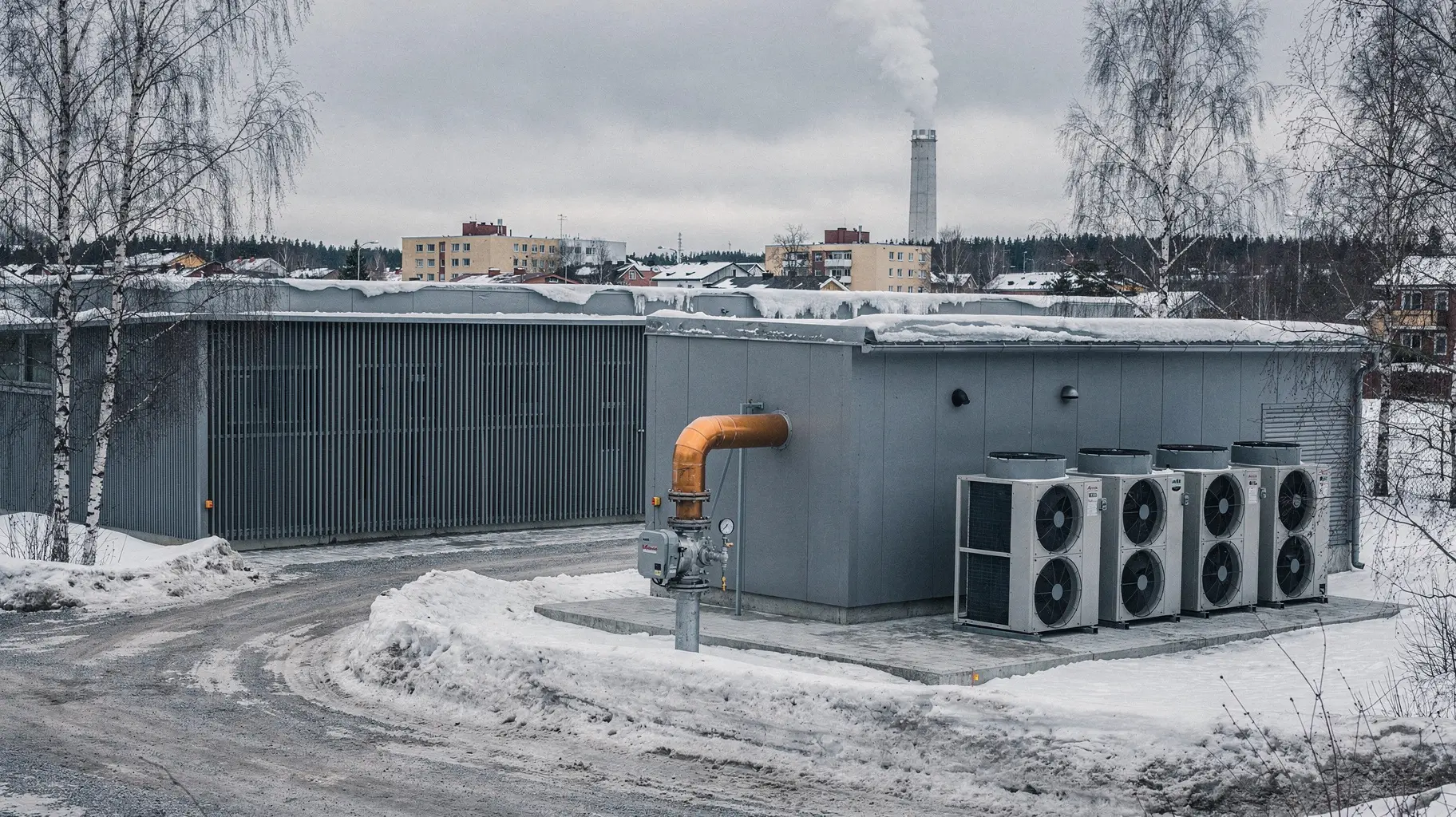
The plant itself has been rebuilt around the surplus. Calefa, the heat-pump supplier, says the facility went from six pumps to eleven, with about 7 MW of capacity and roughly 30 GWh of thermal output a year, and that another 1 MW unit is being added (Calefa, 5 November 2026). Its own undated project page gives the earlier configuration, approximately 6 MW and 25 GWh, and says the recovered heat is upgraded to as much as 80 °C (Calefa reference). Read the two together and you are watching a plant grow in public in increments of one pump.
Temperature is where the public record gets slippery, and it matters, because delivery temperature is what a district-heating network actually buys. Three descriptions are in circulation. The liquid arrives at the recovery plant at 30–35 °C. Nebius's own explainer says air-to-water exchangers lift water to 35–40 °C and that the municipality then boosts it to a standard 55–60 °C before distribution (Nebius, Turning heat into a resource) — but that page is undated and describes the air-based recovery path, not automatically the newer liquid loop. The supplier says up to 80 °C. None of these is a contractual delivery specification, and no inspected document names one.
The commercial side is stranger still. Nebius states that recovered heat will be supplied free of charge from 2026 (https://assets.nebius.com/assets/79cf11ba-bb23-4cb8-802e-21dc155be31c/Nebius%202025%20Sustainability%20Report.pdf?cache-buster=2026-07-31T14:46:57.627Z). Set that beside the utility's 10,100 MWh of heat-pump electricity: the seller of the heat has decided not to sell it, and the buyer spends power and capital to make it usable. Nivos Vesi ja Lämpö Oy, the legal district-heating counterparty, confirms in its 2025 financial statements that it agreed with Nebius DC Oy during the expansion to continue the waste-heat deliveries (Nivos Vesi ja Lämpö Oy, 2025 statements). The document is signed 25 February 2026 and it does not reproduce volumes, temperatures or price. Deliveries continuing is documented. The terms are not.
One more layer sits underneath, and it is bureaucratic in the way that physical plants usually are. Building permit LP-505-2024-00480, granted on 11 December 2024 and posted five days later, names Global DC Oy as applicant for Moreenikatu 6, parcel 505-407-3-286, on a 7.9987-hectare site: a new datacenter of 19,676 m², a 145 m² extension to an energy-transfer building, and an existing 348 m² heat-recovery building (Mäntsälän kunta, permit LP-505-2024-00480). The permit imposes no electrical limit, no recovered-heat requirement and no delivery temperature, and it does not name Nebius DC Oy; the inspected file does not establish the legal relationship between the applicant and the operator. Anyone citing a megawatt figure as if a permit granted it is citing something the permit does not say.
The visible growth is contracted, not commissioned. Assemblin Caverion announced a substation contract worth roughly EUR 15 million for a new 70 MW building alongside the existing 75 MW site, with completion targeted for autumn 2027 (Assemblin Caverion, 2 October 2026). Add the two and you get a possible 145 MW footprint. That arithmetic describes a construction pipeline. It is not operating capacity, and the contractor's announcement does not establish permit finality or energization.
Nebius's own release on the report is precise about method in a way worth crediting: heat recovery is metered at the point of handoff and reported gross, and the electricity that generated the heat stays fully inside the company's electricity consumption (Nebius newsroom, 30 July 2026). The same release separates 19.5 GWh actually exported in 2025 from design export capacity above 250 GWh. That is an unusually honest pair of disclosures, and it is also the pair that sinks the marketing version of the story. Gross handoff heat is not avoided electricity. Free heat is not revenue. And a 250 GWh recovery ceiling on a site delivering under a tenth of it is a statement about the town, not about the datacenter.
So the ledger closes like this. The recovery engineering works: meters read, the utility books the energy, the pump hall has doubled. The second product is real and, from 2026, worthless to its producer by design. What limits the flow is the absorption capacity of a municipal network serving 43.2 GWh of demand in a warm year, down from 48.5 GWh of district-heating sales the year before (https://nivos.fi/wp-content/uploads/2026/04/Nivos-Vesi-ja-Lampo-Oy-tilinpaatos-ja-toimintakertomus-2025.pdf) — and a wider heat-utilisation project with a neighbouring utility that did not proceed in 2025 after failing to secure an investment grant (https://nivos.fi/wp-content/uploads/2026/04/Nivos-Vesi-ja-Lampo-Oy-tilinpaatos-ja-toimintakertomus-2025.pdf). More server heat is available than the pipes can take. The next pump, the next 1 MW, and the next 70 MW building all get decided on the town's side of that line.
Member Briefing
Deeper Trend Context
Sign in with the right membership level to unlock the full briefing and source notes.
Strategic Circle
A daily briefing in your language, built from changes we have verified.
Join for USD 20/monthCancel anytime.
Public reporting stays free. Member research, the daily briefing and the forum need a membership.