
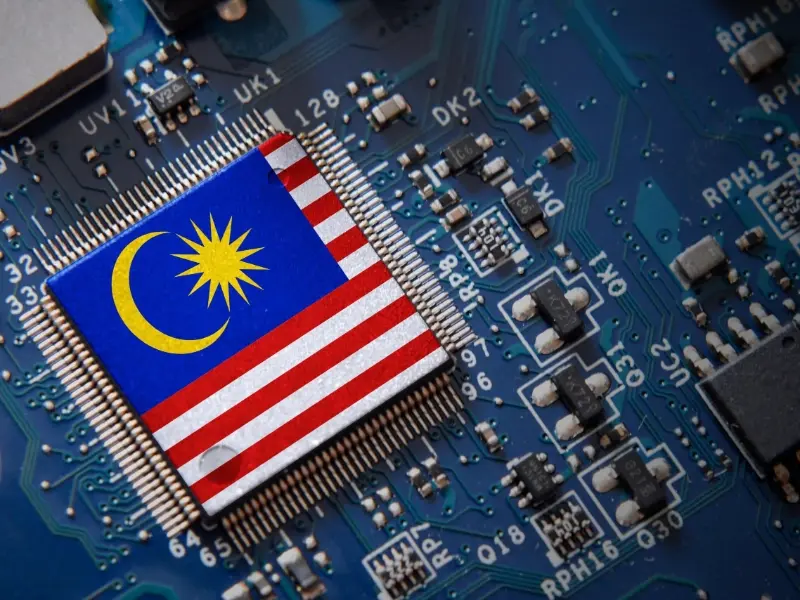
Malaysia becomes semiconductor hub amid U.S.-
- Malaysia attracts semiconductor giants like Intel, GlobalFoundries, and Infineon, leveraging decades of expertise in assembly, testing, and packaging.
- Challenges like brain drain remain, but government initiatives aim to boost the semiconductor ecosystem and retain skilled talent.
- Regional developments see countries like India and Japan also vying to become major chip hubs amid U.S.-China tech tensions.
Rising importance of Malaysia in the semiconductor industry
Malaysia is emerging as a crucial destination for semiconductor manufacturers, driven by escalating U.S.-China tensions that have prompted companies to diversify their operations. Major chipmakers such as Intel, GlobalFoundries, and Infineon have recently established or expanded their presence in the country.
“Malaysia boasts a well-established infrastructure with around five decades of experience in the ‘back end’ of semiconductor manufacturing, particularly in assembly, testing, and packaging,” said Kenddrick Chan from LSE IDEAS, the foreign policy think tank of the London School of Economics and Political Science.
Major investments in Malaysia
American chip giant Intel announced in December 2021 a $7 billion investment to build a new chip packaging and testing facility in Malaysia, with production set to begin in 2024. This decision was rooted in Malaysia’s diverse talent pool, well-established infrastructure, and robust supply chain, according to Aik Kean Chong, Intel Malaysia’s managing director.
Intel’s first overseas production facility was an assembly site in Penang launched in 1972 with a $1.6 million investment. Over the years, the company has added a full test facility as well as a development and design centre in Malaysia.
GlobalFoundries also opened a hub in Penang in September to support its global manufacturing operations, while Germany’s top chipmaker Infineon announced in July 2022 the construction of a third wafer fabrication module in Kulim. Additionally, Neways, a key supplier to Dutch chip equipment maker ASML, revealed plans to build a new production facility in Klang.
Also read: Malaysia seeks $107B to lead in semiconductors
Malaysia’s strategic advantages and challenges
“Malaysia’s edge has always been its skilled labour in packaging, assembly, and testing, and lower comparative operating costs, making exports more competitive globally,” said Yinglan Tan, founding managing partner at Insignia Ventures Partners. He also noted that the current position of the ringgit makes the country an attractive location for foreign players.
According to the Malaysian Investment Development Authority, Malaysia holds 13% of the global market for chip packaging, assembly, and testing services. Exports of semiconductor devices and integrated circuits saw a slight increase to 387.45 billion Malaysian ringgit ($81.4 billion) in 2023, despite global chip demand weakness.
Brain drain
However, Malaysia faces challenges such as brain drain, with many skilled workers leaving for better opportunities abroad. An official study conducted in 2022 revealed that 3 out of 4 Malaysian workers in Singapore are skilled or semi-skilled, highlighting this issue.
“Whether the demand generated by supply chain diversification will be met with enough supply of skilled talent in the country is still an ongoing operational challenge,” said Tan of Insignia Ventures Partners. Malaysian Prime Minister Anwar Ibrahim has indicated that the government is looking to attract skilled Malaysians to return and contribute to the country.
Also read: U.S. trade fears over China spark $500B chip stock slide
Regional developments and future outlook
In January, Malaysia set up a national semiconductor strategic taskforce to grow its semiconductor ecosystem and attract further investments. The country aims to focus on the “front end” of the chip manufacturing process, which involves wafer fabrication and photolithography, in addition to its existing strengths in packaging and assembly.
Similarly, countries like India and Japan are also courting foreign firms to set up operations locally as they strive to become major chip hubs alongside the U.S., Taiwan, and South Korea.
Also read: US grants $400M to Taiwan’s GlobalWafers for silicon wafer production
Also read: TSMC forecasts 34% revenue jump soaring to 23.2B in Q3
India, for instance, approved the construction of three semiconductor plants in February with investments of more than $15 billion and U.S. memory chip giant Micron’s plans to set up a semiconductor unit. TSMC, the world’s largest contract chip maker, opened its first factory in Japan in June as part of its diversification strategy amid U.S.-China tensions.
“Malaysia and Asia in general is poised to benefit from the China-U.S. tech war, where access to advanced semiconductor chips are being weaponised as a tool to establish global technological supremacy,” said May-Ann Lim, director of the data governance practice at public policy consultancy Access Partnership.
Member Briefing
Deeper Profile Context
Sign in with the right membership level to unlock the full briefing and source notes.
Only for Strategic Circle
Strategic Circle
Open to all readers. Unlock profile briefings after joining and signing in.
Join Strategic CircleOnly for Leadership Alliance
Leadership Alliance
For qualified IP-asset owners and management; sign in to unlock alliance briefings.
Join Leadership AllianceSnapshot
Category
CompanyRegion
ASIA PacificSignal Focus
GovernanceContent Type
ProfilePrimary Domain
MarketTopic
GovernanceImpact
MediumConfidence
Limited confidence (80%)Confidence score guide
Several public sources