
Intelligence
Latest Articles
Latest intelligence on infrastructure operators, policy decisions, market moves, and digital power shifts.
Story
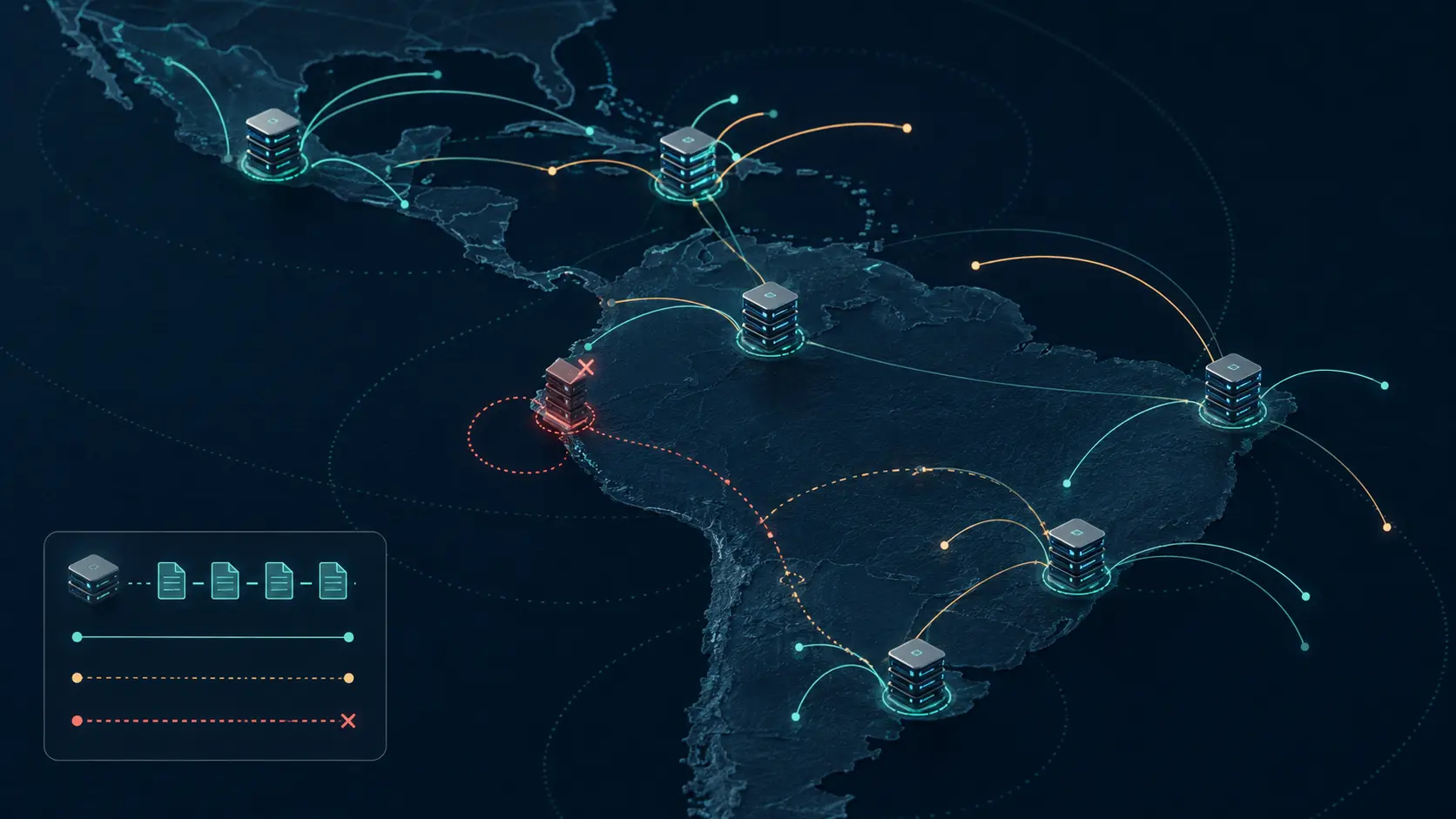
LACNIC’s reverse-DNS anycast turns registry continuity into a distributed control
Reverse DNS is easy to overlook until it stops answering. LACNIC’s use of anycast for delegated reverse zones shows why registry continuity is not a single-server property, but an operating discipline built from placement, routing, synchronization and observation.

History
The Standard That Required Two Answers: TCP-AO's Cryptographic Baseline
Algorithm agility sounds like freedom of choice. For TCP-AO, RFC 5926 exposed the harder half of that promise: two endpoints could each support sound cryptography and still fail to authenticate a single segment unless they shared one precise MAC-and-key-derivation pair.

AFNOG
AIS 2026 Says Conversations Become Progress Without Publishing an Outcome Ledger
AfNOG presents AIS as a place where conversations translate into real progress. The current first-party page reviewed here does not publish the outcome ledger that would separate discussion from commitment and show follow-through.

IETF
A Graceful Shutdown Community Declares Maintenance Without Taking the Neighbor's Routing Authority
Planned maintenance is a local decision, but the traffic it moves belongs to an interconnection. RFC 8326 gives one network a standard way to say that an EBGP path is about to disappear while leaving the neighboring network in control of its own route preference. That…

History
The Translator That Changed the Authenticated Connection: TCP-AO and NAT
A middlebox can change a packet without changing its route. TCP-AO made the consequences depend on what changed: rewriting a TCP option could be accommodated by authenticating fewer fields, but rewriting an address or port changed the identity of the protected connection itself.

AFNOG
AIS 2026 Names Its Organisers and Host but Not Their Decision Boundaries
AIS 2026 publicly names AfNOG and AFRINIC as joint organisers and TESPOK as host. The current first-party page reviewed here does not say which institution decides what when their roles meet.

Story
LACNIC’s measurement commons turns regional latency into operating evidence
A latency chart is not a verdict on a country’s Internet. It becomes useful when operators can see the probes, time window and comparison behind it—and when the result leads to a question that can be tested again.

Story
AFRINIC Reported Unauthorised Routes from Reserved IPv4 Space. Full Withdrawal Was Not Yet Confirmed
AFRINIC described route announcements involving parts of 102.224.0.0/12 and several response actions; its notice did not close the record on full withdrawal.

AFNOG
AIS 2026 Calls Distance No Barrier Without Publishing a Hybrid Participation Standard
AIS 2026 promises live streams and interactive discussions and says distance is not a barrier. The current first-party page reviewed here does not publish the service and remedy standard behind that commitment.

History
The Reset That Could Not Be Trusted: TCP-AO After a Peer Reboot
TCP normally has a blunt way to tell a peer that an old connection no longer exists: send a reset. TCP-AO makes that answer harder to trust on purpose. When a protected peer reboots and forgets its connection state, the reset it can still send may be precisely the reset the…

AFNOG
AIS 2026 Names the Power to Exclude but Not a Meeting Appeal Route
AIS 2026 makes one end of its conduct system clear: AFRINIC may exclude a registrant from the meeting, including chat or other communication channels. The public pages reviewed for this article do not make the full meeting-specific decision and review chain equally visible.

IETF
An Extended DNS Error Explains Failure Without Authorizing a Different Answer
A DNS failure can be technically correct and operationally opaque. RFC 8914 lets a responder attach a more precise explanation to the result, but it deliberately leaves the result itself unchanged. That separation gives operators a useful observability channel—and creates a…

Story
LACNIC’s RPKI controls make route origin authority operable
LACNIC’s RPKI controls make route origin authority operable intelligence summary explains the development, the public evidence available to readers, the organisations involved, the regional context, market exposure, and the infrastructure consequences that may follow. The Story…

Number Resource Society
An ASPA Is Not a Complete AS-Path Attestation
An ASPA can help an operator test whether an AS path is consistent with published customer-to-provider authorizations. That is valuable route-leak evidence. It is not a signature over every hop, a proof of route origin, a commercial contract, or a guarantee that the published…

AFNOG
AIS 2026 Can Change Its Attendance Terms Without Publishing a Notice Rule
AIS 2026 says its attendance terms may be amended and become valid upon publication. It also treats attendance after a change as confirmation that a registrant has accepted it. The reviewed terms do not say how a consequential change will be brought to each registrant's attention…

Story
AFRINIC Offered In-Person Registry Checks at AfPIF. The Frozen Page Does Not Report Outcomes
AFRINIC promoted face-to-face help with registry records, identity checks and open requests at AfPIF 2026; the frozen source set does not show what was completed.

AFNOG
AIS 2026 Requires an ID Upload Without Publishing Its Handling Rule
AIS 2026 asks every registrant to upload a passport or other government-issued identity document. The public registration and terms pages explain several uses of attendee information, but the reviewed text does not explain the specific lifecycle of that required file.

IETF
The Insecure Middle of a Secure TACACS+ Migration: RFC 9887 and the Cost of Dual-Stack Authentication
A TACACS+ client using TLS must not fall back to non-TLS when TLS negotiation fails. Yet a migration can temporarily keep separate non-TLS TACACS+ servers for devices that cannot move at once. That coexistence is not a secure dual stack: RFC 9887 considers the mixed phase…

History
The Segment That Returned to the Same Number: TCP-AO's Sequence Number Extension
A TCP sequence number can come back during one long-lived connection. TCP-AO had to ensure that the repeated 32-bit value did not also repeat the evidence presented to its authenticator.

CASE FILE
The Notification Arrived. One Backend Still Had Nothing to Serve
The IETF is asking for final comments on a proposed operating guide for RPKI publication services. Its sharpest rule is also the easiest to violate during a routine rollout: do not expose the new notification until every snapshot and delta it names is already available. An index…