
Intelligence
Latest Articles
Latest intelligence on infrastructure operators, policy decisions, market moves, and digital power shifts.

Story
RIPE NCC Finished the RIS Bare-Metal Move. That Does Not Close the Pipeline
RIPE NCC’s newest RIS plan uses “finished” and “in progress” in the same paragraph, without contradicting itself. The data moved; processing assurance, storage choices, Kafka renewal and a consumer’s latency response sit on different clocks. The useful public record is not one…

CASE FILE
Sirius Telecom’s missing operating chain
The public record places Sirius Telecom in the Directory as a global network operator and links the name to PeeringDB network 1283. It does not yet establish the chain that would turn that label into an independently verifiable operating business: a legal entity, a functioning…

Global Institutional Trends
Utherverse Network Operations: What AS33169 Can—and Cannot—Show About Continuity
A forensic examination of the public record around Utherverse Network Operations finds a network identity, but not yet an auditable picture of who controls prevention, detection, response or durable repair.

ICANN
ICANN’s Remedies Are Not One Appeal: Who Can Stop, Review or Reverse a Decision?
ICANN’s accountability system does not place every objection on one appellate ladder. It distributes authority among the Board, the Empowered Community, ICANN’s staff-facing reconsideration process and an independent review panel. The practical question is therefore not simply…

IETF
Standards Become Infrastructure When Operators Must Carry Their State
IETF standards do not operate networks. They define the state machines, security dependencies and recovery procedures that networks must implement if they are to interoperate. That distinction matters when a protocol becomes part of the Internet’s operating surface: continuity no…

History
RFC 10028 and the Institutional Boundary of IPv6 Multicast
RFC 10028 did more than tidy an IPv6 registry. It shows how an IETF decision becomes operational authority: a standards document changes the allocation map, and IANA gives that decision a durable administrative surface. The result is a cleaner boundary between multicast uses—but…

Story
A Scan Found 4,611 Exposed BGP Routers in APNIC. It Cannot Say Why They Were Open
At APNIC 62, researchers put a regional number on a quiet control-plane problem: 4,611 routers across 1,343 APNIC-region autonomous systems answered an unsolicited BGP OPEN exchange in a February IPv4 scan. That is firmer evidence than a port banner, but it is neither a breach…
Number Resource Society
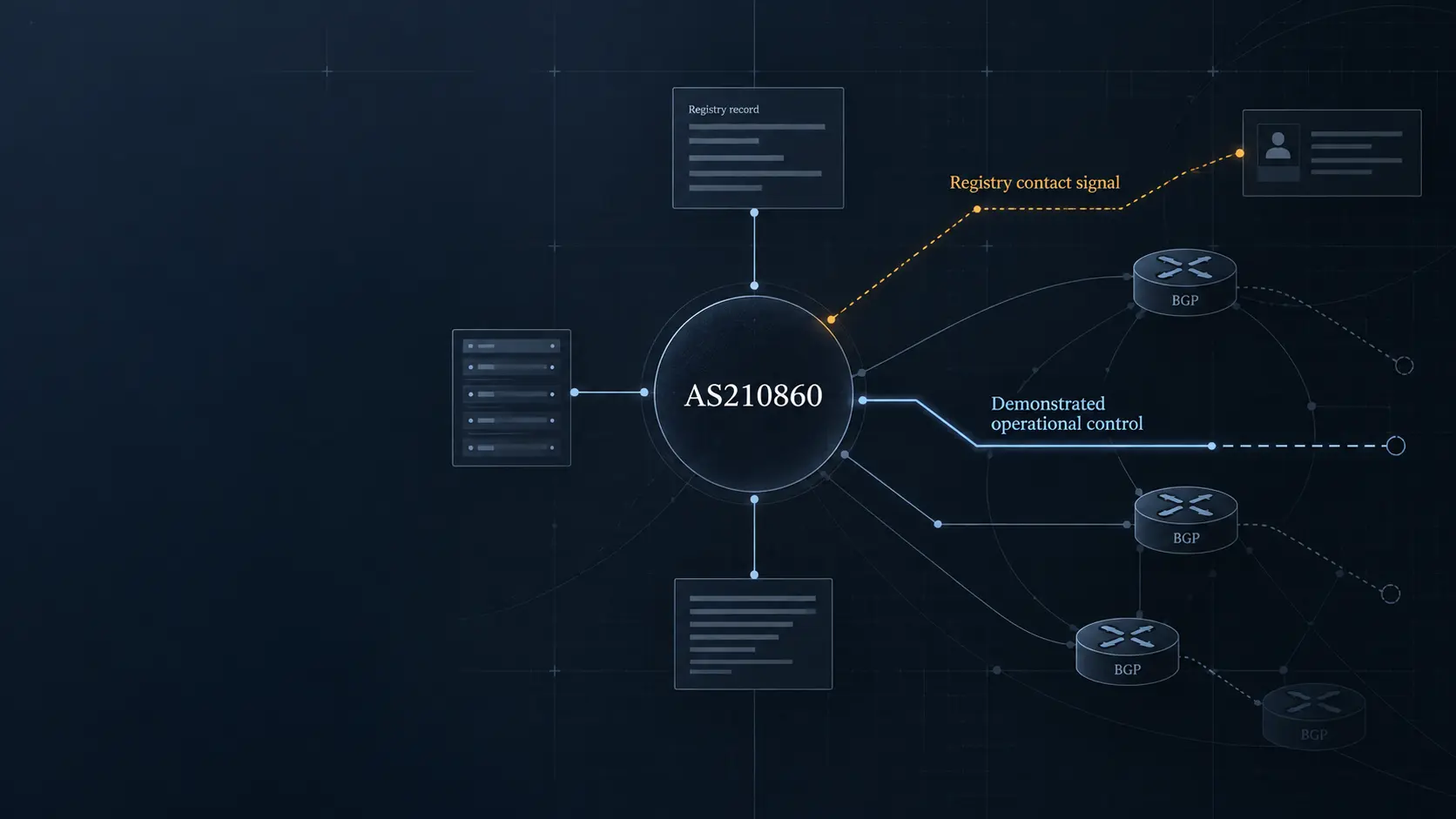
DFINFRA and AS210860: the registry signal still stops short of operational control
DFINFRA and AS210860: the registry signal still stops short of operational control intelligence summary explains the development, the public evidence available to readers, the organisations involved, the regional context, market exposure, and the infrastructure consequences that…

IETF
A D-PATH Stops Loops Only When Gateways Agree on the Domain
A BGP attribute can carry a domain history, but it cannot decide what a domain is. RFC 10039 makes that prior decision operationally consequential: the same configured identifier that lets a gateway reject a returning route can also discard a legitimate route when the gateways…

Leaders
Osipenko Alexander Nikolaevich: The Control Question the Public Record Still Cannot Answer
Osipenko Alexander Nikolaevich: The Control Question the Public Record Still Cannot Answer intelligence summary explains the development, the public evidence available to readers, the organisations involved, the regional context, market exposure, and the infrastructure…

IETF
The Route Carried a Domain Path. The Tenant Still Needed Proof: RFC 10039
RFC 10039 arrives with a practical answer to a dangerous ambiguity: when tenant reachability is re-originated between EVPN and IPVPN domains, redundant gateways need a way to recognize that a route has come back. Its new D-PATH attribute records the declared domain sequence and…

IETF
Cyrus Daboo and the PARTSTAT=ACCEPTED Status That Did Not Prove Attendance
An accepted invitation is useful evidence of a calendar decision. The standards Cyrus Daboo helped shape also show why it is not evidence that the invited person later appeared, stayed, listened, contributed, or completed anything.

Creators
Cricket Liu and the long work of making DNS operable
Cricket Liu’s career follows the Domain Name System from a specialist service run by a small group of operators to an enterprise control plane and, increasingly, a security sensor. His importance lies less in inventing protocols than in explaining how names, addresses, leases and…

History
The Space the Standard Never Required: How POP3 Software Made Compatibility Law
A single blank character can look too small to deserve a history. RFC 1957 showed why it did: once a common server emitted that character on every response, clients learned to depend on it, and a conforming shorter reply became the dangerous case.

IETF
RFC 7506 Is Historic. Router Alert 69 Can Still Be on the Wire
A standards register can retire a behavior without touching a single router. RFC 7506 is now Historic, its MPLS OAM Router Alert value is deprecated, and RFC 9570 says new LSP Ping implementations must not set it. None of those facts proves that value 69 has disappeared from an…

History
The Proposal Added a Header. It Refused to Rewrite the Address: RFC 1955
RFC 1955 described a way to make the Internet's routing problem look smaller without pretending that its addressing problem had disappeared. At an entrance border, the proposal would place the original IPv4 datagram inside a second IP header addressed to an autonomous domain. At…

Story
AFRINIC’s Two-Day Service Clock Opens on Three Different Maps
AFRINIC promises an effective response within two working days. Yet a correspondent choosing where to send a request meets twelve queue labels, sixteen specialist addresses, or three broad contacts and a general form. The commitment needs a public map between the front door and…

IETF
Mark Crispin and the \Seen Flag That Did Not Prove a Human Read the Message
An email turns from bold to ordinary type, and a shared mailbox quietly acquires a fact: `\Seen`. The interface calls the message read. The server can prove that a flag changed. Between those statements sits the question Mark Crispin’s IMAP makes unavoidable: what, exactly…

IETF
A NAT64 Mapping Is Not a Filtering Policy
A repeatable public tuple can prove how a stateful NAT64 translator allocates an address and port. It cannot prove which IPv4 sources are allowed to use that state on the way back. Treating those two facts as one control turns an interoperability test into a security verdict it…

IETF
The disclosure rule that does not travel alone
An incident report can inherit its sharing conditions from the structure around it. Turning that report into a convenient extract is therefore a policy decision, even when none of its factual fields changes.