
Intelligence
Latest Articles
Latest intelligence on infrastructure operators, policy decisions, market moves, and digital power shifts.

IETF
The Preference Won the Election. It Did Not Prove the Forwarder Was Ready: RFC 9785
An operator can make one EVPN Provider Edge router the obvious administrative favourite. RFC 9785 gives that intention a precise place in the DF election. What it does not give is a shortcut from “preferred” to “safe to carry traffic”. The standard opens a control surface…

IETF
The XML Matched. The Network Did Not
Two configuration documents can be well formed, stable under XML canonicalization and accepted by a validator, yet still fail to describe the same effective YANG data—or any change that a device actually applied. The first NETMOD draft dedicated to YANG’s XML encoding makes the…

History
Dave Täht and the Result That Had to Be Reproducible
A failed run can be more valuable than a beautiful graph. Dave Täht’s work on network latency made that unsettling proposition practical: if the apparatus cannot expose why a result is invalid, the result is not yet evidence.

IETF
DetNet’s ‘Optimal Path’ Is a Governance Decision Before It Is a Calculation
A DetNet controller may be able to calculate several feasible routes and install one of them precisely. The difficult question arrives earlier: who was entitled to decide that latency mattered more than spare capacity, that protection justified duplicated resources, and that…

History
The Message Had an Address, Not the Object: RFC 2017
In October 1996, RFC 2017 gave MIME mail a way to point at an external entity with a URL. Its economy was the point—and the trap. A locator could arrive intact while the content stayed elsewhere, retrieval still needed permission, and neither a declared type nor a matching digest…
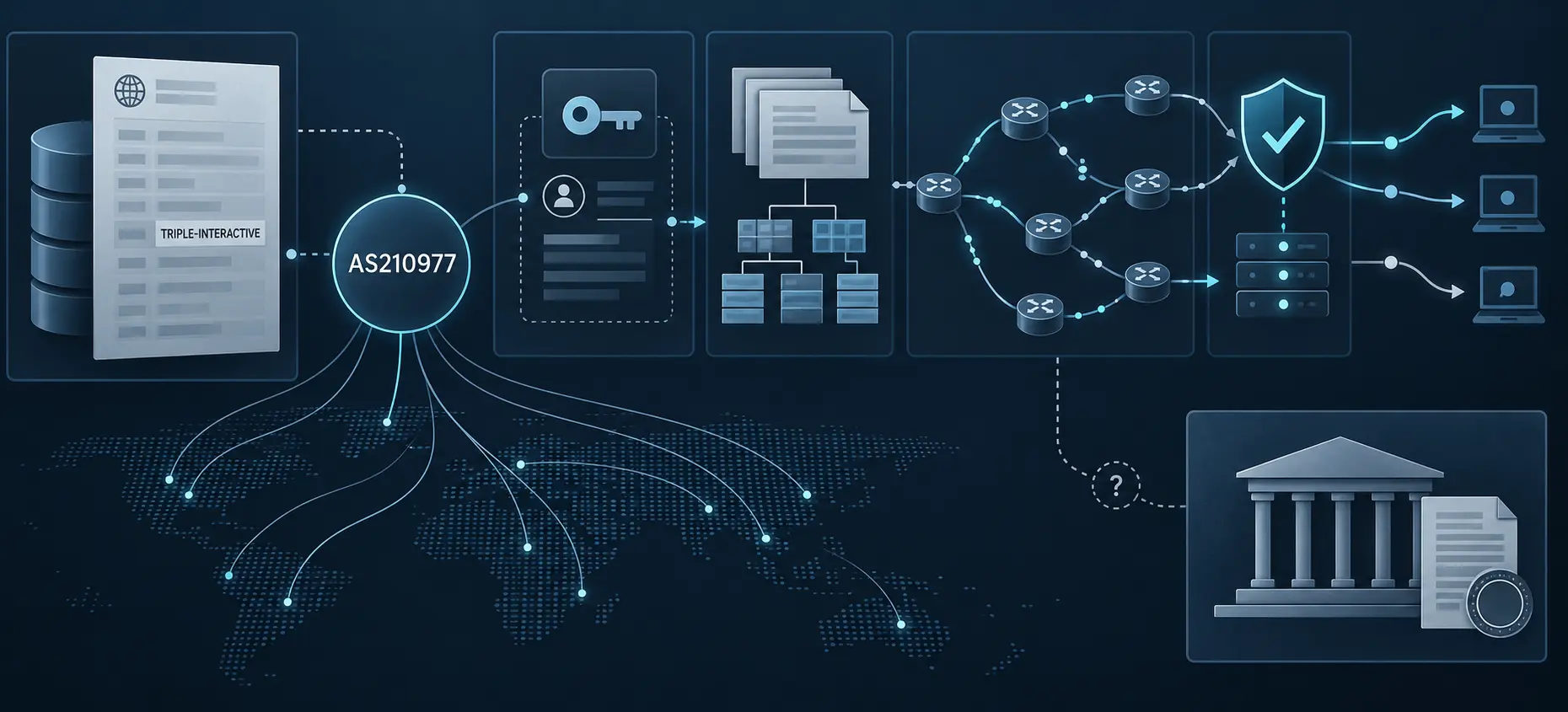
Global Institutional
What AS210977’s Registry Record Can—and Cannot—Prove
What AS210977’s Registry Record Can—and Cannot—Prove intelligence summary explains the development, the public evidence available to readers, the organisations involved, the regional context, market exposure, and the infrastructure consequences that may follow. The Global…

Global Institutional
What AS210764 Can—and Cannot—Prove About ISC’s Operational Control
What AS210764 Can—and Cannot—Prove About ISC’s Operational Control intelligence summary explains the development, the public evidence available to readers, the organisations involved, the regional context, market exposure, and the infrastructure consequences that may follow. The…

Number Resource Society
Florian Bauer and AS210833: What the Public Record Can Test About Network Stewardship
Florian Bauer and AS210833: What the Public Record Can Test About Network Stewardship intelligence summary explains the development, the public evidence available to readers, the organisations involved, the regional context, market exposure, and the infrastructure consequences…

Europe and Middle East Cloud Services
Genesis Cloud’s Public Control Chain Cannot Be Read From One Network Record
Public records can describe a cloud provider’s identity, domain, autonomous-system registration and reported interconnection. They cannot, by themselves, prove that one operator controls every layer or that a service is reachable worldwide.

IETF
The Message Had One Security Badge. Its Layers Did Not Share One Status: RFC 9787
The comforting part of an encrypted-mail interface is the badge. The difficult part is deciding exactly which bytes are entitled to it. RFC 9787 makes that boundary explicit: one received message gets one cryptographic summary, calculated only from the contiguous protection…

History
The Binding Was Accepted; the Location Was Not Proven: RFC 2002
Mobile IP’s first standards-track design separated a durable network identity from a temporary delivery instruction. The home agent could authenticate and accept that instruction, yet neither act proved where the device physically was—or that a packet completed its journey.

Story
ARIN’s ASPA Change Is a Set Decision. It Needs a Diff Receipt
Changing one upstream in an ASPA is not the digital equivalent of adding a name to a contact list. The operator is replacing a signed statement about the whole provider set. ARIN can acknowledge the transaction, yet the operator still needs evidence of what changed, what was…

Story
LACNIC’s Highest Risks Have Two Clocks and No Public Start Point
LACNIC has put unusually sharp time limits around its most serious residual risks. Its public Board record says what must happen immediately, within 90 days and in less than 120 days. What it does not publish is the event from which either clock is counted—a small omission that…

Global Regional ISP
AS210833 and the evidence gap between registration and stewardship
AS210833 and the evidence gap between registration and stewardship intelligence summary explains the development, the public evidence available to readers, the organisations involved, the regional context, market exposure, and the infrastructure consequences that may follow. The…

IETF
A Valid ECH Key File Does Not Prove the Right Privacy Boundary
RFC 9934 gives operators a portable way to place an Encrypted ClientHello private key beside the public configuration that uses it. The match is valuable, but it is smaller than the decision a privacy service must make: which names, DNS records, servers, retry paths and time…

History
David Clark and the Reliability the Network Could Not Finish
A subsystem can be flawlessly honest about the work it completed and still be unable to answer the question its user actually asked. David Clark’s end-to-end reasoning begins in that gap.

Global Institutional
DFINFRA and AS210860: The Evidence Stops Before Operational Control
DFINFRA and AS210860: The Evidence Stops Before Operational Control intelligence summary explains the development, the public evidence available to readers, the organisations involved, the regional context, market exposure, and the infrastructure consequences that may follow. The…

Europe and Middle East Cloud Services
AS210775 Is a Registry Endpoint, Not Yet a Running Network
AS210775 Is a Registry Endpoint, Not Yet a Running Network intelligence summary explains the development, the public evidence available to readers, the organisations involved, the regional context, market exposure, and the infrastructure consequences that may follow. The Europe…

IETF
The Route Policy Can Change While Its SR-Algorithm Number Stays the Same
RFC 9933 lets a path request name an SR-Algorithm. For a Flexible Algorithm, however, the number is only a handle: the policy that actually selects a route lives in a winning definition, a metric dictionary, a topology snapshot and an ordered evaluator that can all change…

Story
APNIC Reported 60 Atlas Probes Distributed and 23 Deployed. The Missing Unit Is the Cohort
A probe in a box is an opportunity to measure the Internet. A probe that has connected, remained available and filled a blind spot is measurement capacity. APNIC’s 2025 reporting places 60 distributed devices beside 23 deployed ones, but does not publish the join that would tell…