Summary
- At an 11 January 1982 meeting at ISI, participants chose to extend
username @ hostnameintousername @ host.domain. They placed the entire new hierarchy after the single@and left local username syntax alone, including dots that some systems already used. - The group proposed ordered, administratively controlled domain names and several possible name-service responses. Software still had to accept dotted host fields, and DARPA was asked to set a date when senders could use them across the network without objections.
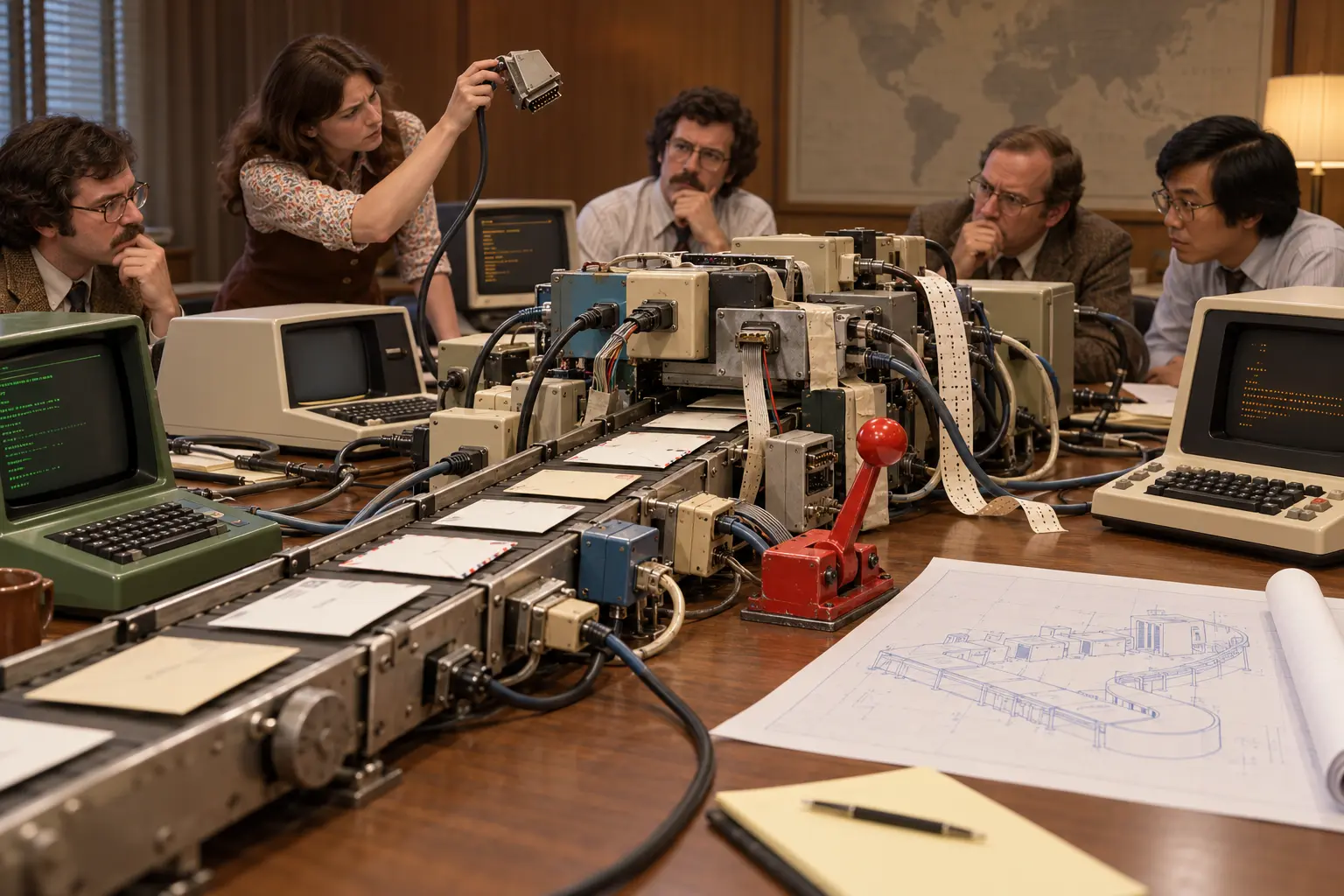
Imagine a mailroom in which every tenant labels the drawers on the left however they please. One drawer says J.Smith; another site's drawer might use the same punctuation differently. The building grows, and a planner arrives with a splendid proposal: renumber every drawer to fit a new global map. The tenants have other ideas. Jon Postel's RFC 805 records the computer-mail meeting at ISI on 11 January 1982 that faced this problem. Its least glamorous decision is also its cleverest: leave the drawers alone and extend the street address on the right side of @.
The meeting began with a larger ambition. A mailbox could in principle have a globally unique identity that survived a change of location: unique-id @ location-id. The location would tell the network where to deliver, while the identity would remain stable. But the established form was user @ host, and local systems had developed too many variations in the user field. Replacing it would have sent the bill for global tidiness to every local mail program. The group set aside the cleaner abstraction and worked with what people already typed.
Where should a hierarchy go? The notes say the designers compared levels to the left and right of @, and compared orders within the levels. They judged the information content equivalent. What differed was the damage to installed practice. Some systems already put a dot in a username. A global rule that reinterpreted that dot as a boundary would turn yesterday's valid local mailbox into tomorrow's puzzle. So the new hierarchy went wholly on the host side. The formal address would contain exactly one @; nodes to its right would be separated by dots, running from the most specific to the most general. Postel's example was Postel @ F.ISI.IN. The top names had to be globally unique, with administrative control over who chose them. Local naming freedom survived because the global system drew its boundary in the right place.
This was more than typography. The meeting distinguished an absolute hierarchical domain name from a source route, which described a relative path through mail handling. It also separated three jobs that are easy to blur into a magical “look up the user” box: find a person by attributes, map a stable identity to a location, and map a location to a numeric network address. Only the last job was needed soon. If a lookup returned a final host address, a subordinate name server, or a forwarder, the reply had to say which; a mailer could not treat every answer as a doorstep.
The participants discussed service and protocol details, including the mixed NCP/FTP and TCP/SMTP world, without settling every transport choice.
They even sketched a migration path for the directory behind the names. An FTP-accessible text file and query servers over TCP-like connections or UDP datagrams were among the options. A central server could get things moving; separate servers for domains would give administrators local responsibility, with copies of each database for resilience. Those are proposals in a meeting note, rather than a report that the later Internet name system had already arrived. The awkward immediate work was simpler: revise mail specifications and transition plans, and teach programs to accept dots in the host field.
The calendar was the sharp edge of the design. DARPA's Duane Adams received an action item, due 1 March 1982, to set the date after which senders could put dotted host names into mail addresses throughout the ARPANET and Internet without complaints from recipients. RFC 805 records the assignment; it does not certify that such a date was set by the deadline or that every receiver upgraded at once. A syntax can be agreed in a room. Its first safe day on a distributed network must be coordinated with the people still running yesterday's parsers.
That is the small comedy inside a large design choice. The @ sign was already doing a useful job: separating a locally governed person name from a location. By adding structure only to the location, the meeting made a growing network legible without confiscating every mailroom's drawer labels. It left one question for the human operators and their calendars: when would the new address stop looking like an error to the next machine?
Member Briefing
Deeper Profile Context
Sign in with the right membership level to unlock the full briefing and source notes.
Only for Strategic Circle
Strategic Circle
Open to all readers. Unlock profile briefings after joining and signing in.
Join Strategic CircleOnly for Leadership Alliance
Leadership Alliance
For qualified IP-asset owners and management; sign in to unlock alliance briefings.
Join Leadership Alliance