Summary
- Internet Archive's 2002 Bookmobile downloaded public-domain books and made paper copies at schools, libraries and other stops.
- Its early equipment notes put output at an estimated four to six books an hour. Local machinery and the people operating it determined how the digital collection reached a reader.
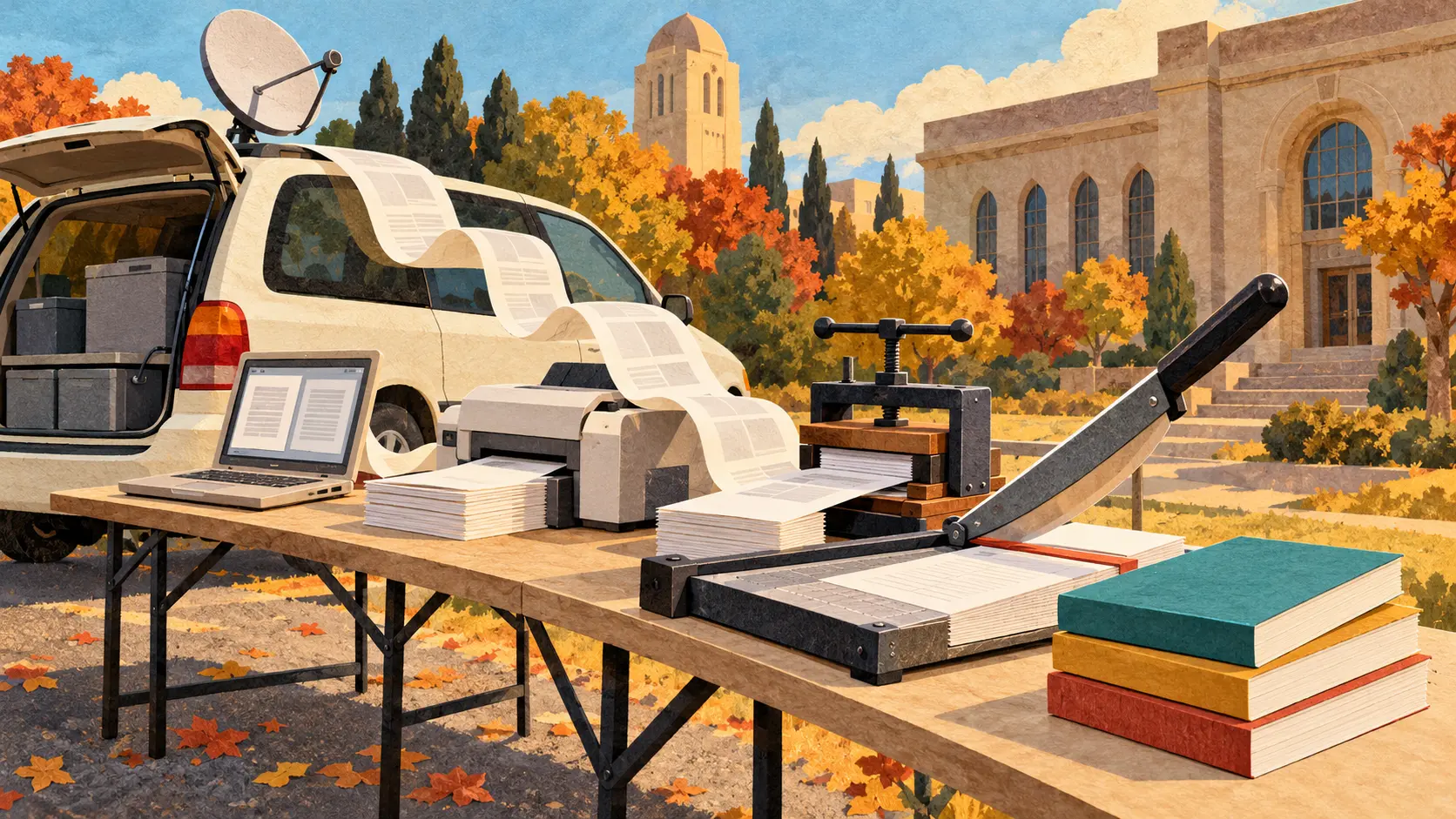
The Internet could deliver the file. Somebody still had to trim the edges. Among the more revealing objects in Internet Archive's early Bookmobile equipment list is a manual paper cutter: a pleasingly blunt answer to the question of how knowledge gets into people's hands.
The project took its first school tour on the road on 30 September 2002. Its itinerary runs from Menlo Park through Salt Lake City, Ohio, Pittsburgh and Baltimore to Washington. Brewster Kahle and his son Caslon travelled with a workshop that made books as it went. The network supplied a collection; the van supplied the last few feet between a file and a paperback.
Internet Archive's project account described satellite downloads of public-domain works, followed by printing and binding. The destinations included schools, libraries and retirement homes. A visit was also a demonstration for the institution: after the van left, a library was supposed to understand how to make books itself.
A small factory with a very large catalogue behind it
The surviving equipment notes list the less romantic side of universal access: duplex printing, cover printing, a binder and a cutter. The team reported spending about $14,000 and a month assembling the mobile operation, with computer equipment donated by HP. A satellite connection and a generator helped the workshop travel.
For an existing library or school, the team estimated roughly $3,000 for a stationary setup, assuming a computer and cover printer were already available. Colour laser printing was optional. Printing on both sides was close to essential. The cheap cover printer, the notes admitted, had been a miserable bargain. Even the future of knowledge could suffer from a false economy in the stationery department.
The advertised “Buck a Book” had some arithmetic beneath it. The same page estimated $1.65–$2 in consumables for a 240-page book; shorter books, discounts and donations supported the dollar slogan. Its production estimate was four to six books an hour. These are the project's historical planning figures, and they describe a workshop with a pace of its own.
The trip's popular titles included The Wonderful Wizard of Oz and Alice's Adventures in Wonderland. That is a useful measure of what the apparatus was for. A reader could leave with a story, hold a page open and put the book on a shelf. Once made, that particular copy needed no connection to the van.
The Bookmobile made a surprisingly practical proposition about the Internet: put the collection within reach, then put the means of finishing the job nearby. Its satellite dish attracted attention. Its binder and paper cutter explained the workload.
Member Briefing
Deeper Profile Context
Sign in with the right membership level to unlock the full briefing and source notes.
Only for Strategic Circle
Strategic Circle
Open to all readers. Unlock profile briefings after joining and signing in.
Join Strategic CircleOnly for Leadership Alliance
Leadership Alliance
For qualified IP-asset owners and management; sign in to unlock alliance briefings.
Join Leadership Alliance