
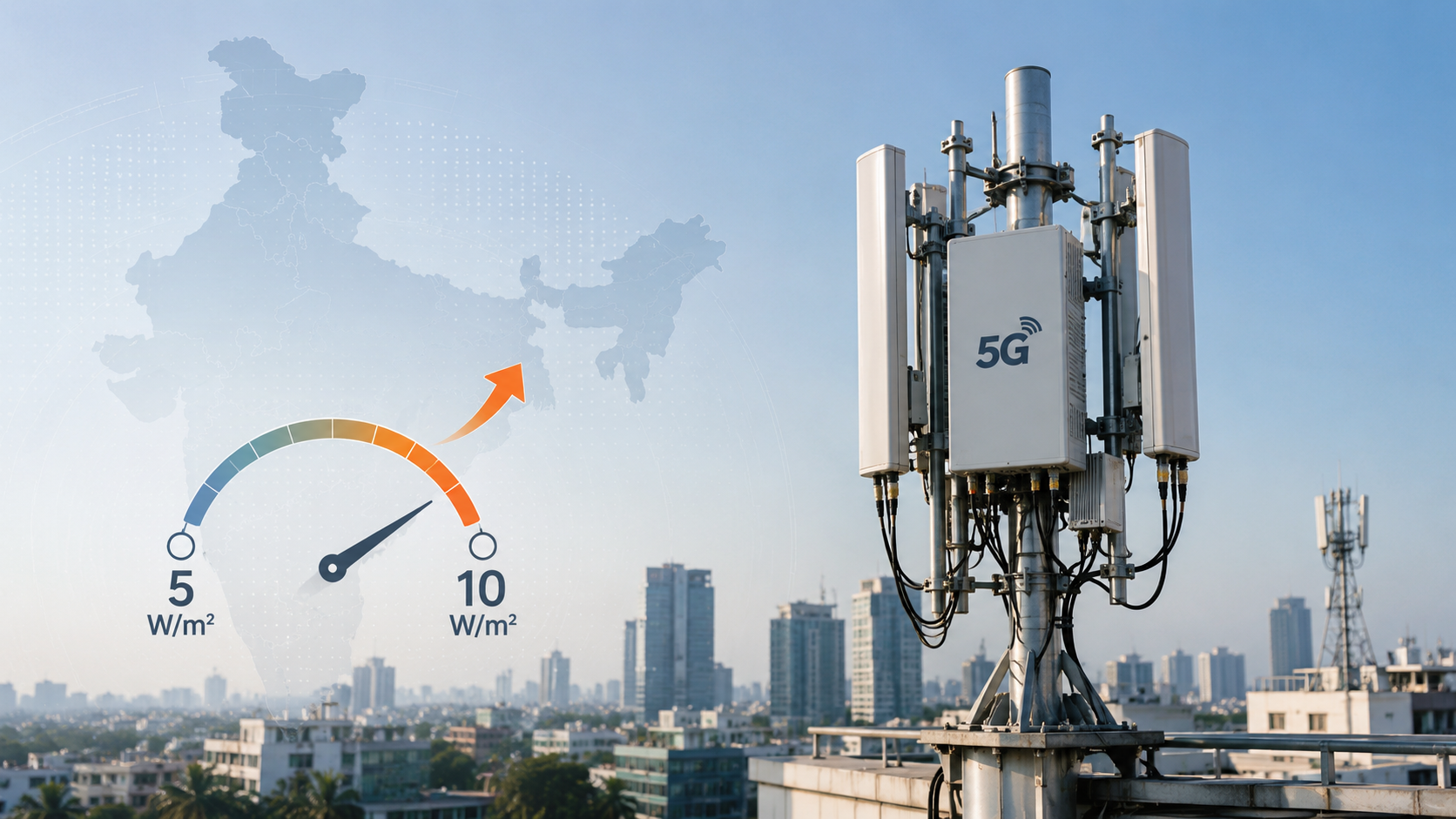
- The Economic Times reports that India will raise the permitted power density for 5G base stations from 5W/m² to 10W/m² from September
- The higher ceiling could give operators more flexibility in radio planning, but it does not mean coverage will automatically double or tower requirements halve
The fact
India is set to double the permitted electromagnetic field power density for 5G base stations to 10W/m² from 5W/m², The Economic Times reported, citing people familiar with the matter. The revised limit is expected to take effect in September. The Department of Telecommunications had not confirmed the change when ET published its report.
The reported move follows an earlier relaxation in 2025, when the limit for 5G base stations was increased from 1W/m² to 5W/m². ET said the new 10W/m² ceiling brings India into line with the reference level recommended by the International Commission on Non-Ionizing Radiation Protection and used in many other countries.
Reliance Jio and Bharti Airtel have already deployed much of their 5G networks, while Vodafone Idea is still expanding its rollout. ET reported that all three operators could benefit from the revised rules, with Vodafone Idea able to incorporate the higher limit into new network planning.
The Assessment
The higher limit gives operators more room to work with at sites where EMF rules are already restricting transmit power. That could allow engineers to push more signal from an existing or planned site, but the benefit will vary from one location to another.
Coverage is not determined by transmit power alone. Spectrum, antenna design, surrounding buildings, terrain, interference and traffic demand all affect how a cell performs. Operators may therefore gain useful headroom without changing the number of sites they need, particularly in areas where extra towers are required for capacity rather than coverage.
For BTW readers, the important question is how often the current 5W/m² limit is actually shaping network design. Where it is the binding constraint, the new ceiling could give operators more flexibility. Where spectrum, backhaul, capacity or access to sites is the bigger problem, the regulatory change is unlikely to alter deployment very much.
What to watch
Watch for the DoT order confirming the effective date and the technical conditions attached to the 10W/m² limit. Operator disclosures on site plans, radio configuration and capital spending will show whether the change alters deployment in practice. Vodafone Idea's continuing 5G rollout should provide particularly useful evidence because more of its network is still being built.
Member Briefing
Deeper Profile Context
Sign in with the right membership level to unlock the full briefing and source notes.
Only for Strategic Circle
Strategic Circle
Open to all readers. Unlock profile briefings after joining and signing in.
Join Strategic CircleOnly for Leadership Alliance
Leadership Alliance
For qualified IP-asset owners and management; sign in to unlock alliance briefings.
Join Leadership Alliance