
Summary
- The directory entry for Guam Exchange has one evidence link — an autonomous-system query at rdap.org/autnum/152735 — and that URL returned no readable registry text when I retrieved it on 18 October 2026. That is a dated retrieval outcome, not a finding about the operator or the number.
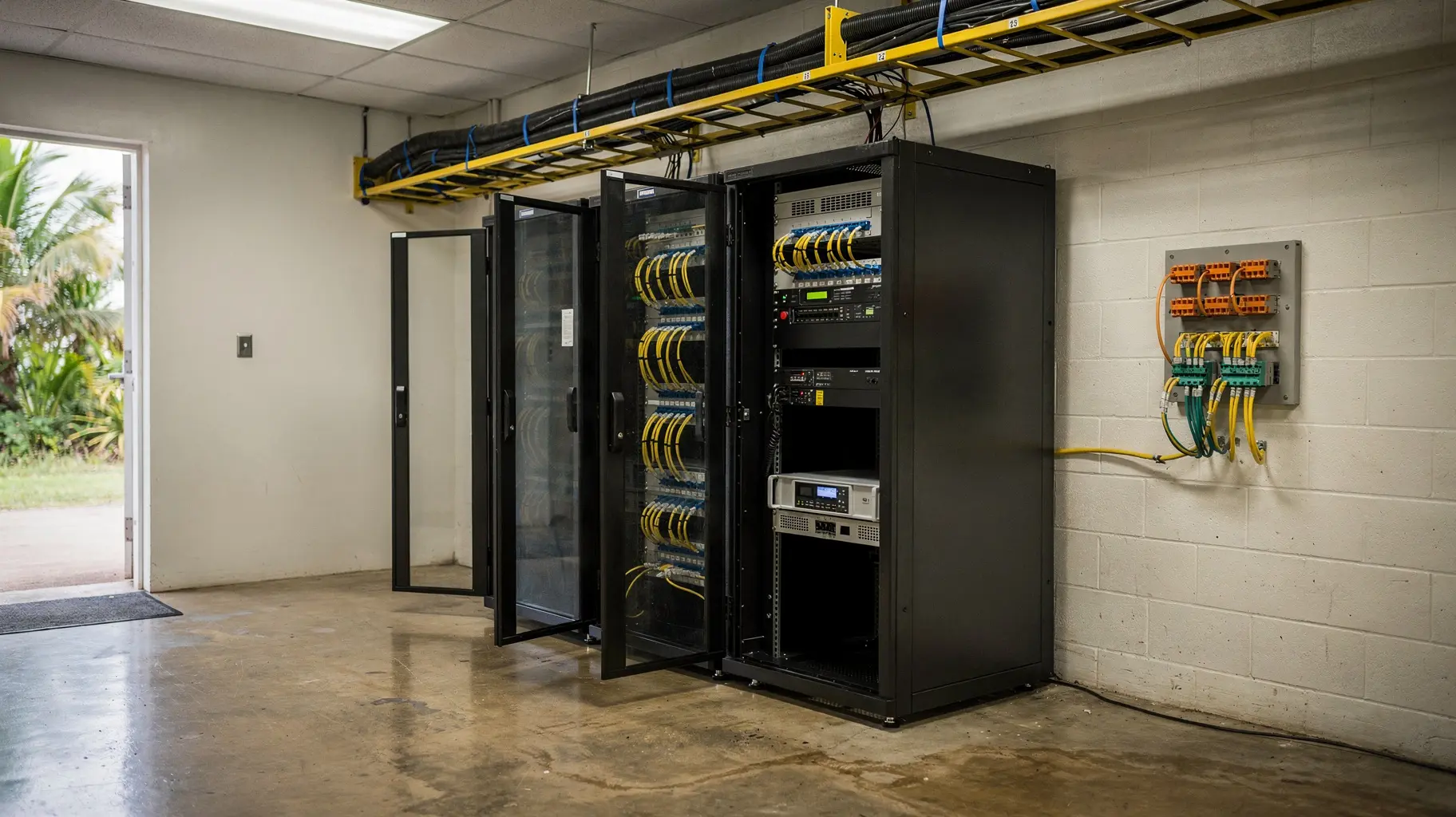
- The operator's own pages place the Guam IX peering fabric inside "the Guam Exchange Datacenter" at 122 W Harmon Industrial Park Road, Suite 103, Tamuning, and describe Guam IX as "a project operated by Guam Exchange, a Citadel Pacific Data Center" (ix.gu/about, ix.gu/peering).
- Nothing I retained establishes the legal owner of the building, the tenancy or cross-connect arrangements, power and redundancy design, participant count or traffic volumes. The entity name, the peering fabric and AS152735 have to be read as three separate layers, because that is as far as the sources go.
The record as it stands
The directory projection I read on 18 October 2026 — the record itself was last updated on 17 June 2026 — describes Guam Exchange as a private company headquartered and registered in Guam, serving Guam with a service list that contains nothing more specific than "other". Website, primary domain, aliases, inbound and outbound edges, relationships and leadership contacts are all empty, and the BTW claim namespace holds nothing at all. One evidence link is attached, labelled "Public registry record evidence" at confidence 0.82, and it points to rdap.org/autnum/152735.
That target is an autonomous-system query. It is not a corporate registration, and it is not a facility document. When I retrieved the same URL on 18 October 2026, the response carried no readable record: no registrant name, no allocation date, no sponsoring registry. The retained snapshot holds an access failure rather than a body of text. A failed retrieval on a single date is not a finding that AS152735 is unregistered, and it says nothing about anyone's conduct. It is simply the state of the only citation the entry has.
The card's own data-gaps field asks for precisely what this citation cannot supply: the legal entity's country, current services, visible assets, parent or subsidiary links, and responsible public leadership contacts. Until one of those documents arrives, "private company" and "registration jurisdiction Guam" remain the card's characterisation rather than a documented legal form, and I treat them that way throughout.
What the operator's pages describe
The exchange's own pages are more specific about operations than the directory is about ownership. The About page states: "Guam IX is a project operated by Guam Exchange, a Citadel Pacific Data Center", that the goal is "to keep local traffic, local to the region", and that "Guam IX operates openly with all network operators and carriers" (ix.gu/about). The peering page adds the physical anchor: "Peering is available at the Guam Exchange Datacenter", followed by the address 122 W Harmon Industrial Park Road, Suite 103, Tamuning, Guam, 96913 (ix.gu/peering).
The homepage fills in the operational kit rather than the commercial terms. It lists a peering agreement document, MANRS, directory listings at PeeringDB, Euro-IX, IXPDB, IX-F and the Packet Clearing House IXP directory, RPKI route-origin validation, "Peering Lan and Route Server uptime", IXP Manager, a looking glass, IX traffic statistics and a customer portal (ix.gu). A route server, a looking glass and an uptime indicator are the marks of a fabric meant to be used by parties other than its operator. The traffic statistics link is listed; I did not read the statistics page, and no traffic, latency, route-count or participant measurement was retained.
Separately, the PeeringDB record headed "AS152735 - Guam IX Services" lists Organization "Citadel Pacific Data Center", ASN 152735, Network Types "Route Server", Geographic Scope "Asia Pacific", Facility "Guam Exchange", city Tamuning, country Guam (peeringdb.com/asn/152735). PeeringDB is a user-maintained database, so this is a page extract rather than a registry document. It is nonetheless the second, independent narrator to name Citadel Pacific Data Center in relation to Guam IX — and the only one that attaches the Role of route server to a specific ASN.
Three layers, one name — my construct, not a finding
The reading I find useful is my own analytical device rather than anything the sources assert. Layer one is a building: a leased or owned suite on an industrial road in Tamuning, described by the operator as "the Guam Exchange Datacenter", about which no facilities document was retained. Layer two is a service: a peering fabric called Guam IX, operated by Guam Exchange, which states openly that it takes all network operators and carriers. Layer three is a routing identity: AS152735, network type route server, attributed in a user-maintained database to an organization named Citadel Pacific Data Center.
Each layer derives its authority from a different instrument — physical plant, operating agreement, registry record respectively — and no single document I retained covers more than one of them. That is why collapsing them is costly. A reader who treats the directory entry's ASN citation as proof of the building would be reading a routing lookup as a property record. A reader who treats the About page's apposition ("a Citadel Pacific Data Center") as an ownership chain would be reading a marketing sentence as a corporate structure.
The sentence does not name a legal entity, a jurisdiction of incorporation, an ownership chain or a registration number, and no such document was obtained for either name.
What the address settles, and what it does not
The address does something real: it converts an abstract peering claim into a place. A network evaluating whether to take a port on the fabric now knows the physical location to plan around, and the page states that peering is available there. Combined with the tooling on the homepage, the public description is coherent: a route-server-based exchange point run inside a datacenter that shares the operator's name.
What it does not settle is the part an operator or investor actually has to price. There is no published statement of power feeds, cooling, floor space, redundancy or cross-connect policy for the facility. There is no pricing, contract, service-level or non-member terms document for the fabric. There is no participant list with autonomous system numbers, so the openness statement stays a self-characterisation until membership becomes checkable. Whether the building is owned, leased, or operated under an agreement with a third party is not stated in any retained text.
Nor does the record quantify Guam's role in regional connectivity: no submarine-cable landing document specific to Guam was retained for this piece, so I assert nothing about which systems land there or at what capacity.
I did search for a facility-level record naming Citadel Pacific. That query returned zero source candidates on 18 October 2026 after an earlier attempt failed at the provider end. Zero candidates is a retrieval result; it is not evidence about the facility or its operator, and I do not treat it as such.
The ordinary consequence
For a network in the western Pacific, an exchange point inside a datacenter is a latency and backhaul decision before it is anything else: traffic handed over locally stays local, which is exactly the outcome the operator states it wants. But the decision rests on physical facts the public record does not carry — how the suite is fed, how it fails over, and what a cross-connect costs. The operative asymmetry is that the operator knows all three and the outside reader knows none of them.
That is not a criticism of Guam Exchange. It is the normal shape of small-exchange disclosure, and it is also why a directory entry matters: it is often the only structured thing a distant engineer reads before making a routing decision. Which is precisely why its single citation should be legible as what it is — a number-resource lookup — and not stand in for the building.
The directory entry this article reads is the BTW directory record for Guam Exchange; the materials cited above were retrieved on 18 October 2026 and the entry itself was last updated on 17 June 2026.
Member Briefing
Deeper Profile Context
Sign in with the right membership level to unlock the full briefing and source notes.
Only for Strategic Circle
Strategic Circle
Open to all readers. Unlock profile briefings after joining and signing in.
Join Strategic CircleOnly for Leadership Alliance
Leadership Alliance
For qualified IP-asset owners and management; sign in to unlock alliance briefings.
Join Leadership Alliance