
Summary
- Greenhouse Datacenters describes itself as an independent, carrier-neutral colocation platform in het Westland, with data centres in Naaldwijk, and an independent trade report names it an additional landing partner for the IOEMA subsea cable at Scheveningen.
- The same record carries a connectivity count, five internet exchanges, a power usage effectiveness below 1.2, 100% green electricity, an uptime claim dating to 2013 and six certifications — but no megawatt figure, no grid connection or queue position, no environmental permit condition and no heat-rejection arrangement.
- That asymmetry is the finding. What a colocation provider publishes tracks what it sells; the layer that fixes usable capacity is contractual and largely invisible from outside, so it belongs in a diligence file rather than a brochure.
What is actually on the record
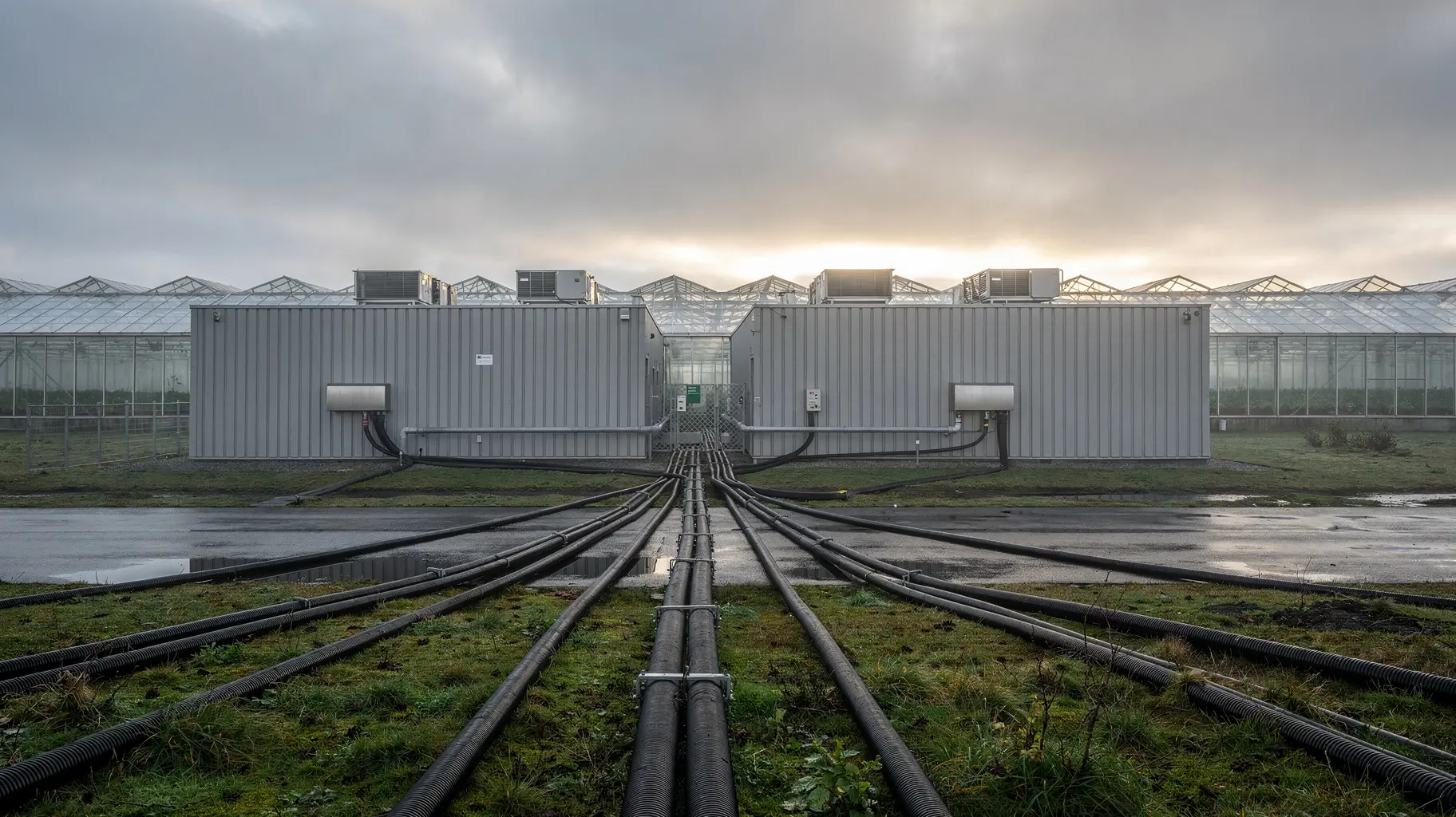
The company's own page is precise about two things and silent about a third. On identity, it states that Greenhouse Datacenters is an independent, carrier-neutral datacenter platform in het Westland, with data centres located in Naaldwijk, in the Westland, in the Rotterdam/The Hague region of Zuid-Holland (operator site). On service, the extracted claim set from that page describes colocation and connectivity through more than ten partners and five internet exchanges, customised infrastructure, advisory services, and in-house management of the chain from building and cooling to power and network. It also states a power usage effectiveness below 1.2 on 100% green electricity, continuous uptime since an opening in 2013, and certifications spanning ISO 27001, ISO 9001, ISO 14001, PCI DSS, ISAE 3402 and NEN 7510.
Those are the company's representations, published on its own site. They are specific enough to be checkable, which is what makes them useful; none of them is independently audited in this record, and the distinction between a stated position and a verified one should be kept visible rather than smoothed away.
The third thing — the electrical envelope — is absent. No retrieved document states a capacity figure in megawatts, kilowatts or racks. None states a grid connection, a firmness level, a queue position or a delivery date. None states an environmental permit decision or an operative condition attached to one. None states how rejected heat leaves the building or whether anyone buys it. That absence is recorded here as a dated scope limit, not as evidence of anything: it says what these two documents contain, and nothing about what the company has or has not done.
A connectivity event, correctly labelled
The second source is a trade report stating that the IOEMA project selected Greenhouse Datacenters as an additional landing partner for the IOEMA subsea cable, which is to come ashore at Scheveningen (IOEMA landing report). The report attributes the selection to the South Holland location and to an existing connectivity ecosystem including AMS-IX, Lumen, Delta Fiber, Odido and DCspine. The operator's own page describes the same IOEMA connectivity as in preparation with the landing planned at Scheveningen, so the two accounts agree on the project and differ only in tense.
This is a real event and it should be described as one: a project decision, reported by a third party, corroborated by the operator. It is not a capacity measurement, and the geography matters. The landing is at Scheveningen on the coast; the colocation campus described in the first source is at Naaldwijk, inland. A landing partner role establishes that a cable system will terminate in the region and that the operator is party to that arrangement. It does not establish that additional electrical capacity exists behind the racks, nor that any particular customer can buy it.
The two announcements describe two different things that happen to sit in the same province.
What the event does establish is direction of travel. A carrier-neutral platform whose selling proposition is interconnection benefits when a new subsea system chooses its region, because interconnection is the product it can actually differentiate on. That is the commercially rational thing for such an operator to publish, and it explains why the connectivity layer of the record is so much denser than the power layer.
Why a ratio is not a capacity
Power usage effectiveness is total facility energy divided by IT energy. A figure below 1.2 describes how efficiently the facility converts purchased electricity into compute load; it says nothing about how much electricity is available to convert. A campus with excellent PUE and a modest connection and a campus with the same PUE and a large one publish identical numbers. The ratio is a quality signal about the engineering, and buyers reasonably treat it as one. It is not a quantity.
The same caution applies to the certification set. ISO 27001 addresses information security management; ISO 9001 addresses quality management; ISO 14001 addresses environmental management; PCI DSS addresses cardholder data; ISAE 3402 addresses assurance reporting on controls; NEN 7510 addresses information security in Dutch healthcare. Each speaks to a management system and its assurance scope. None of them certifies a megawatt, a firmness level or a permitted operating envelope.
And an uptime claim is a claim about the past, expressed as a percentage, without a stated measurement boundary. Continuous operation since 2013 is materially impressive if it is measured at the customer load and less impressive if it is measured at a narrower boundary. The honest reading is that the operator asserts a strong operational record and that the assertion has not been independently examined here.
The layer that decides what a buyer can actually use
For colocation, the binding constraints sit in instruments the operator does not write alone. The grid operator decides how much import capacity is available, when, and on what firmness; in capacity-constrained parts of the Netherlands that question has been contested for years, though no document retrieved for this article establishes the position for this specific site. The permitting authority decides what may be built and operated, and conditions attached to a decision can bind heat reuse, noise, emissions or operating hours.
A heat counterparty decides whether rejected heat has a destination, and on what seasonal profile, temperature and acceptance terms. Each of those can limit usable capacity independently of the other two, and none of them is a substitute for another.
That is the practical consequence of the asymmetry. A buyer comparing carrier-neutral campuses is comparing published interconnection and published efficiency, because that is what is comparable from outside. The differences that decide whether a contracted commitment can be delivered sit one layer down, in documents that are exchanged under confidentiality and are therefore invisible in any comparison a buyer can run from the public record.
What this record supports and what it does not
It supports a description: an independent, carrier-neutral colocation platform in Naaldwijk with a broad connectivity ecosystem, a stated efficiency position, a long operational claim and a full certification set, now additionally named as an IOEMA landing partner at Scheveningen. It supports the observation that the operator publishes its interconnection and efficiency story thoroughly.
It does not support a capacity figure, a statement that capacity is scarce, a statement that capacity is ample, or any reading of the missing layer as deliberate. Silence in a marketing page about contractual instruments is ordinary; the instruments are not marketing material, and their absence from a website is not evidence about their content. Equally, the absence of a megawatt figure is not evidence that the operator has nothing to sell.
The only defensible statement is the one the record earns: as of 18 October 2026, the retrieved public documents do not state the electrical envelope, the grid position, the permit condition or the heat destination, and a buyer who needs those should ask for them directly.
The directory record behind this article describes the same entity — Greenhouse Datacenters B.V., jurisdiction Netherlands, one brand domain, one website — and marks most of its own dossier sections as needing source coverage (BTW directory record). That is a statement about a research file's completeness, not about the company's operations, and it is the reason a structured request for the underlying instruments is more useful here than another pass over public pages.
Member Briefing
Deeper Profile Context
Sign in with the right membership level to unlock the full briefing and source notes.
Only for Strategic Circle
Strategic Circle
Open to all readers. Unlock profile briefings after joining and signing in.
Join Strategic CircleOnly for Leadership Alliance
Leadership Alliance
For qualified IP-asset owners and management; sign in to unlock alliance briefings.
Join Leadership Alliance