
Policy continuity, legitimacy, and accountability signals across internet governance institutions.
Governance
Governance
Internet governance intelligence tracks institutions, policy processes, standards activity, registry operations, accountability disputes, and implementation signals that affect internet infrastructure. BTW.
RIR WatchdogCase FileNumber Resource SocietyICANNIETFHistory of InternetNOGs

RIR Watchdog, Case File, NRS, ICANN, IETF, History of Internet, and NOG sessions.
Coverage prioritizes implementation evidence and institutional behavior over declarative positions.
Latest Coverage
Latest from Governance
7,550 articles

History
The Internet’s Tool Catalog Needed a Tool of Its Own
By 1990, keeping a TCP/IP network alive required more than a clever administrator and a heroic command line. There were alarms, traffic analyzers, topology maps and debuggers; finding out which existed was another job entirely. The IETF’s NOCTools group built a catalog for that…

ICANN
ICANN moves $20 million into its Project Fund, with spending decisions still ahead
ICANN’s Board has turned a forecast surplus into a specific fund transfer. The money is now authorized to move out of daily operations, but the resolution names no project that may spend it.

History
The Network Arrived Before the Research Could Be Found
An Indonesian research network could reach beyond the country while its own papers remained hard to find online. A 1997 account of IPTEKnet shows why connecting institutions and building usable local information required different people, budgets and decisions.

ICANN
ICANN adopts the IDN country-code plan but closes one risk-appraisal route
An applicant whose proposed country-code domain resembles another name only when capitalised has lost a proposed way to argue for an exception. ICANN’s Board approved the broader IDN ccTLD policy, then withheld that narrow escape route over security concerns.

ICANN
A 20–0 GNSO vote sends the diacritics plan to ICANN’s Board
A registry operator considering an accented counterpart to an ASCII suffix now knows where the GNSO stands. It still cannot treat the proposed exception as an operative rule: the Board has a separate decision to make.

Story
APNIC prop-168 adds a /12 reserve to a higher IPv4 ceiling
APNIC prop-168 v004 would let some account holders grow their IPv4 holdings to a combined /22, while reserving a separate /12 for a much later IPv6-transition purpose. The draft’s real test is how APNIC would manage those two claims on a finite pool—and explain who qualifies…

History
The Broadcast That Crossed Two Gateways Without Making Either One a Repeater
In a 1985 Cronus experiment, two distant Ethernet networks shared selected broadcasts through software on hosts. RFC 947 makes the placement of that software, and the price it imposed on a busy host, the interesting part of the story.

Story
A Temporary IPv4 Bridge Needs an Operational Exit
An IPv6-only network can still need a small IPv4 foothold: a resolver, mail gateway, monitoring system or connection to a service that has not made the same transition. APNIC proposal prop-165 v004 would offer eligible new IPv6 networks one IPv4 /24 for that work. Its hardest…

Story
ARIN’s /24 Threshold Would Open a Narrower Gate to Cross-Region IPv4 Use
A proposed /22-to-/24 change would lower one eligibility threshold while preserving other tests and exclusions. ARIN’s own staff review raises a separate question: what quantity of out-of-region space could that threshold support?

Story
RIPE NCC’s arbiter election will choose who hears disputes, not what they can decide
Six seats are up for election at RIPE NCC’s October General Meeting, but the ballot will not redraw the Arbiter Panel’s jurisdiction. The procedure calls its process “arbitration” while expressly placing it outside Dutch civil-law arbitration; the practical test is the remedy…

Story
APNIC Marks Prop-167 Implemented; Its MyAPNIC View Still Needs a Receipt
APNIC’s policy page says the directory-usage proposal was implemented on 30 June 2026. The approved text, however, joined public WHOIS/RDAP statistics to a separate MyAPNIC view for each resource holder. The Executive Council’s record treated those outputs differently; the public…

History
Students Sold Cupcakes for NetDay. Who Would Help Their Teachers Afterwards?
California’s 1996 school-wiring campaign made the work of connecting classrooms visible. The harder handover — from installing equipment to supporting lessons — was already emerging in the official record.

History
At AUB, the Internet Allowance Changed After Business Hours
A university account opened the network to students and staff. A small clause in American University of Beirut catalogues added another condition: access without a quota belonged to particular times of day and to holidays.

History
Algeria’s Researchers Had Email Accounts. Many Still Needed a Modem
In October 1994, CERIST reported that it had satisfied about 500 requests for its email service. Only a tenth of users could actually use it. The missing pieces were often on a university desk, not at the country’s international gateway.

History
The Computer Could Not Boot to Learn Its Server Had Moved: RFC 966
The server could move; the client could not start long enough to discover its new address. RFC 966’s answer was stranger than a backup server: preserve a destination that might, for a time, have no receivers at all.

Story
ARIN’s 2025 transfer map runs in two directions
ARIN recorded 78,234 transferred IPv4 `/24s` across its 2025 inter-RIR flows. The total is easy to quote and easy to misread: most listed outflow went to LACNIC, while most listed inflow came from RIPE NCC. Direction carries the story that a single net figure loses.
Story
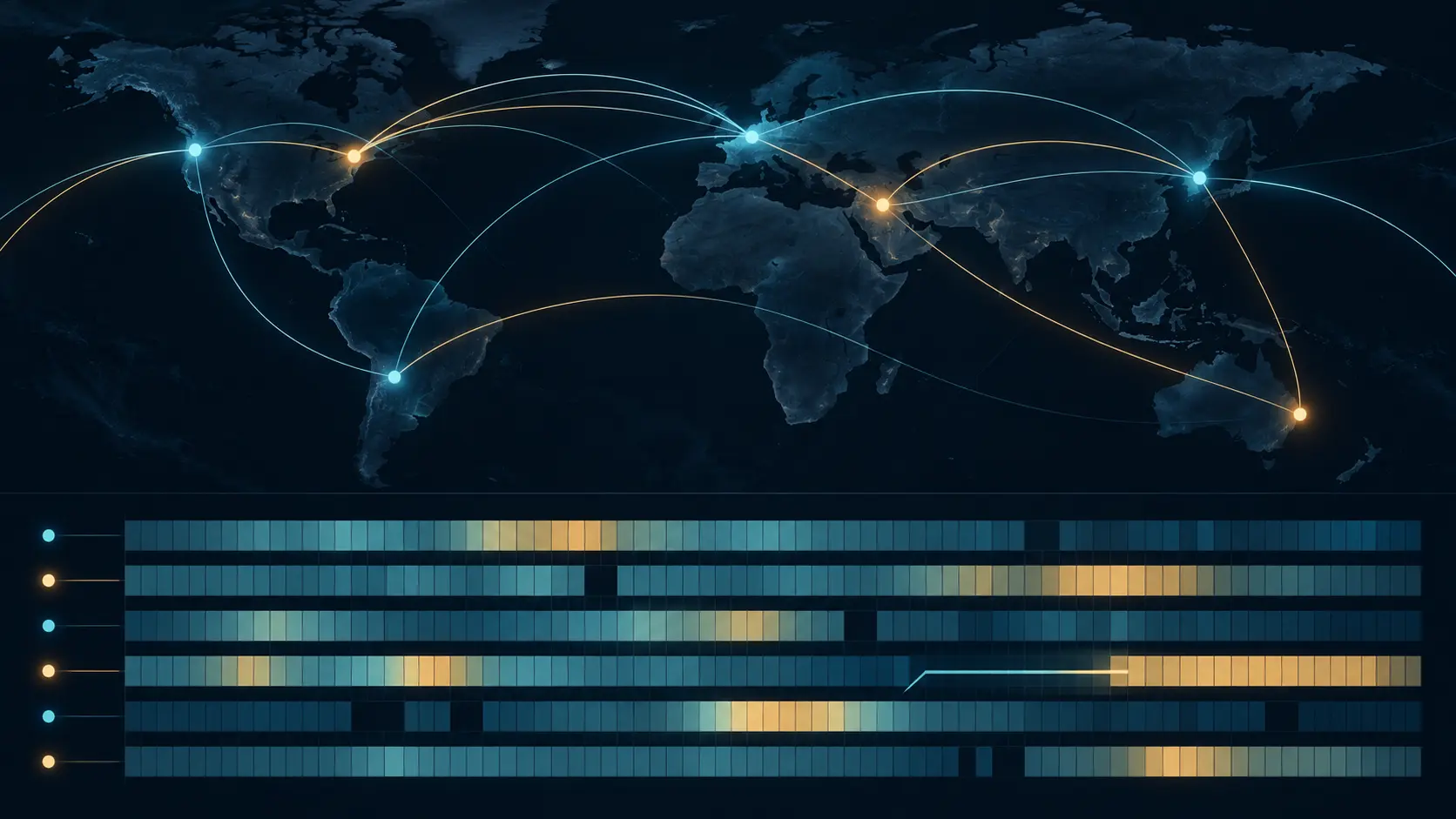
RIPE Atlas puts anchor corridors on a heatmap. The baseline stays inside the window.
When a network path slows, an average rarely tells an operator when the change began or which measured corridors shifted. RIPE Atlas’s new view makes that existing evidence easier to trace—but the baseline still comes from the selected time window.

IETF
IETF’s Mail Migration Went Live. Its Edge Cases Became the Real Test
The IETF says most of its work happens on more than 500 mailing lists. After a mail migration, the practical test is whether a confirmed entity’s message still reaches colleagues: a held post or disabled address can narrow the route into standards discussion even while the…

CASE FILE
Mayotte’s Fibre Pause Tests the Economics of Public Coverage
A temporary order over five municipalities is also a test of the financing logic behind a territory-wide network: can a public concession still reach lower-density places if a parallel build changes where the expected wholesale revenue sits?

Story
AFRINIC’s IXP Reserve Needs a Ledger Before It Needs a Bigger Block
AFRINIC’s own policy record raises a practical question about the IPv4 held for Internet exchange points: can the community see which parts are used, which remain contiguous, and who is waiting? Until that picture is public, a debate over whether a `/16` should become a `/15` is…
Session Map
Governance Branch
RIR Watchdog
Five regional sessions tracking allocation policy, board legitimacy, and institutional continuity.
Open RIR WatchdogCase File
Long-cycle governance dossiers with legal, election, and institutional stress analysis.
Open Case FileNumber Resource Society
Membership, charter, and resource-governance intelligence from the NRS ecosystem.
Open NRS SessionICANN
DNS coordination, accountability frameworks, and global multi-stakeholder process dynamics.
Open ICANN SessionIETF
Protocol standardization trajectory and interoperability risk under fragmented policy conditions.
Open IETF SessionHistory of Internet
Long-cycle infrastructure history used for governance interpretation and structural forecasting.
Open History SessionNOGs
Operator-level implementation intelligence from APRICOT plus regional and national NOG ecosystems.
Open NOGs Session