
Summary
- CERIST’s October 1994 account described roughly 500 accepted email-service requests but said only 10% of users could use the service, largely because institutions lacked equipment.
- Subsequent letters follow a stalled international capacity request and the building of regional nodes. They show the work between opening a gateway and making it useful to researchers.
Aouaouche El-Maouhab had good news to send from Algeria in October 1994. Two local networks at CERIST were connected to the Internet. A government-funded leased line ran from Algiers to CNUCE in Pisa. Its reliability had improved since September. Universities and research institutes had been invited to use the connection, and about 500 requests for the offered email service had been satisfied.
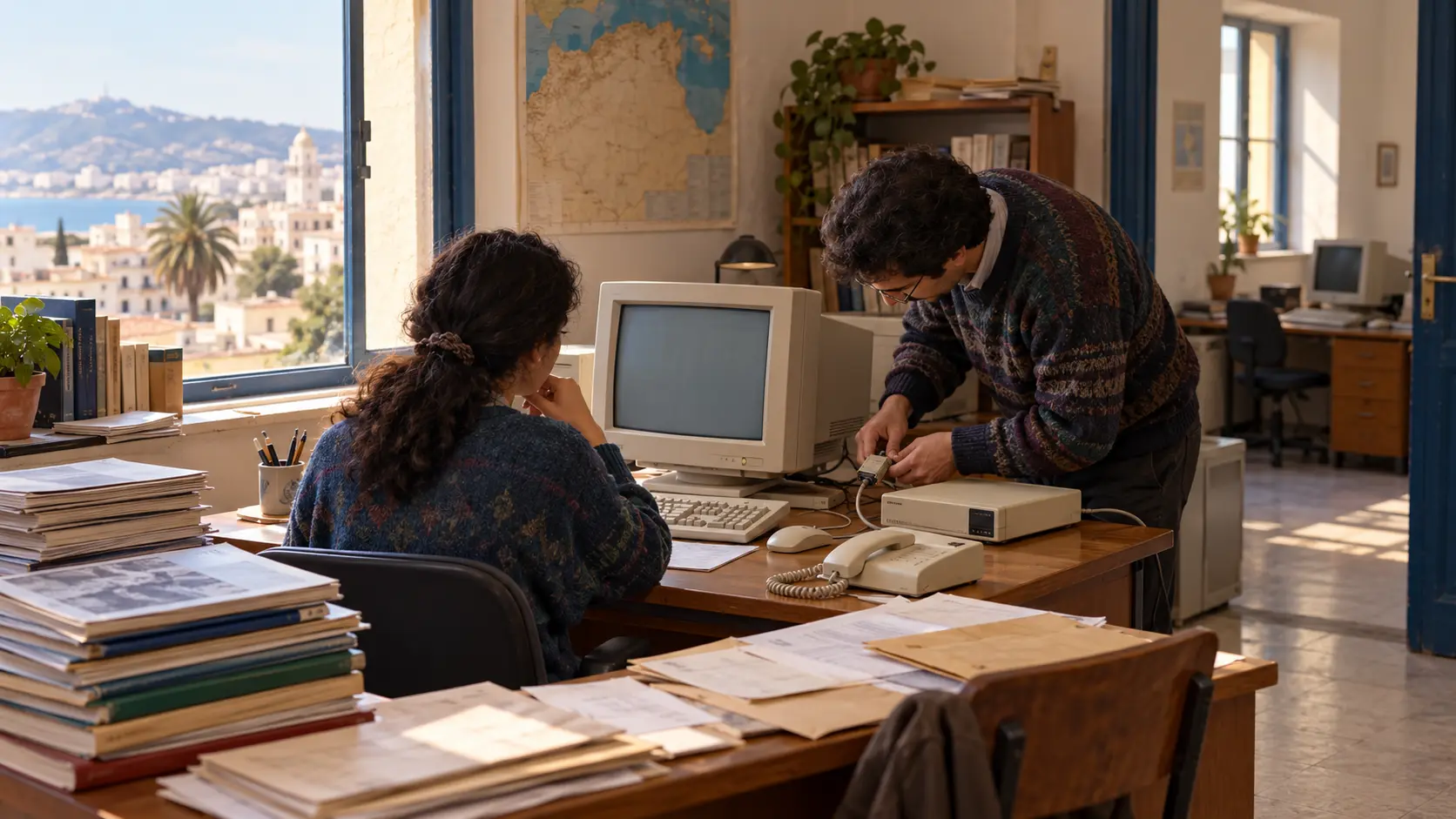
Then her update of 24 October delivered the more revealing number: only 10% of users could really use it. Many institutions had no modem; some also lacked a telephone line or a personal computer. A modem was the device that let a computer communicate over a telephone line. Without that small bridge, an account at CERIST could remain a name in a directory rather than a working means of correspondence.
The figure belongs to the service cohort El-Maouhab described. It is neither a survey of Algerian households nor a national Internet-use rate. Its importance is more intimate. The centre could grant a researcher access without being able to supply everything needed in that researcher’s institution. An approval and a usable connection were separated by purchases, installation and local telephone service.
CERIST’s purpose helps explain why the gap mattered. A March 1994 statement described work on national periodical and publication catalogues, access to databases and communication for the scientific community. Researchers needed to exchange information and find one another’s work.
CERIST’s own retrospective in 2010 places computer networking in a longer history of library cooperation and the collection, processing and distribution of scientific information. Connecting the centre served a practical purpose: helping that information reach the people who needed it.
Even for equipped institutions, the initial offer was constrained. The Algiers–Pisa circuit carried 9,600 bits per second. In October, El-Maouhab explicitly linked that limited capacity to the decision to offer email only at this first stage. The centre was choosing a service it could support while the wider academic network was still being assembled. Equipment acquisition and leased lines for other sites were works in progress.
There was also no single instant when all the pieces became “the Internet.” The March statement said the international leased line had been established at the end of January, with registration still in progress. A later letter dated the connection to March 1994. Those descriptions need not be forced into one ceremonial birthday: they record a physical circuit and a subsequent connection milestone in different accounts.
By June 1995, El-Maouhab was still reporting occasional disconnections and the same international speed.
CERIST had asked the PTT for a second leased line, at 64 K, to Ebone’s Paris node. No positive answer had arrived. The PTT suggested a connection through the Algerian and French public packet networks, Dz-Pac and Transpac. She considered that option economically unsuitable. Her letter gives neither a tariff comparison nor the PTT’s reasoning, so it cannot sustain a claim about deliberate obstruction. It does show that working computers inside CERIST were insufficient to secure the next international circuit.
The December 1996 report changes the scene again. Free email had been offered in 1994; terminal dial-up Internet services followed in 1995, with about 1,500 registered users by that year’s end.
By the later report, SLIP/PPP dial-up access had also been added, allowing connected computers to use Internet protocols over the call. A node had been installed in Sétif in June 1996 and another in Oran in December. Regional dial-up arrangements were still to be finished.
These were practical steps toward reaching people beyond the original site. CERIST also offered to host institutions’ web servers until those institutions obtained direct connections. But a node’s installation did not establish that every nearby researcher could dial it. Nor do 1,500 registrations prove that the earlier equipment problem had disappeared: the records use different measures and do not follow the same users.
The letters leave the story in motion. Higher international speeds were still plans for 1997. What they preserve is already significant: Algeria’s academic Internet was being built through the patient alignment of a research mission, a long-distance circuit and ordinary office equipment. For a researcher ready to send a message, the last of those could be the decisive missing piece.
Member Briefing
Deeper Profile Context
Sign in with the right membership level to unlock the full briefing and source notes.
Only for Strategic Circle
Strategic Circle
Open to all readers. Unlock profile briefings after joining and signing in.
Join Strategic CircleOnly for Leadership Alliance
Leadership Alliance
For qualified IP-asset owners and management; sign in to unlock alliance briefings.
Join Leadership Alliance