
Policy continuity, legitimacy, and accountability signals across internet governance institutions.
Governance
Governance
Internet governance intelligence tracks institutions, policy processes, standards activity, registry operations, accountability disputes, and implementation signals that affect internet infrastructure. BTW.
RIR WatchdogCase FileNumber Resource SocietyICANNIETFHistory of InternetNOGs

RIR Watchdog, Case File, NRS, ICANN, IETF, History of Internet, and NOG sessions.
Coverage prioritizes implementation evidence and institutional behavior over declarative positions.
Latest Coverage
Latest from Governance
8,186 articles

History
A Pointer Was Not the Information: RFC 1290 Had Not Made the Route Invisible
In 1991, the problem was not a lack of material on the network. RFC 1290 described the opposite: information and file repositories so abundant that browsing could consume a lifetime. The problem was how a person crossed from abundance to something usable. The document separated…

CASE FILE
The UUID Sorted. The Event Was Not Proven: RFC 9562 and the Boundary Between Identifier Order and Evidence Time
At 14:03, a review screen puts two rows in an immaculate order. The smaller UUIDv7 belongs to `reversal-requested`; the larger one belongs to `reversal-completed`. It looks like a ready-made account of what happened. But the first identifier may have been allocated before a…

CASE FILE
DNS Received the Hint. The Parent Still Had to Decide: RFC 9859’s Delegation Boundary
RFC 9859 can make delegation maintenance faster. It cannot make a notification into a parent-side decision, or turn a received response into proof that DNSSEC or delegation state has changed.

History
Changing the Route Was Not the Same as Filtering the Packet: RFC 1104
In June 1989, RFC 1104 divided “policy routing” into mechanisms that were already easy to confuse. A network could change which reachability it disclosed, inspect a particular packet, assign scarce bandwidth or buffers, and record usage for later accounting. Each act could be…

History
A SHUT State Was Not an Off Node: RFC 1289 Kept the Existing Links
The word “shutdown” invites a clean story: an operator chooses a state, a node stops, and the work is over. RFC 1289 preserves a more demanding chronology. Its DECnet Phase IV MIB did not treat every admission restriction as an OFF node. `SHUT` allowed no new logical links, but…

IETF
Todd Herr and the DMARC Pass That Did Not Make the Message Safe
The green word `pass` can be perfectly correct and dangerously misunderstood. In DMARC it certifies a narrow relationship between domains. It does not certify the person in the display name, the proposition in the message, the attachment behind the button or the wisdom of putting…

CASE FILE
The Router Repaired the Path. It Did Not Restore the Service: RFC 9855 and TI-LFA’s Local Boundary
A router can react to a directly attached failure in milliseconds and still know nothing about whether a customer service has recovered. RFC 9855 gives Segment Routing deployments a disciplined way to precompute and activate a loop-free repair path at the Point of Local Repair.…

CASE FILE
WCAG-EM’s 10% Random Check Is Not 10% of the Product
An accessibility report can contain a precise percentage and still leave its denominator invisible. W3C’s new WCAG Evaluation Methodology says the random part of a representative sample should equal 10% of the structured part. It does not say that evaluators inspect 10% of the…

CASE FILE
The Collector Received a Delay. It Did Not Receive a Verdict: RFC 9951
At 09:17, a collector receives a Flow Record with a mean delay, a maximum delay and an identifier for the transit point that exported them. By 09:20, someone wants the record to settle three larger questions: whether a customer suffered, whether a path changed, and which team…
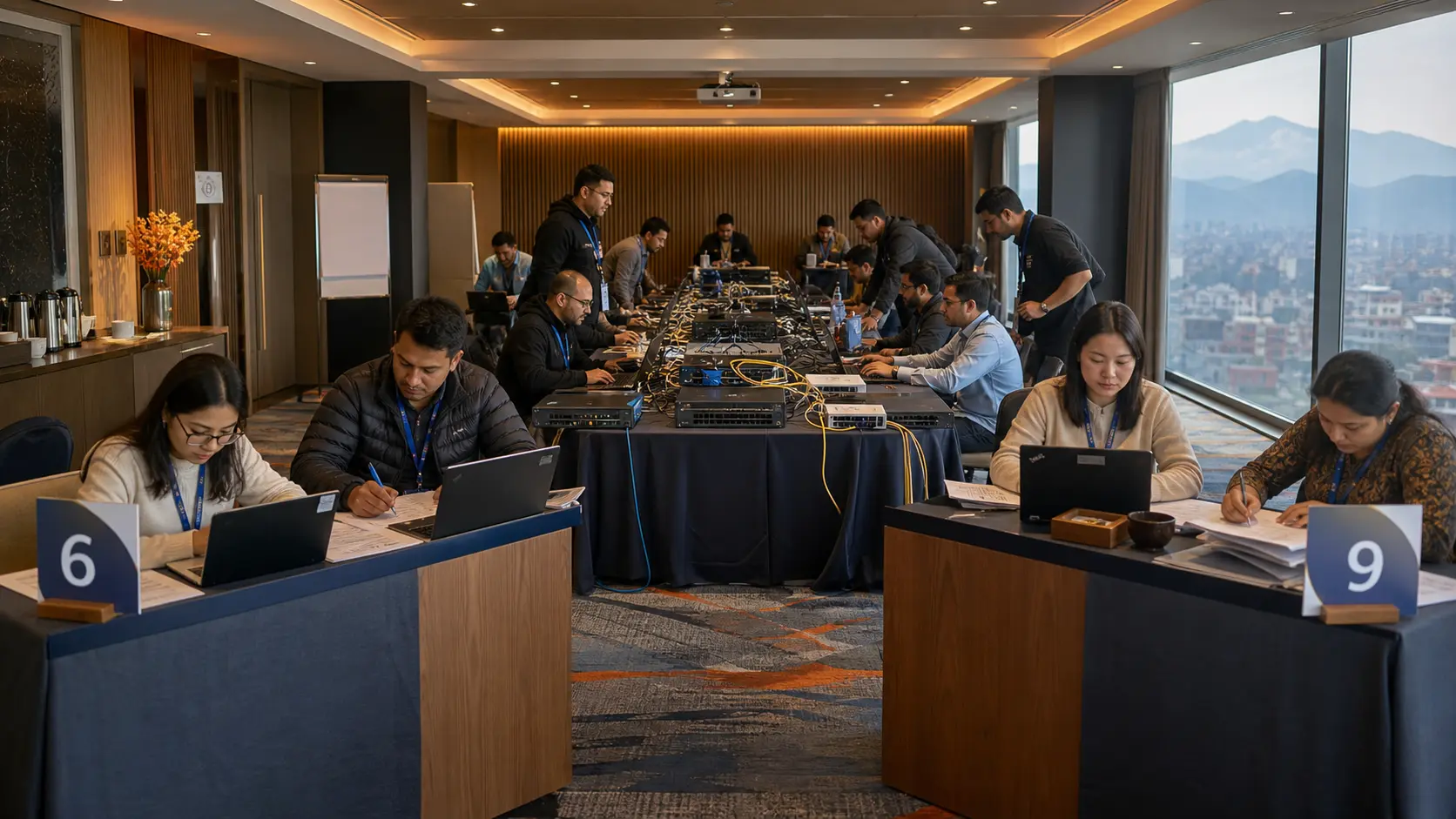
NPNOG
One Week, Two Institutions—and Two Edition Numbers: Untangling npNOG and SANOG-38
In July 2022, operators arriving at the Kathmandu Marriott encountered one technical week: four workshop days followed by a conference. The surviving institutional record is less unified. npNOG calls the event NPNOG-6 with SANOG-38. SANOG's contemporaneous pages called the same…

History
The Architecture Retreat Named Five Problems. It Did Not Pick the Next Internet: RFC 1287
In 1991, a group of Internet architects looked at growth, address exhaustion, multiple protocol suites, security, real-time traffic and the next generation of applications. RFC 1287 is the record they left behind. It is tempting to read such a record backwards: it discusses…

History
The Memo Called It a Standard. The Record Did Not: RFC 1097
On 1 April 1989, a three-page RFC proposed a Telnet option for flashing messages too quickly for a user to notice. Its joke is easy to recognize. Its more durable lesson is quieter: the memo could call itself a standard, but it could not confer that standing on itself; a Telnet…

Story
The RIR Governance Draft Would Freeze Its Own Amendment Path During an Emergency
The newly public Version 3.4 RIR Governance Document does not merely describe how a registry crisis might be handled. It also proposes a small constitutional restraint: while the crisis machinery is active, the machinery's own rules cannot be amended.

CASE FILE
The Resource Named Its Authorization Server. It Did Not Grant a Right: RFC 9728’s Discovery Boundary
A resource can accurately publish where a client should look next and still have made no decision to let that client do anything. RFC 9728 gives protected resources a disciplined way to publish OAuth metadata. Its value is coordination: it narrows a discovery problem. It is not…

CASE FILE
The Authorization Conversation Was Still Pending. It Was Not an API Right: GNAP’s Continuation Boundary
A client can be entitled to continue an authorization conversation without being entitled to call the API it asked about. RFC 9635 makes the distinction unusually explicit: a continuation credential advances one grant request at the authorization server; a resource right appears…

CASE FILE
Internet Society Added ‘Obedience’ to Its Policy Opening. The Duty Runs to Mission, Not Management
One word can make a governance document look more authoritarian just as the underlying rule becomes easier to read. Internet Society’s Board added the duty of obedience to the opening paragraph of its Trustee fiduciary policy in July 2026. Yet the Board’s own resolution says the…

Story
AFRINIC Says Douala-IX Strengthens Local Exchange. Its Public Snapshot Does Not Yet Measure It.
AFRINIC’s March community bulletin frames its support for Douala-IX as a way to strengthen local interconnection in Cameroon. The public evidence now available is useful, but it is an inventory of exchange attributes—not a measurement of the claimed operational result.

IETF
Adrian Farrel and the Implementation Receipt That Disappeared Before Publication
One of the most useful sections in an Internet-Draft is written with an expiry condition. It can name the code, version, coverage, licence, test contact and interoperability evidence that made a proposal real. Then, if the proposal becomes an RFC, the section is supposed to…

Story
AFRINIC Named Its Next CEO. He Takes Office on 1 January
The appointment is public. The decision date is not. And the authority of the office does not follow from the title “CEO Designate” before the announced start date.

History
A Bridge Port Was Not Necessarily an Interface. Its Counters Did Not Describe the Whole Line: RFC 1286
A network operator can be handed three reassuringly familiar facts: a port number, an interface index and a counter. RFC 1286, the 1991 Bridge MIB, is valuable because it refused to let those facts collapse into one picture. A bridge port could correspond to an interface without…
Session Map
Governance Branch
RIR Watchdog
Five regional sessions tracking allocation policy, board legitimacy, and institutional continuity.
Open RIR WatchdogCase File
Long-cycle governance dossiers with legal, election, and institutional stress analysis.
Open Case FileNumber Resource Society
Membership, charter, and resource-governance intelligence from the NRS ecosystem.
Open NRS SessionICANN
DNS coordination, accountability frameworks, and global multi-stakeholder process dynamics.
Open ICANN SessionIETF
Protocol standardization trajectory and interoperability risk under fragmented policy conditions.
Open IETF SessionHistory of Internet
Long-cycle infrastructure history used for governance interpretation and structural forecasting.
Open History SessionNOGs
Operator-level implementation intelligence from APRICOT plus regional and national NOG ecosystems.
Open NOGs Session