
LACNIC · RIR Watchdog
Story
BTW reporting and context linked to this RIR. For the proposal-by-proposal history, the people involved and their changing positions, start with Policy.
Story
Latest stories
283Stories

Story
LACNIC WHOIS nslastaa Records the Last Successful Check, Not Current DNS Health
A date in a registry response can look like a present-tense assurance. LACNIC gives `nslastaa` a narrower meaning: it is the last date on which a correct reverse-DNS configuration was observed on a listed server. That historical success is useful evidence, but it is not a promise…

Story
LACNIC’s IRR turns route filters into a derived registry view
A route filter can look like a policy decision even when several of its inputs were generated from other registry systems. LACNIC’s Internet Routing Registry makes that provenance part of the operating question.

Story
LACNIC Geofeeds makes IP location a maintained claim, not a registry fact
An address holder’s legal domicile is not necessarily where its packets meet users. LACNIC Geofeeds creates a public path for member administrators to state where address blocks are actually used—and makes maintenance part of the claim.

Story
LACNIC’s RDAP shift turns registry data into an automation contract
Registry data stops being merely a lookup result when production systems depend on it. LACNIC’s account of RDAP shows why the transition from port 43 WHOIS is an operational redesign, not a cosmetic protocol swap.

Story
The root KSK rollover makes resolver readiness the real continuity test
A DNS service can be healthy while users behind a stale validating resolver see failure. That is the operational paradox of a root key-signing-key rollover: the cryptography changes centrally, but continuity is decided across distributed resolver fleets.
Story
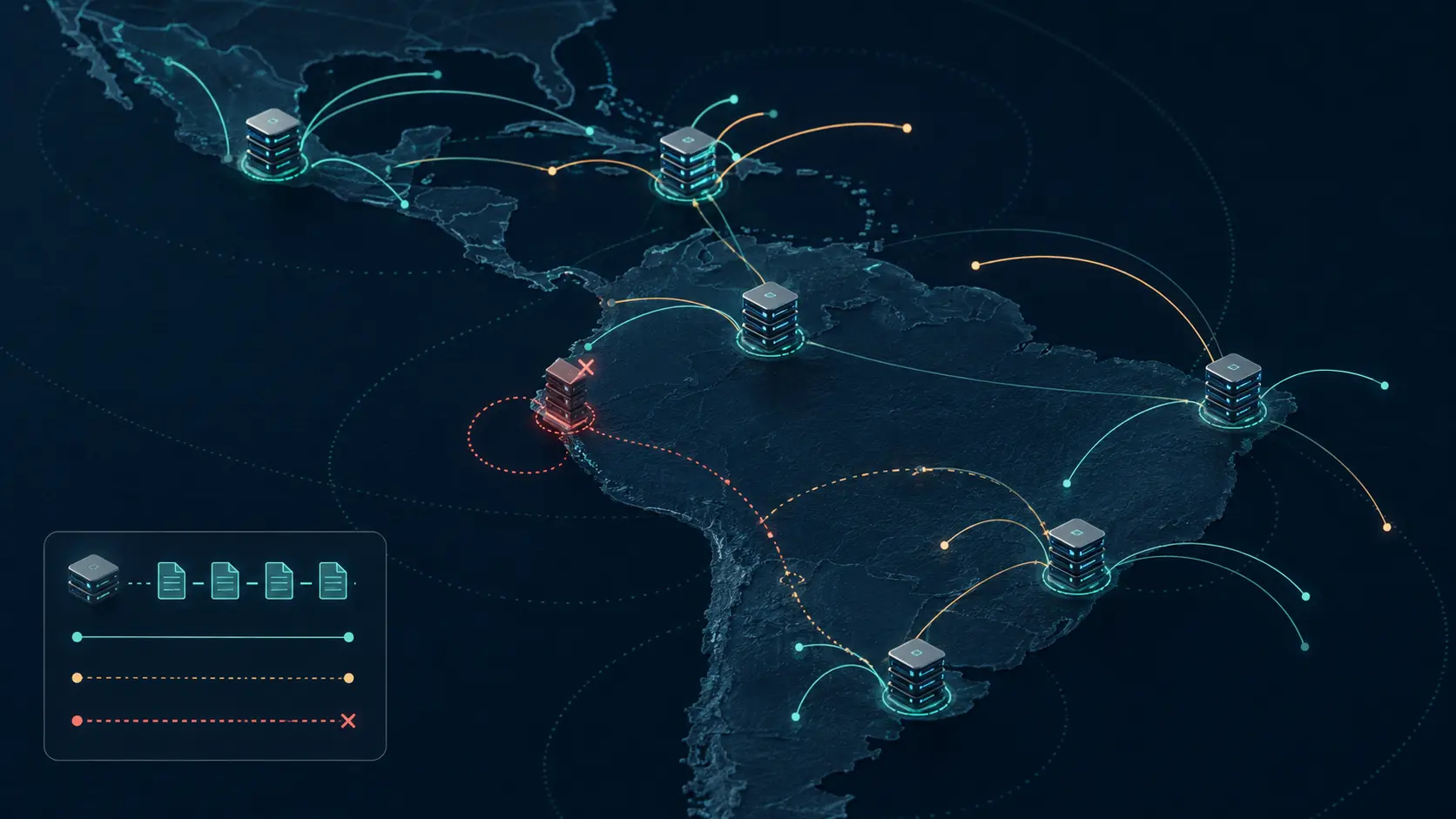
LACNIC’s reverse-DNS anycast turns registry continuity into a distributed control
Reverse DNS is easy to overlook until it stops answering. LACNIC’s use of anycast for delegated reverse zones shows why registry continuity is not a single-server property, but an operating discipline built from placement, routing, synchronization and observation.

Story
LACNIC’s measurement commons turns regional latency into operating evidence
A latency chart is not a verdict on a country’s Internet. It becomes useful when operators can see the probes, time window and comparison behind it—and when the result leads to a question that can be tested again.

Story
LACNIC’s RPKI controls make route origin authority operable
LACNIC’s RPKI controls make route origin authority operable intelligence summary explains the development, the public evidence available to readers, the organisations involved, the regional context, market exposure, and the infrastructure consequences that may follow. The Story…

Story
LACNIC’s IPv6 allocation rules make scale plannable
**BTW analysis:** IPv6 offers a vast address space, but abundance alone does not tell a network operator what it may request, how need will be assessed, or what obligations follow an allocation. In Latin America and the Caribbean, those practical questions meet LACNIC’s published…

Story
LACNIC’s 2025 Path Study Does Not Date Its Measurements
A year in a report title tells readers when an edition belongs on the shelf. It does not tell a network operator when the packets behind its charts crossed the wire. LACNIC’s regional path study offers a useful view of routes and latency, but leaves that second clock unstated.

Story
LACNIC 46's Machine Records Still Say LACNIC 39 and LACNIC 45
The closing entry in LACNIC 46's current agenda belongs to the right event when read through its canonical taxonomy and presentation title. Three other fields still name LACNIC 45. A separate homepage field goes further back, to LACNIC 39. This is a small data-integrity problem…

Story
LACNIC’s RDAP Name Is a Registration Label, Not a Legal or Routing Identity
A field called `name` invites more confidence than it deserves. In LACNIC’s live RDAP record for `200.0.0.0/21`, the value is simply the address interval written as a label. It identifies a registration record; it does not settle who legally owns the addresses or who operates the…

Story
LACNIC’s RDAP Self Link Locates the Record, Not the Network’s Serving Infrastructure
A URL inside a registry response can look like an infrastructure clue. In LACNIC’s RDAP output, however, `rel: self` tells a client where to retrieve the registration entity; it does not say where the registered network’s traffic, applications or authoritative services run.

Story
LACNIC’s RDAP Conformance List Identifies Response Specifications, Not Network Authority
An RDAP response can look like a compact certificate of power: it carries a registry name, a range, a handle, a hierarchy link and a row of terse technical tokens. But the tokens in `rdapConformance` answer a narrower question. They describe the specifications used to build the…

Story
LACNIC’s IPv4 transfer market and the price of scarcity
IPv4 exhaustion does not end allocation politics. It changes the place where they happen: from the distribution of a free pool to the rules governing transfers of resources that are already held.

Story
One Prefix, Two Countries in LACNIC’s Geofeed
A public location feed repeats 23 prefixes, four with conflicting country codes. The useful repair is narrower than deciding where the networks are: stop a loading rule from masquerading as geographic evidence.

Story
LACNIC’s Voice Primer and the Bandwidth Beyond the Codec
An 8 kbit/s voice encoder can send a 24 kbit/s stream before Ethernet, security and control traffic enter the calculation. LACNIC’s latest telephone explainer points to a distinction that matters when operators turn compression into a capacity budget.

Story
The Refill Behind LACNIC’s Falling ASN Forecast
The Refill Behind LACNIC’s Falling ASN Forecast intelligence summary explains the development, the public evidence available to readers, the organisations involved, the regional context, market exposure, and the infrastructure consequences that may follow. The Story intelligence…

Story
LACNIC’s fee schedule and the price of a durable registry
*By Nia Okafor*

Story
LACNIC Ratified the Sub-Assignment Rule. An Operating Log Still Needs Its Own Receipt.
LACNIC records LAC-2025-5 as ratified on 24 March 2026. Its final text calls for a WHOIS link and a public start-and-end movement log for qualifying IPv4 sub-assignments. Those are consequential commitments, but a ratification history is not itself a record of an individual…