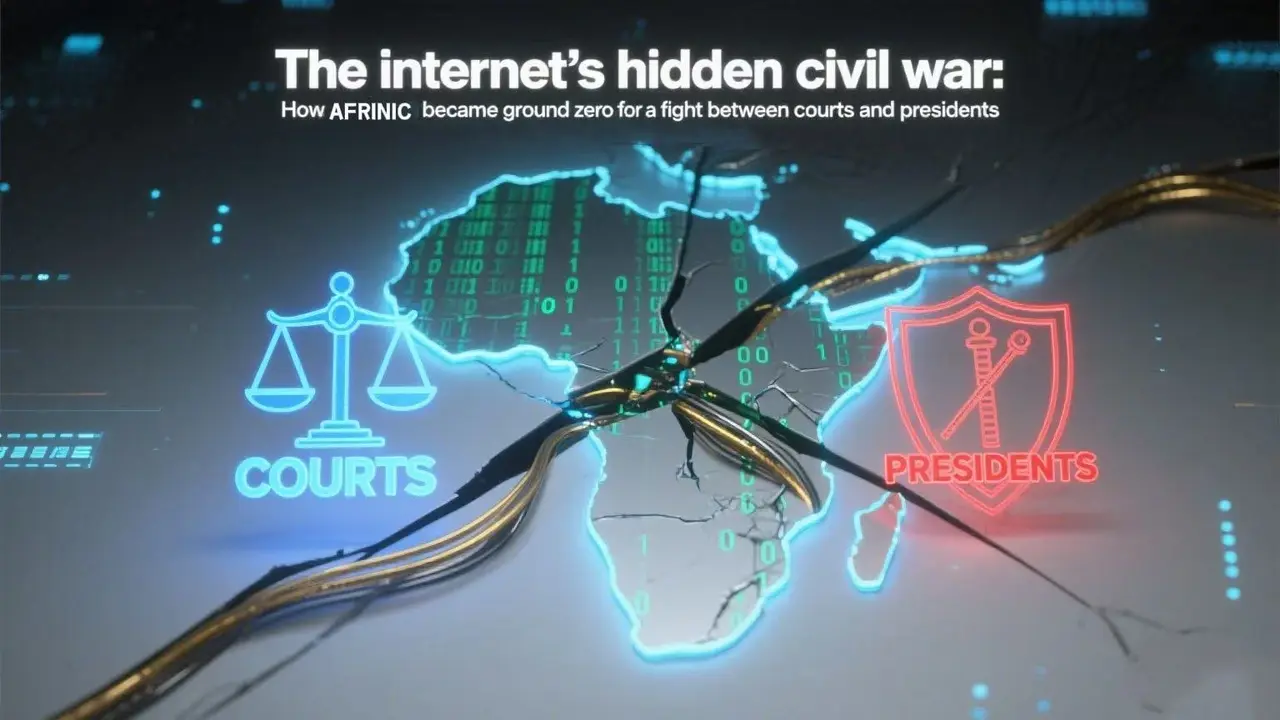
- AFRINIC’s receiver governs without an elected board, and the election the Supreme Court ordered on Cloud Innovation’s motion has still not been held
- Cloud Innovation challenges foreign-backed registry control, calling for constitutional order and compliance
AFRINIC paralysed under its receiver
AFRINIC, the African Network Information Centre, remains leaderless, boardless, and legally paralysed. Since AFRINIC’s receiver annulled the June 2025 election on 26 June 2025, citing a proxy dispute, no new board has been seated. Its August vote is likely to be delayed, despite court orders mandating a return to democratic governance.
On 7 August 2025, on Cloud Innovation’s urgent application, the Judge in Chambers of the Mauritian Supreme Court restrained an inspector from carrying out an inspection of AFRINIC under a mandate issued under a Proclamation (the order of 7 August 2025). Earlier, on 25 November 2024, on Cloud Innovation’s motion, the Supreme Court had ordered AFRINIC to hold its election by the end of June 2025 and recorded the receiver’s undertakings (the court record).
Yet AFRINIC’s interim receiver remains in power. Backed by foreign actors such as ICANN, the receiver continues to govern the registry without electoral legitimacy. The election the Supreme Court directed under AFRINIC’s constitution has still not been held, setting the stage for a legal confrontation between national institutions and external influence.
Also read: Cloud Innovation calls for AFRINIC wind-up after ‘impossible’ election standards
Also read: EXPOSED: The letter that reveals who was really benefitting from AFRINIC’s lawsuits
When CEOs defy courts, governance becomes geopolitics
At the heart of this institutional disobedience stands Kurt Lindqvist, CEO of ICANN. Despite clear judicial guidance, Lindqvist has continued to recognise AFRINIC’s unelected management. His actions—widely viewed as siding against judicial oversight—have escalated concerns that ICANN is enabling authoritarian-style control over Africa’s internet infrastructure.
On 24 December 2024, under Lindqvist’s leadership, ICANN ratified a new ICP-2 compliance framework. This document, adopted without community consultation, introduced a mechanism enabling ICANN to unilaterally derecognise regional internet registries. Though framed as administrative, its implications grant the ICANN executive arm disproportionate influence over global RIR legitimacy.
While Lindqvist defends the move as necessary to maintain operational continuity, critics argue that support for AFRINIC’s receiver—despite court rulings—amounts to interference in a sovereign constitutional process. Legal observers warn this undermines judicial supremacy and sets a precedent where foreign executives override national courts.
One of the strongest institutional voices pressing for compliance with the court’s rulings has been Cloud Innovation Ltd. (CI), AFRINIC’s third-largest resource member. CI has filed legal petitions demanding that AFRINIC return to lawful elections and that ICANN respect national judicial rulings. It has characterised the current governance structure as “untenable” and warned that ongoing foreign interference risks delegitimising the entire RIR system.
CI has also publicly called for ICANN and the Number Resource Organization (NRO) to immediately appoint an existing RIR to take over AFRINIC’s functions under the terms of ICP-2—not to create a new registry, but to ensure continuity where governance has failed.
A civil war in law, with global implications
What is unfolding in Mauritius is more than administrative failure. It is a conflict over legal authority—between a judiciary grounded in legal tradition, and those who control AFRINIC, leaning on foreign support to get around court orders.
Observers increasingly warn that if a foreign executive such as Lindqvist can ignore constitutional rulings with impunity, the very premise of regional self-governance collapses. In this model, international infrastructure governance becomes beholden to power, not process.
AFRINIC’s crisis now serves as a cautionary tale. It illustrates how internet governance, once built on ideals of openness and community, can be quietly overtaken by unelected control and geopolitical alignment. For African stakeholders and global observers alike, the outcome of this confrontation will shape not just the future of one registry—but the credibility of global internet governance itself.
Correction, 14 November 2026: this version names AFRINIC’s receiver as the one who annulled the June 2025 election, on 26 June 2025, and removes characterisations of the Government of Mauritius. This version also rewrites the headline, summary, opening point and a section heading that had cast Mauritius’s courts and executive as adversaries, and reports the order of 7 August 2025 as the court record shows it. The original URL and publication date are retained.