Summary
- After the United States announced an end to intentional degradation of public GPS signals, Dave Ulmer posted a May 2000 invitation to find a black plastic bucket and exchange items.
- The original discussion soon turned to map references, a proposed 80-character description and container units. Publishing numbers was easy; giving strangers the same understanding took conversation.
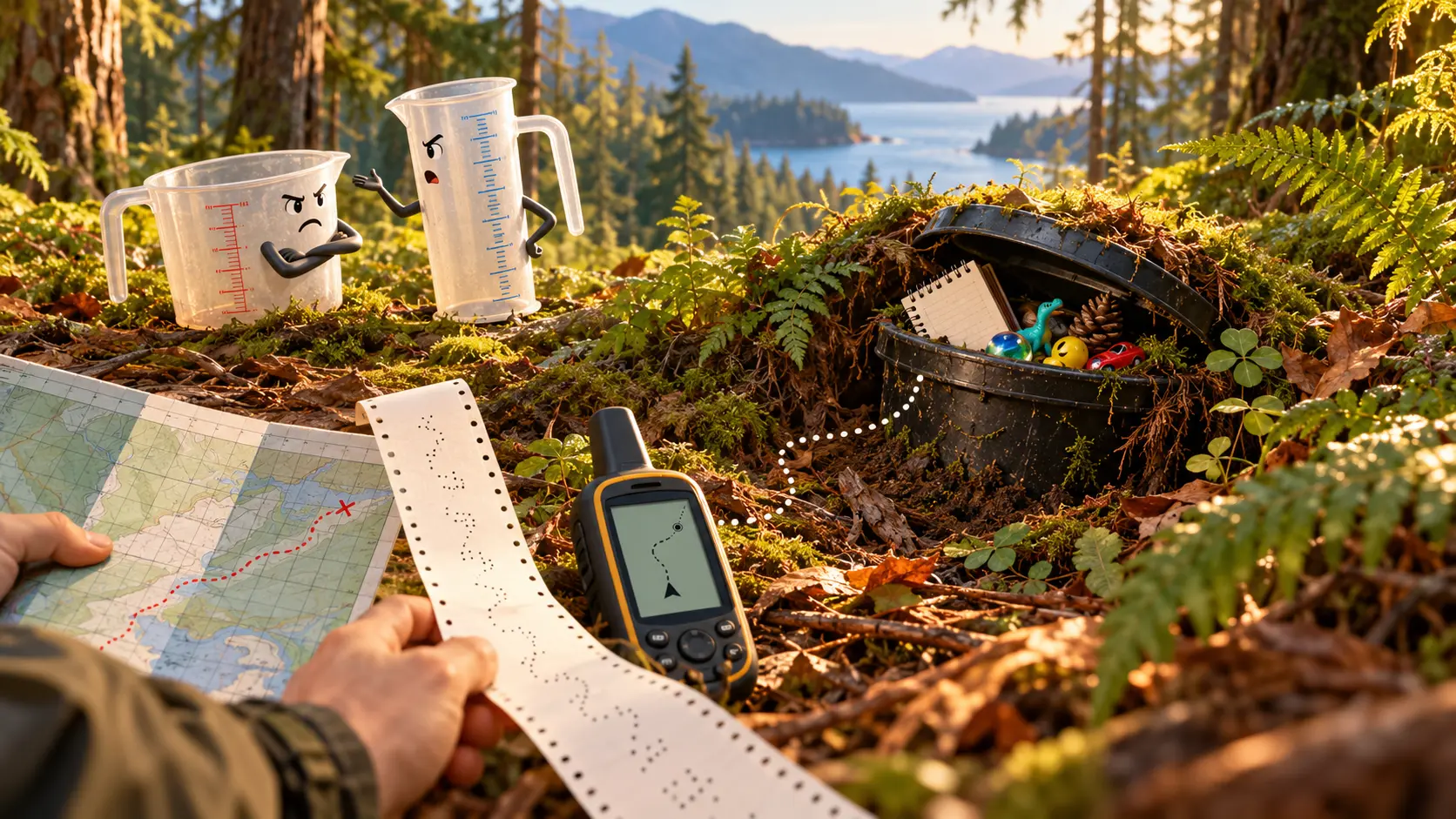
By 8 May 2000, the people discussing a new GPS treasure hunt had reached a question satellites were poorly equipped to settle: which gallon?
One participant wanted a container's volume in the listing. Another observed that an American reader already knew what a five-gallon bucket looked like. The conversation promptly acquired British gallons and American measures. The treasure hunt had gone international before the bucket had finished explaining itself.
A signal, a bucket, an invitation
A week earlier, the White House had announced that intentional degradation of civilian GPS signals would end at midnight following its 1 May statement. It predicted that civilian users could locate themselves up to ten times more accurately. An important setting in a government-operated system was changing; people with receivers could try new things with the result.
On 3 May, Dave Ulmer posted a stash-hunt invitation to the Usenet group sci.geo.satellite-nav. The original description, restored in the official Geocaching cache record, offered coordinates and a black plastic bucket mostly buried in the ground. Visitors could take items, leave others and record the exchange in a logbook. The contents ran from software and books to a slingshot. The Internet had acquired a very modest branch office in the woods.
The receiver supplied a way to approach the place. The post supplied a reason to go there and a rule for what to do on arrival. Those were different jobs, performed by different parts of the arrangement.
Eighty characters, several assumptions
The next day's discussion shows how quickly the practical questions arrived. A reader asked which map datum the coordinates used and suggested UTM, a grid-based way of expressing position. Dave replied that he was considering a one-line, 80-character description that would be easy to sort and manage. What should fit in it?
First, the numbers needed a common geographical reference. A datum defines the reference used to relate coordinates to the Earth; a display format determines how the position is written. In the thread, Richard Cochran explained that choosing a datum and choosing UTM or latitude and longitude were separate decisions. The same datum could be used with either presentation. Another reply acknowledged having run the two questions together.
This was useful housekeeping. A neatly formatted pair of numbers can still carry an unstated assumption about where it points. More decimal places will not explain that assumption to the person holding the other receiver.
On 8 May, a participant proposed fields for coordinates, hemisphere letters, container volume and units, followed by a comment. Leading zeroes would help with sorting. Litres would spare the listing a further question about which gallon was intended. These were suggestions for a compact record, offered in an open conversation about making the hunt easier to repeat.
The volume field also had a wonderfully physical purpose: help visitors judge the size of an object they could leave. A location on a screen was becoming a destination with a lid, limited space and other people's belongings.
The record did the travelling
The black bucket stayed put while its description circulated. Someone elsewhere could read the invitation, interpret the coordinates and decide to make the trip. That small division of labour connected an online discussion to an activity outdoors.
The surviving exchange catches participants doing the unglamorous work that makes an appealing idea usable. A signal improved. A person hid a container. Other people started asking what the numbers meant and how much the container held. Even a treasure hunt needs a few shared instructions before everybody can get pleasantly lost.
Sources
Member Briefing
Deeper Profile Context
Sign in with the right membership level to unlock the full briefing and source notes.
Only for Strategic Circle
Strategic Circle
Open to all readers. Unlock profile briefings after joining and signing in.
Join Strategic CircleOnly for Leadership Alliance
Leadership Alliance
For qualified IP-asset owners and management; sign in to unlock alliance briefings.
Join Leadership Alliance