Summary
- FreeBMD introduced reader notes in February 2006, while keeping its transcription faithful to the historical index.
- In April 2007 it added administrative System Entries for errors that defeated searches, linking the added information to the actual index entry.
A note explaining a wrong surname looks like a splendid remedy. It has one awkward requirement: somebody must find the wrong surname first.
FreeBMD ran into that problem while turning the General Register Office index for England and Wales into a searchable resource. Its rule for volunteers was to copy what the index said. An accurately copied mistake could therefore arrive on the web in excellent condition.
The project's operational diary records a succession of attempts to give readers more than a transcription. On 11 May 2005, it reported that search results had been linked to scan images, followed by a large increase in corrections. Readers could look at the source and challenge the typing.
On 12 February 2006 came Postems: short notes attached to entries, with their content determined by the person leaving them. The launch description said they would be seen by people who searched for and found the entry concerned. A reader could bring knowledge to the page without taking over the index.
The wrong name was guarding the entrance
That arrangement had a limit. By April 2007, the project explained that volunteers could record a theory and searchers could leave a Postem, but neither helped enough when an index error meant the entry would not normally be found.
Its example was unusually clear. Several marriage entries for June 1882 belonged under Lucas but appeared as Luby, because the surname change had not been correctly recorded in the index. A faithful copy preserved the problem. A helpful note beside the copy still depended on somebody reaching it.
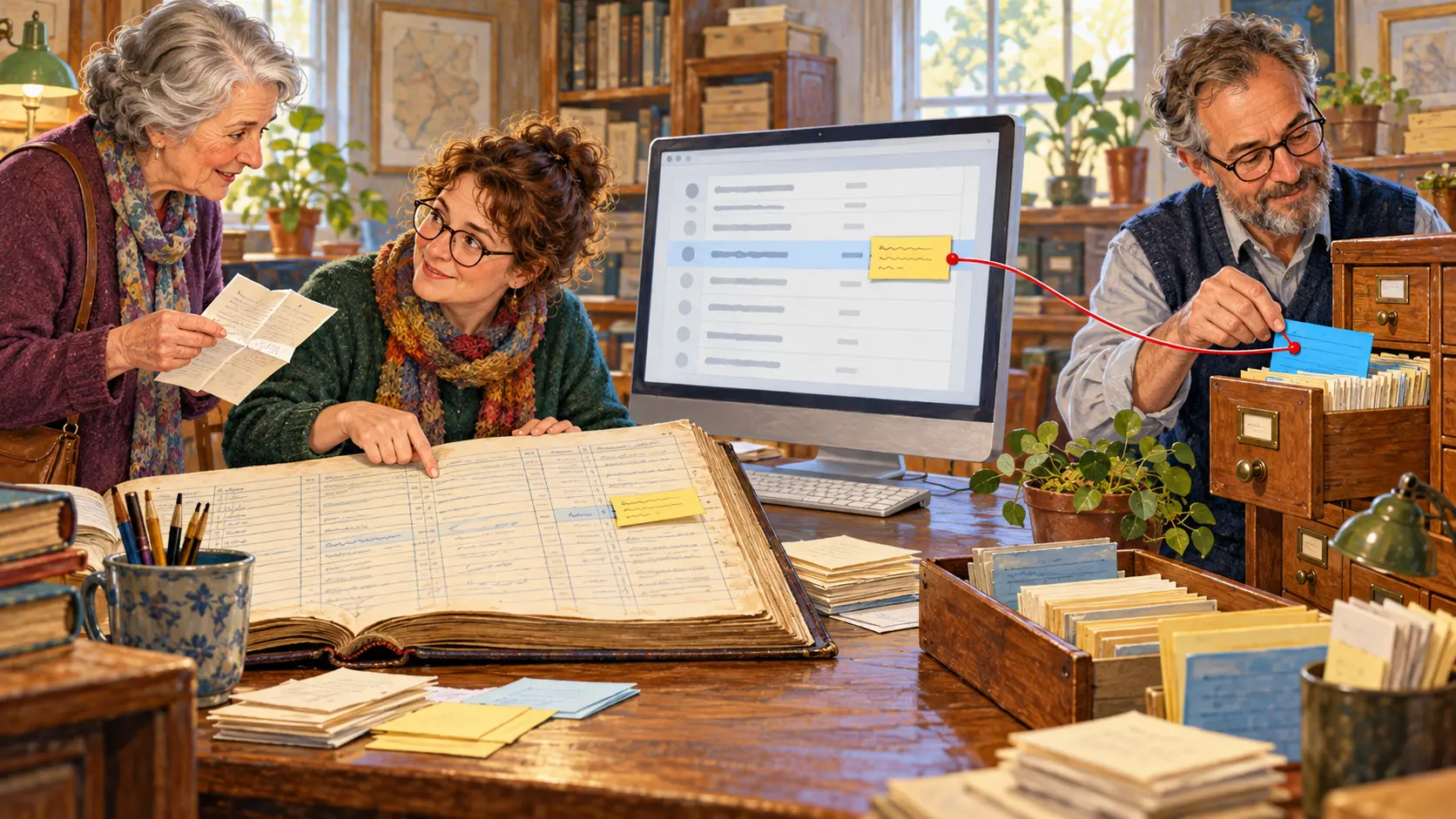
On 1 April 2007, FreeBMD announced System Entries. Administrators could add what the project believed should have appeared in the index and link it to the actual entry. This gave the misplaced name another route into the search results while keeping the reader connected to the old evidence.
The distinction had practical consequences. A volunteer supplied the transcription. A reader supplied a note. The administration could add a discoverable entry. Those were three different kinds of influence over what another researcher would see.
Family knowledge had somewhere to sit
By 18 August 2007, FreeBMD reported a typical 40–50 Postems a day. Around 15% were correction notes left after a correction had not been accepted. That figure describes the notes being posted; it tells us which part of the commentary was taking on work the correction channel had declined.
The surviving Postem help page describes the space as communication between researchers. It gives examples such as extra details from a certificate, a spouse's name and a correction to the original index. Project staff do not monitor it as a support inbox. The official FAQ explains the other side of the arrangement: the searchable transcription follows the index, with comments, reader notes and clearly marked administrative additions handling other information.
FreeBMD had acquired several ways to say that something needed attention. Each reached a different audience and carried different powers. The decisive 2007 addition addressed the problem a comment box could not solve by itself: making a record discoverable under the name a researcher had reason to enter.
Member Briefing
Deeper Profile Context
Sign in with the right membership level to unlock the full briefing and source notes.
Only for Strategic Circle
Strategic Circle
Open to all readers. Unlock profile briefings after joining and signing in.
Join Strategic CircleOnly for Leadership Alliance
Leadership Alliance
For qualified IP-asset owners and management; sign in to unlock alliance briefings.
Join Leadership Alliance