Summary
- Flickr's August 2005 announcement required Yahoo IDs for new users, let existing users keep their Flickr login temporarily, and promised their screen names would survive account association. It warned that third-party API tools might need authentication updates after a merge.
- By September 2006, Flickr's main Sign In link led to Yahoo while a side route still admitted old accounts. The mobile site used Yahoo ID alone. The old email login was slated to end in March 2007; a 2019 rollout began moving members back to Flickr's own sign-in.
The photos stayed where they were
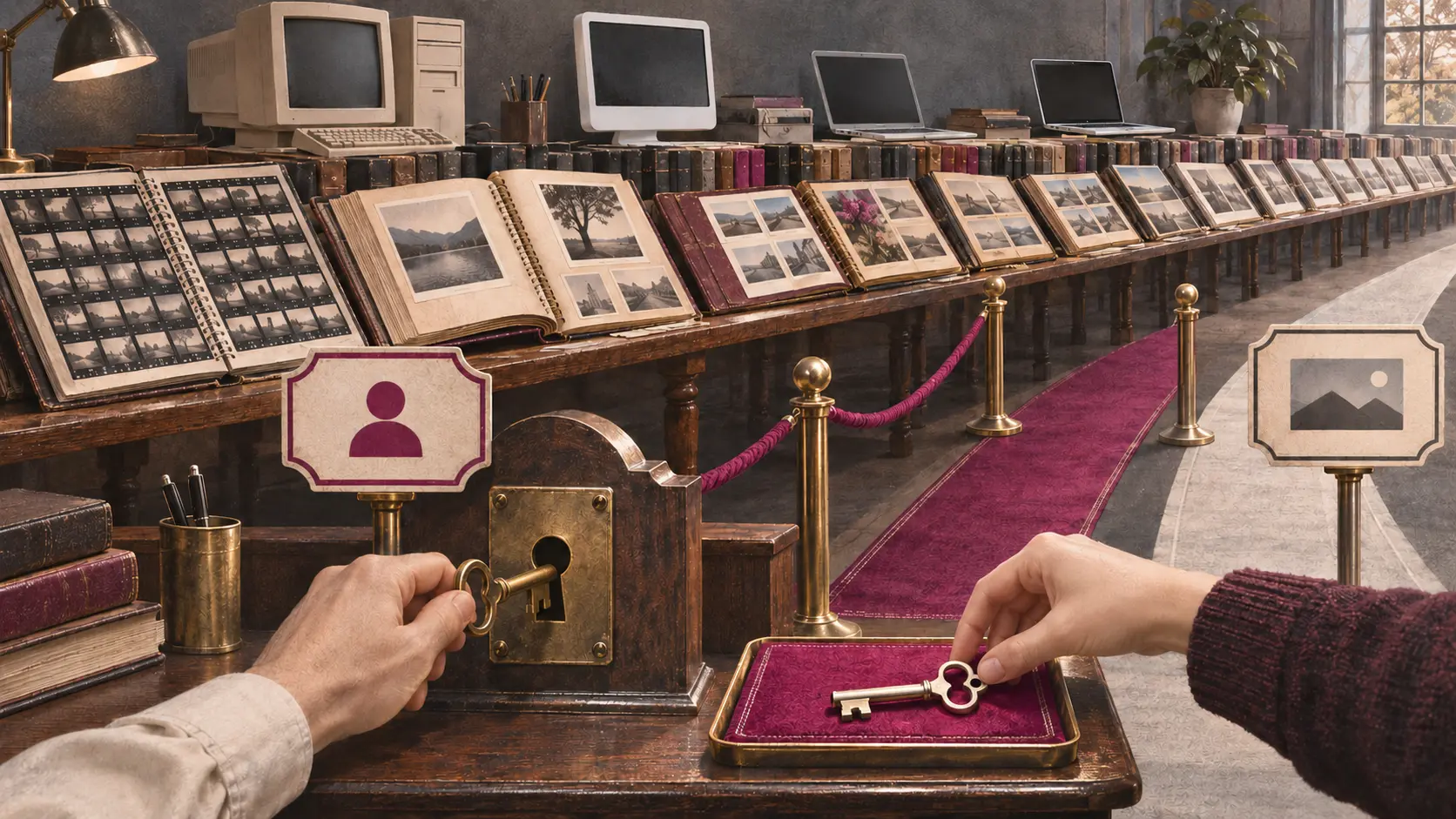
A photographer can be known by a name, a page address and a collection of pictures. None of those is necessarily the credential used to edit the account. Flickr had to explain that distinction when it began joining its sign-in system to Yahoo. In August 2005, new members had to use a Yahoo ID; existing members could still enter with their Flickr email and password or associate the accounts. The company said the visible Flickr screen name would remain. Its longer explanation nine days later also promised that photo-page addresses would stay intact. Friends could keep linking to a familiar album while its owner acquired a different means of opening the editing room.
Flickr argued that one fewer password would make entry easier. The attraction was real for someone who already used Yahoo. The transaction was less tidy for someone who had chosen a Flickr identity precisely because it was separate. The public profile could remain flickr.com/photos/youralias; the sign-in identifier, password recovery path and account association now depended on Yahoo's system. Flickr's August explanation treated the Yahoo ID as a private key to entry and the screen name as the name shown to other people. That split preserved links. It also made the account owner's route to those links a new operational dependency.
There was an immediate software cost. Flickr's first announcement warned existing users of outside applications built on the Flickr API to wait before merging: some tools might fail until their developers adopted the new authentication API. Flickr did not provide a count of affected applications in that notice. The warning still makes the mechanism plain. A photographer could log in on the website after association while an upload client or other program needed different credentials or code. The front door and the service entrance moved on different schedules.
The August follow-up offered an unmerge route for people whose associated accounts caused trouble during the transition, while saying a merge would eventually be required. The temporary escape mattered because it admitted the migration was a process, not an instantaneous switch. An old user could retain the Flickr key for now; a new user never received it. Both saw essentially the same public site. Behind it, the operator was already running two account populations.
The optional key became the only key
The next move was subtle. In September 2006, Flickr announced that clicking the main Sign In link would take a visitor straight to Yahoo's login page. An old Flickr account still worked, but the route to it became a secondary link from that page. Flickr described the old split screen as a source of confusion. The interface change also made the institution's preferred credential the default path. Keeping an exception buried one click away is a different kind of permission from presenting two doors side by side.
By November 2006, the updated mobile site offered an even clearer boundary. It accepted Yahoo ID sign-in; an old-style Flickr account could not use that mobile service until its owner merged. The user did not need to wait for the final retirement date to feel the new rule. One feature had already crossed the line. A person could keep using the old credential on the desktop site and find the mobile door locked to that same account.
In January 2007, account access and safety guidance met at the login domain. Flickr's security notice told members that Yahoo-ID sign-in belonged at login.yahoo.com, with an exception for old-style accounts. That guidance responded to fake Flickr pages trying to collect passwords. The operator had moved the real password prompt to a different hostname, then had to teach users which unfamiliar-looking door was genuine. The change shifted a trust decision to the reader's address bar.
Flickr's 30 January announcement said the old email-based sign-in would end in March 2007, after which everyone would need a Yahoo ID. Its notices disagree on the exact day: the 30 January post names 20 March but also says users could switch until “the 15th,” while the earlier security notice names 15 March for the old-account exception. The reliable conclusion is the hardening of the requirement during March. A precise universal switch-over day would need an operator record reconciling those notices.
The transition produced another practical problem: which Yahoo ID was attached to which Flickr account? On 15 March 2007, Flickr introduced a tool to move a Flickr account between two Yahoo IDs. The same notice directed people still using old-style Flickr accounts to the association process. The public photos were not the variable in that repair. The login binding was. Flickr could keep a photographer's visible name and gallery while giving them a way to change the private Yahoo identity behind it.
The borrowed key lasted longer than the sale
Years later, Flickr described what the Yahoo requirement had cost some members. In its 2018 announcement about leaving Yahoo login, the company reported confusion over which email address belonged to an account and missed notifications. It said even Flickr's chief executive had been locked out by credential confusion. That is Flickr's own account of access trouble, not an estimate of how many members were affected. The point is narrower and sharper: the owner of a public photo collection could lose the practical ability to enter the account even while its public identity remained recognizable.
The new owner, SmugMug, wanted a Flickr login again. The March 2019 rollout announcement began moving members away from Yahoo authorization gradually. It warned that members would continue using their Yahoo credentials until the update reached their account. At first, the new sign-in email had to be the Yahoo sign-in address or the account's primary Flickr contact address; the member then chose a new password. Restoring an independent login was itself a migration with a queue, an identity check and a recovery problem. The photo address was the easy part to leave alone.
Flickr's chronology makes the invisible owner of a website visible. The public page can be stable through an acquisition, a parent company's account system and another sale. The user who made that page still depends on whoever controls the authentication decision. Flickr kept the public sign on the gallery. For more than a decade, the key to its back room belonged to Yahoo. In 2019, Flickr began cutting a new key. The gallery did not have to move for the power to enter it to change twice.
Member Briefing
Deeper Profile Context
Sign in with the right membership level to unlock the full briefing and source notes.
Only for Strategic Circle
Strategic Circle
Open to all readers. Unlock profile briefings after joining and signing in.
Join Strategic CircleOnly for Leadership Alliance
Leadership Alliance
For qualified IP-asset owners and management; sign in to unlock alliance briefings.
Join Leadership Alliance