
Summary
- Fervo says Cape Station’s first GeoBlock reached commercial operation on 30 September 2026, delivered 33 MW net power and began generating revenue under a PPA.
- The report marks a change in project status, not proof of continuous generation, repeatable construction or cash flowing to Fervo after project-level financing priorities.
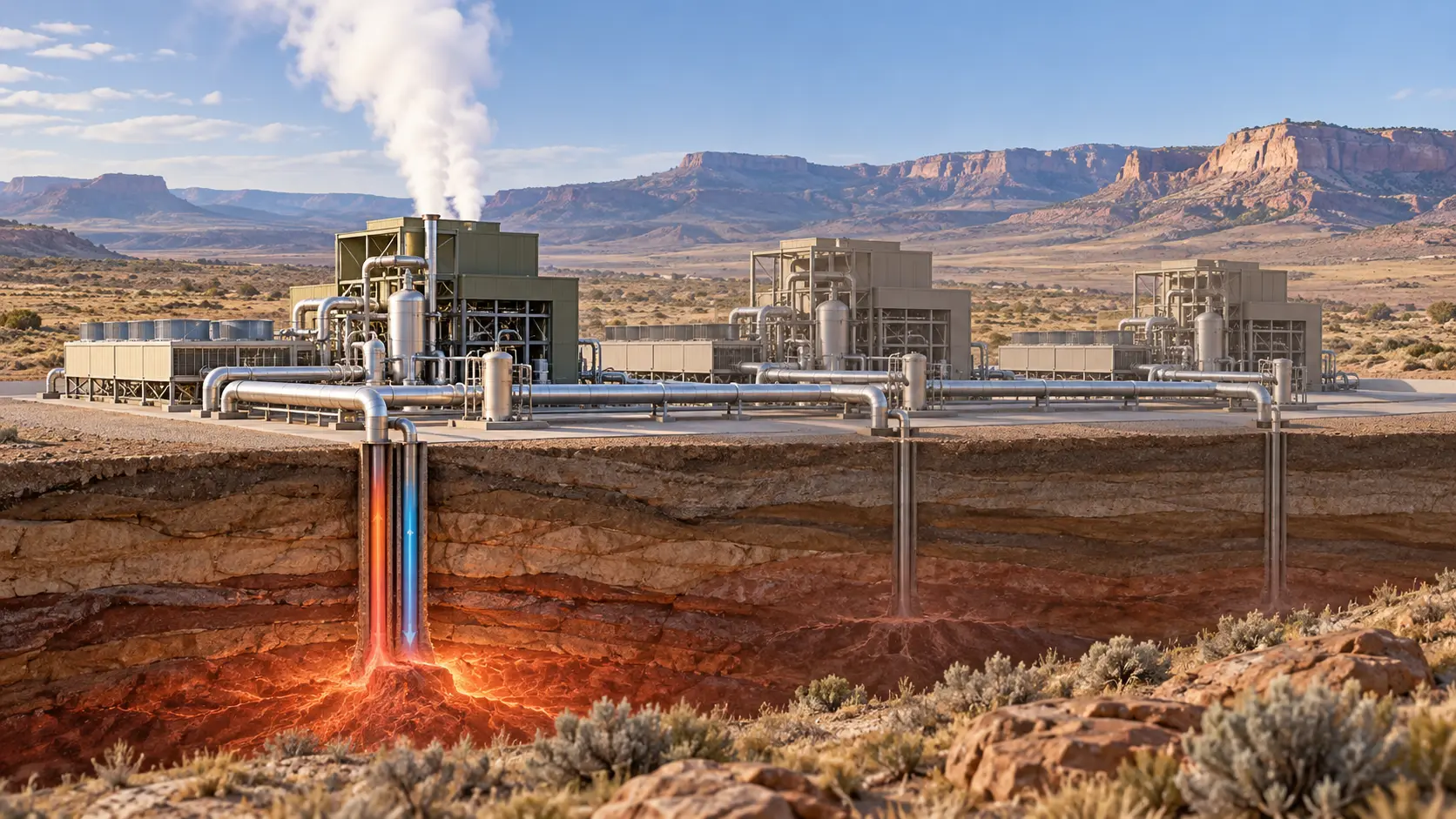
Fervo Energy’s first Cape Station GeoBlock has moved from a construction schedule into the operating record. The company said the unit synchronized with the grid on 24 September and reached commercial operation on 30 September, one day before its contractual date. It reported 33 MW of net power production, meeting the threshold expected under the relevant power-purchase agreement, and said revenue had begun.
That is a meaningful step because the project now has an operating milestone tied to a commercial contract. It is also a narrow one. The 1 October announcement gives no time series for metered output, availability, interruptions, delivered energy or the amount of revenue. It does not identify which purchaser agreement applies to the first unit. The reported 33 MW therefore establishes that Fervo says the contractual threshold was met at the COD milestone; it does not show how the plant performs over a month, a season or a year.
The distinction matters as Cape Station expands. Phase I is planned at about 100 MW across three 33 MW GeoBlocks. Fervo said the other two remained in commissioning and expected their contractual commercial-operation dates by 1 January 2027. A separate 400 MW Phase II is under construction with expected commercial operation in 2028. The first block cannot stand in for either the remaining Phase I units or the larger second phase.
Fervo has also framed the first unit as a construction test. The company said it built and commissioned the facility in 23 months and believes later GeoBlocks could reach an 18-month timeline. That shorter cycle is management’s goal, not an achieved result. Its value will depend on whether subsequent units meet comparable schedules, costs and operating thresholds while using a repeatable design and supply chain.
The financial boundary is just as important as the engineering one. Fervo’s 30 June 2026 Form 10-Q predates the COD announcement. At that date, it reported about US$212.3 million of principal outstanding under the Phase I Project Granite facility and described project-level financing through consolidated variable-interest entities. The filings describe a priority distribution waterfall before cash becomes available to Fervo. Project revenue can therefore precede cash at the parent, and the June balance cannot be treated as a post-COD debt update.
The first block also should not be conflated with Fervo’s separate 396 MW Google Energy agreement. The August filing describes a 15-year PPA divided into four 99 MW tranches, with target commercial-operation dates beginning in the third quarter of 2028. The COD announcement does not say the first 33 MW serves Google or a data centre. The two developments may matter to the same broader market for firm power, but they are different contracts and project milestones.
Investors now have a clearer set of questions than a construction announcement alone can answer: how much net energy the first block delivers over time; whether the next two Phase I units commission on schedule; and how project receipts move through debt service and priority distributions. The milestone advances the evidence from planned capacity to one reported operating threshold. It leaves sustained performance, repeatability and sponsor-level cash conversion to be demonstrated.
Sources
Member Briefing
Deeper Profile Context
Sign in with the right membership level to unlock the full briefing and source notes.
Only for Strategic Circle
Strategic Circle
Open to all readers. Unlock profile briefings after joining and signing in.
Join Strategic CircleOnly for Leadership Alliance
Leadership Alliance
For qualified IP-asset owners and management; sign in to unlock alliance briefings.
Join Leadership Alliance