
Profile
Research
Research profile intelligence connects person, company, institution, and other entity coverage for readers comparing the subjects behind BTW.MEDIA reporting. The page helps compare public profiles, related events, evidence packs, role changes, operating footprints, governance exposure, organisational links, and market relevance while keeping organisation and people records distinct from ordinary news chronology. Readers can understand the subject behind the headline, the evidence supporting that profile, and the infrastructure or market relationships that make the profile relevant. They can see who or what the profile represents, which public sources support it, how it connects to companies, markets, governance bodies, or events, and what changes may deserve continued attention as the subject evolves.

History
In 1993, GNN Turned an Internet Guide into an Ad-Supported Web Publication
A printed catalog became a navigable Web service. Its financing choice reveals how publishing, network policy and the limits of online payment met in the early 1990s.

History
Nepal Opened International Gateways to ISPs in 1999. NTC Still Held the Local Line
Nepal’s 1999 decision changed who could buy international capacity. It did not hand ISPs the wires connecting local customers to them.

Story
Digitel says IPv6 reaches five million devices; DNS headroom remains unmeasured
The Venezuelan mobile operator says IPv6 serves 74% of connected devices and carries 42% of mobile traffic. Its separate report of DNS-server load near 45% raises a capacity question, but supplies no measurement window or ceiling.

History
Gopher Gave the Internet a Menu. Each Site Chose How to Arrange It
Gopher’s familiar menu hid a useful separation: a site could shape what readers saw without moving documents into one central store. The protocol’s small common grammar made that arrangement portable, while control of the client remained a point of leverage.

History
RFC 7168 Updated the Coffee-Pot RFC. It Did Not Make Tea an Internet Standard
In 2014, a tea-brewing extension pointed to RFC 2324 with an Updates header. On the same page, RFC 7168 described itself as an independent, informational contribution and made no claim about implementation or deployment. The labels answer different questions.

History
Nigeria’s .ng Started with One Domain. The Registry Handover Had to Be Learned
In 1995, the first recorded .ng namespace was remarkably small: a RINAF retrospective says its only registered name at the time was `yaba.edu.ng`. Yet the work around that name—registration rules, a WHOIS database, technical operation and eventual succession—already crossed…

Global Institutional Trends
Gavi’s HSS Transition Waiver Needs a Record Beyond the Board Vote
The Gavi Alliance’s December 2025 waiver was narrow: it removed a new independent review for specified changes to previously approved Health Systems Strengthening grants during the move to Gavi 6.0. A sound transition now needs a traceable link from the original review to the…

History
The Internet Arrived in Stages: Papua New Guinea’s 1997 Launches
Papua New Guinea’s Internet did not enter the record as one switch thrown on one day. A carrier announcement, an international gateway, retail providers, academic use and a public website each marked a different kind of arrival—and the sources assigned them different dates.

History
The Computer Had No Address Yet. BOOTP Told It How to Start
A diskless workstation had to ask the network for an address and a boot file before it could request the file that would start its operating system. BOOTP made that circular first exchange a protocol problem.

History
The Key Was Generated in Two Rooms: DNSSEC’s First Root KSK Ceremony, 2010
The signed root zone appeared in July 2010, but the public milestone concealed a more exacting sequence. A key was generated, protected, moved and accepted across two facilities before the root began carrying DNSSEC signatures. The interval between those steps shows what a…

Global Institutional Trends
The UN Tax Convention’s Accreditation Desk Is Part of Its Governance
The negotiations for a United Nations framework on international tax cooperation are moving from draft language toward bargaining over a convention and two early protocols. Before an organization can contribute in Nairobi, however, it must pass an organization-level accreditation…

History
WAIS Could Search a Database; Finding the Source Was a Separate Job
WAIS made a named database searchable across the network. In 1991, that still left a prior question for the user: which source should the client ask, and who had made it discoverable?

History
The International Link Came First; TCP/IP Came Later: Lithuania’s LITNET, 1991–94
Lithuania’s first route abroad was already useful before its research network had become an ordinary IP network. The early story runs through a satellite channel, X.25 packet switching and X.400 mail, then through a domestic link and a gradual TCP/IP transition.

History
The Phone Bill Became Minitel’s Payment Rail: Télétel, 1984–87
A Minitel user did not need a separate account with every information service. Télétel could carry a charge through the telephone bill, then route a share back to the provider. The convenience came with a trade: France’s telecom operator also controlled the settlement rules and…

Asia-Pacific Institutional Trends
Singapore’s National Cyber Picture Needs a Decision Trail
Singapore’s 2026 cybersecurity strategy puts earlier, faster and more coordinated defence on the national agenda. As the National Cybersecurity Command Centre (NC3) brings signals together, the harder governance question is how a shared picture becomes an accountable decision…

History
Karachi Went Online; Four Cities Still Waited for the Upgrade: Digicom in 1995
In August 1995, a Karachi company could offer a live route to the Internet while the service reported in four other cities still belonged to the slower world of stored mail. Pakistan’s first commercial online service was a real connection, but its launch did not make the same…

History
HotJava Moved the Web’s Extension Point to the Reader’s Machine
HotJava proposed a browser that could acquire behavior from the page’s server: an applet crossed the network and ran inside the reader’s browser. That made client-side execution the route to a more adaptable Web—and made the local security boundary part of the product.

Europe and Middle East Institutional Trends
A Fast Data Request Needs a Traceable Audit Trail
The Council of Europe's new model request for emergency disclosure can standardize what travels across borders. Its harder governance test begins after transmission: whether the decision, provider response and later use of personal data remain joined to the same case.
History
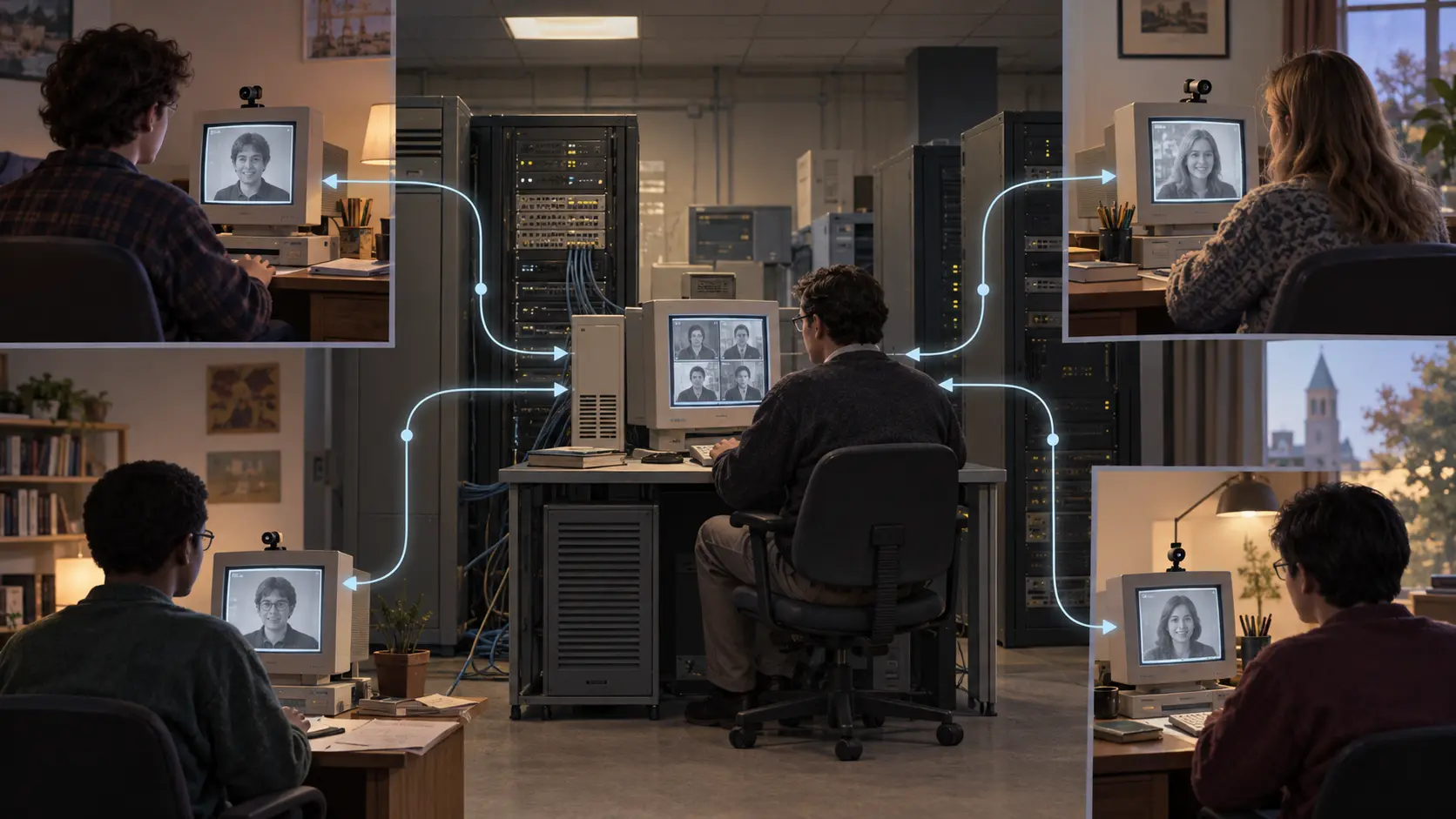
The Mac Could Join; the Reflector Had to Carry Everyone: CU-SeeMe, 1993–1995
CU-SeeMe made a modest Macintosh a place to send live pictures across the Internet. A second entity could connect directly. A third changed the problem: the group needed a Unix machine to receive streams, copy them, and redistribute them. The apparent simplicity at the desktop…

History
Eight Institutions Built India’s Research Network Before Public Internet, 1986–95
India’s public Internet service arrived in 1995, but its research community had been building international connectivity for years. ERNET’s history is a story of institutions learning to operate a network together—and of the boundary between that shared research system and a…