
Primary Domain
Infrastructure
Within the Primary Domain facet, Infrastructure intelligence groups reporting by primary domain so readers can follow a focused area of internet infrastructure, governance, connectivity markets, or digital capital. The page brings together related articles, public evidence, institutions, companies, people, regional exposure, operating dependencies, and market context that may otherwise sit across separate category pages. It explains the domain, the likely actor class, the market or governance context, and the source material readers should use when comparing signals. Operators, analysts, and governance readers can see how the same domain appears across events, profiles, market shifts, public-source evidence, regional dependencies, and longer-cycle infrastructure decisions over time.

History
A Packet Could Hold Up Everyone Else: RFC 3150
On a very slow link, packet size also determines how long everyone sharing the interface must wait. RFC 3150 turned that interval into a design constraint rather than treating MTU as a matter of byte efficiency alone.

History
The Call Agent Controlled the Features. The Mute Button Stayed Local: RFC 3149
MGCP placed call-control intelligence outside the phone, yet RFC 3149 refused to send every touch across the network. A numbered feature key could acquire its meaning from a remote Call Agent, and an XML display could become a separately addressed endpoint. But volume, the…
History
One Path Could Yield Two Valid Capacity Numbers: RFC 3148
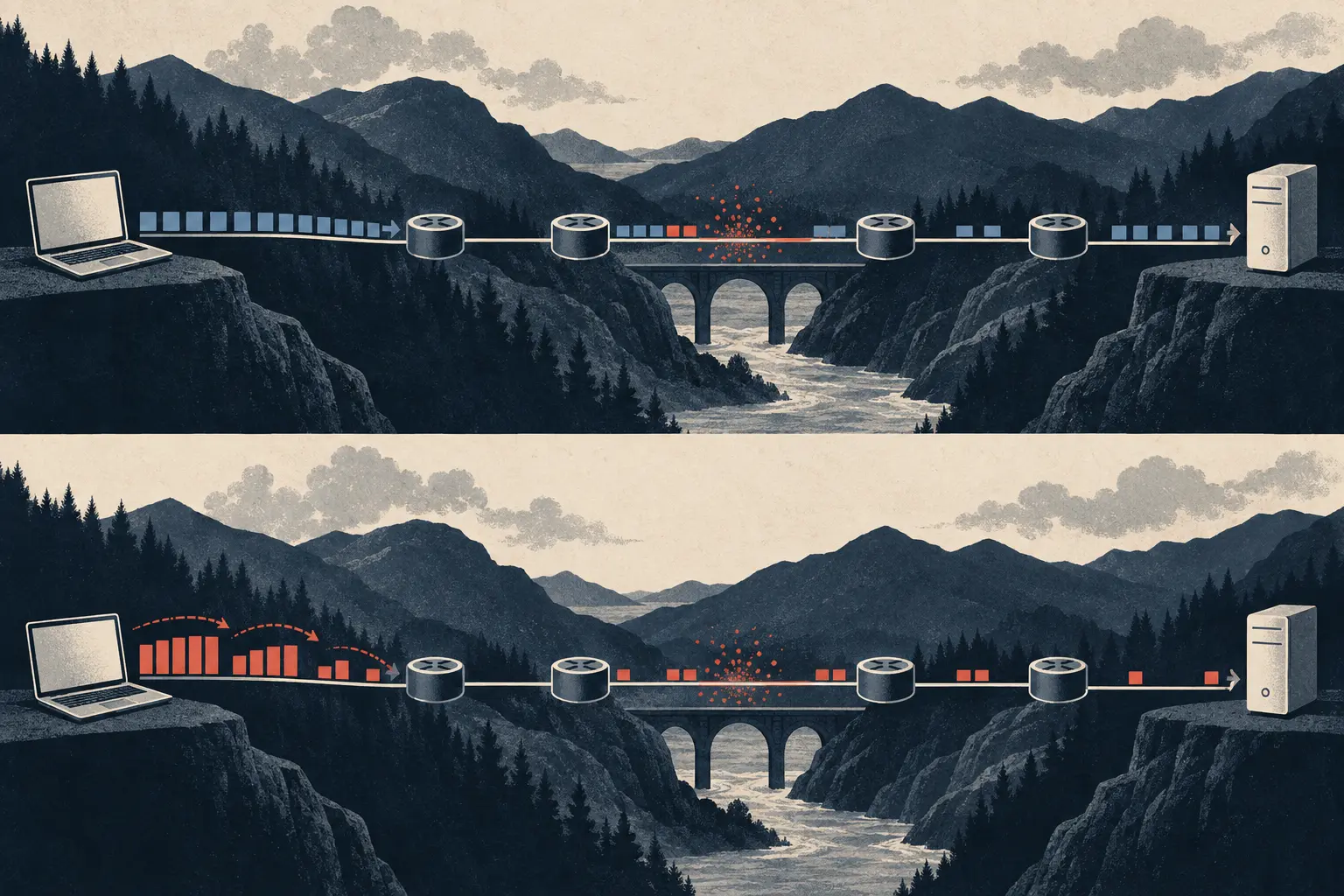
A single-flow bulk-transfer measurement looked like one number. RFC 3148 showed why transport choices could make that number method-dependent—and why the trace beside it mattered.

History
The New Management Network Had to Cross the Old One: RFC 3147
A network migration is usually drawn as an arrow from old to new. RFC 3147 captured the harder topology hidden beneath that arrow: a newly IP-managed device could stand on the far side of a CLNS network that operations could not yet remove. The proposed bridge—GRE carried inside…

History
The Tunnel Closed. The Cause Code Still Could Not Decide Why: RFC 3145
In 2001, L2TP could announce that a tunneled call had ended while remaining nearly silent about the PPP failure inside it. RFC 3145 carried a more precise reason across that boundary. Its lasting lesson was not that a number could settle the incident, but that a useful diagnostic…

History
The Subscriber Chose the Call Treatment. The Network Still Had to Execute It: RFC 3136
A caller reached a busy telephone line while its owner was online. A window appeared on the owner's computer: accept, reject, forward, or send to voice mail. The click felt like the decision. RFC 3136 showed why it was only the beginning of an execution chain that crossed the…

History
The Network Policy Said Gold. Only One Translator Could Write Each Device: RFC 3139
“Give these customers gold service” sounded like one configuration. Across a heterogeneous network it became topology inputs, capability tests, many vendor-specific commands, synchronized changes and feedback from every device. RFC 3139 made the translation visible—and warned…

History
The Proxy Acknowledged the Bytes. The Application Had Not Received Them: RFC 3135
The sender saw an acknowledgement and accelerated. Somewhere beyond that reassuring signal, the bytes were still sitting in an intermediary, waiting to cross the link that had caused the problem in the first place. RFC 3135 made that gap—the distance between faster feedback and…

History
The Delivery Ratio Looked Good. The Application Performed Badly: RFC 3133
One small acknowledgement disappeared. Almost every other frame arrived. The percentage stayed handsome while the sender repeated a much larger body of work and the user waited. In 2001, RFC 3133 put that contradiction inside the definition of the metric itself.

History
The First Packet Had to Wake the Host Before It Could Reach It: RFC 3132
The mobile saved power by ceasing to listen. From that moment, the network could no longer treat an arriving packet as mere traffic. The packet first became a request to remember, search and wake.

History
The Router Stayed Reachable After It Stopped Carrying Transit: RFC 3137
A router did not have to disappear merely because the network should stop crossing it. RFC 3137 turned that distinction into an OSPF advertisement: remain a destination, become an unattractive path.

History
A One-Day Workshop Could Not Test an Expiring Signature: RFC 3130
By the time DNSSEC specialists met around IETF 49, the short workshop had become a misleading unit of proof. A signer could run, a validator could answer and a demonstration could end successfully before the clocks, organisations and independent implementations that determined…

History
The KDC Carried the Trust That Every IPsec Peer Could Not: RFC 3129
In June 2001, RFC 3129 treated Internet key exchange less as a contest between cryptographic algorithms than as a problem of institutional placement. Its question was blunt: if every IPsec peer had to carry policy, certificates, computation and pairwise secrets, could a Kerberos…

History
The First Fragment Passed. The Overlap Changed the Port: RFC 3128
In 2001, a short security note exposed a difficult truth about packet filtering: a firewall could approve one set of bytes while the receiving host later assembled another. RFC 3128 did not discover fragmentation, or even overlapping fragments. Its contribution was to show how…

History
Long-Term Proof Had to Outlive the Key: RFC 3126
RFC 3126 treated an old signature as an evidence-preservation problem. A valid calculation made in 2001 would not explain itself decades later if certificates, revocation records, exact signed bytes or trustworthy algorithms had disappeared. Its answer was a ladder of timestamps…

History
A Valid Signature Still Needed a Policy: RFC 3125
RFC 3125 tried to make the rules around an electronic signature addressable as data. A correct cryptographic calculation remained only the first gate: validity under a transaction still depended on which policy bytes were referenced, which commitments and trust conditions…

History
A Send Grant Was Not a Packet Queue: RFC 3124
The Congestion Manager proposed one place where a host could decide when competing applications should transmit. Its sharpest boundary was equally important: the manager granted an opportunity, while the application still chose the bytes and the network still determined their…

History
A Prefix List Was Not Yet an Access Policy: RFC 3123
DNS could publish a compact list of network prefixes. RFC 3123's more important choice was to refuse to say what that list commanded: the record preserved representation, while applications still had to supply meaning, authority and action.

History
A Delay Number Was Also a Clock Claim: RFC 3116
In an ATM laboratory, subtracting one timestamp from another looked like the easy part. RFC 3116 made the harder truth visible: before the switch could be judged, the clocks, counters, traffic and measurement boundary had to testify too.

History
They Shared a System. They Did Not Merge Authority: RFC 3113
In June 2001, the Internet and the emerging third-generation mobile system needed one another. RFC 3113 made cooperation possible by drawing a line that mattered: information could cross the boundary, but approval authority stayed where it began.