
Summary
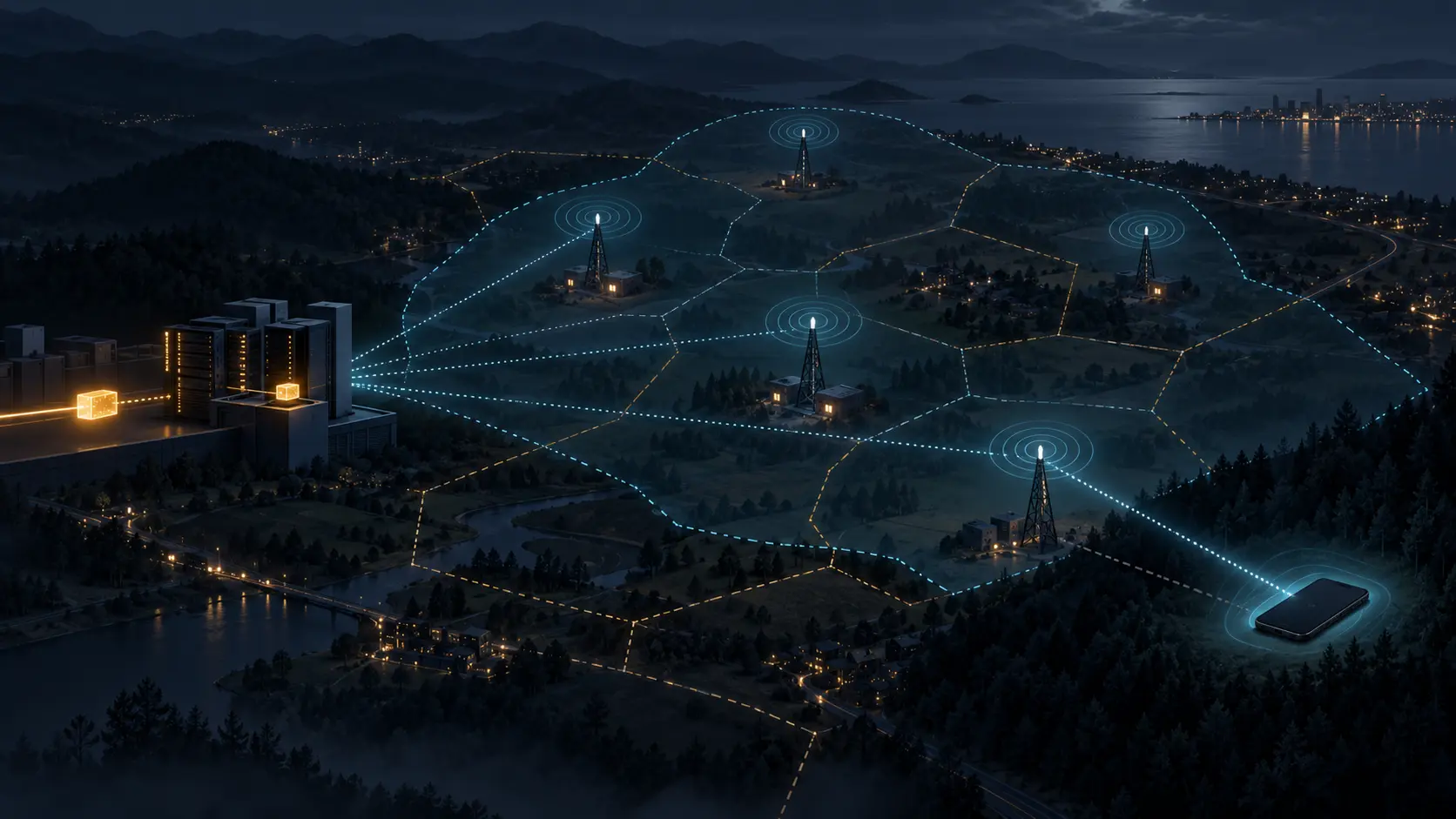
- RFC 3132 separated paging from packet delivery: an arriving packet for a dormant mobile triggered the network to locate and alert the host before a normal last-hop connection could exist again.
- Power and signaling were saved by moving work into the network. It retained a rough paging-area location, reconciled radio areas with IP subnets and accepted that a page sent was not yet a packet delivered.
The packet arrived at the wrong kind of endpoint
An ordinary IP story begins with a destination address and a route. In RFC 3132's story, that was not enough. The destination was a mobile host that had deliberately reduced its ability to receive normal traffic. It was conserving battery by not continuously monitoring the radio channel on which IP packets would travel.
When the first packet arrived, the network could not simply push it over the last hop. It had to locate the host, alert it and cause a usable last-hop connection to be re-established. Only then could ordinary delivery resume. The packet was traffic, but it was also a control-plane trigger.
RFC 3132, published in June 2001 as an Informational memo, called that prior action paging. Its definition was unusually disciplined: paging was the extra signaling used to locate and alert a dormant mobile because a packet had arrived. Merely forwarding the packet over the last hop was explicitly not paging. That distinction created a chain of evidence. A packet could reach a network agent without reaching the host. A page could be sent without being heard. A host could answer without yet having restored routable IP connectivity.
The RFC did not specify the protocol that would complete this chain. It first asked what problem actually required new work.
Sleep saved power by making someone else remember
Dormant mode reduced radio listening and therefore battery drain. It could also reduce location-update signaling. Instead of reporting every move between radio access points, a host might report only when it crossed a larger paging-area boundary—or might not report even then if the operator relied on heuristics.
The saving was real only because responsibility moved. The host stopped maintaining a continuously usable traffic channel. The network retained a coarse belief about where to search, buffered or intercepted the first packet, chose access points over which to page and waited for a response or timeout. Less state and radio work at the handset meant more location memory and coordination elsewhere.
RFC 3132 defined a paging area as a collection of radio access points through which a dormant host might be located. The area did not have to match an IP subnet. That innocent-looking sentence contained the architectural problem. Radio and IP could draw different maps over the same movement.
The host also crossed several distinct states. In a time-slotted dormant mode it alternated between not listening and listening at agreed times. On systems with a dedicated paging channel, it could listen for alerts without opening the traffic channel. Neither case made the normal IP path continuously available.
Some sleeping links already knew the exact location
RFC 3132 did not assume that every dormant host needed an IP-paging protocol. It divided radio links into two broad families.
On a link with dormant mode but no paging system, the host periodically woke on the traffic channel. The access point buffered packets in the meantime. If the host moved beyond the old access point, it discovered the change when it woke, reassociated and allowed the new access point to retrieve buffered packets. In the model analyzed by the memo, the network knew the relevant attachment exactly enough to deliver when the host returned. A new IP-paging layer added no advantage.
The boundary was practical, not universal. Buffer size and retention time were implementation choices. Movement, loss and timeout still mattered. But the memo refused to manufacture a new protocol where the existing link already supplied the necessary location state.
Links with radio paging were different. The dormant host no longer listened or transmitted on the normal traffic channel. It listened to a paging channel, perhaps only in scheduled slots. The network grouped access points into paging areas and sent an alert into the area in which it last believed the host to be. A response allowed delivery to continue; a timeout led the network to treat the mobile as unreachable.
This design also exposed an operator incentive. In licensed spectrum, keeping signaling off traffic channels left more capacity for revenue-producing use and avoided charging users for overhead. RFC 3132 reported that rationale; it did not measure the savings.
One geography was made of cells; the other of subnets
The decisive test was whether Mobile IP registration could carry the dormant host's location without a new paging protocol. IP treated the subnet as the unit at which presence changed. Radio paging treated the paging area as its unit. RFC 3132 walked through three arrangements.
When one paging area matched one subnet, the maps agreed. A radio page could wake the host at the known IP location. No separate IP page was necessary.
When several paging areas existed inside one subnet, the IP address remained topologically valid as the host moved among them. The access router or Mobile IPv4 foreign agent could page across the relevant radio areas. Again, the mismatch was manageable without changing the IP location.
The hard case inverted the containment: one paging area spanned several IP subnets. A dormant host could cross a subnet boundary without crossing a paging-area boundary. Layer 2 saw no event worth reporting. The IP-layer location, however, had become stale. The first packet could arrive at the old subnet and provoke a page that the host answered in another one.
Additional Mobile IP signaling could repair the location, but it inserted more messages and latency before the packet reached the host. A dedicated exchange between the home or hierarchical agent and an agent in the paging area promised to locate the host more directly. RFC 3132 described that as a useful optimization, not the only logically possible mechanism.
Even this three-case analysis was deliberately simplified. Real paging areas could overlap. A technology could assign different area identifiers to terminals in the same place. Operators might disable paging-area registrations and infer location heuristically. The clean diagram was a starting point, not a deployment claim.
More radios multiplied the uncertainty
Heterogeneous access made the search harder. The subnet to which the first packet was sent might no longer contain the host. The radio technology attached to that subnet might also be the wrong one. A user who moved indoors might have lost one signal and gained another, or prefer a cheaper or faster interface.
RFC 3132 sketched an IP-layer paging identity that access points could translate into technology-specific radio pages. Responses would be mapped back to the origin of the search. It also explained why ARP or Neighbor Discovery was not an automatic answer: both normally expected a functioning traffic channel, exactly what the dormant host had suspended.
The sketch was architectural reasoning, not implementation evidence. The RFC's strongest sentence came later: the problem was finding a mobile that had moved while dormant. IP paging was one solution; there could be others.
Requirements made the hidden costs visible
RFC 3154 followed two months later with requirements and a functional architecture. The apparent action—wake a host—expanded into a distributed system.
The protocol was expected to scale to millions of hosts while minimizing power drain. It needed filters so every broadcast, multicast or anycast packet did not wake a device. It had to distinguish a dormant host from one that was inactive or entirely unreachable. It was to work with multiple dormant modes, remain independent of a particular mobility protocol, yet bind to the Mobile IPv4 and Mobile IPv6 work of the time.
It also needed to accept arbitrary paging-area/subnet mappings, reuse Layer-2 paging where available without requiring it, withstand message and network-element failure, and authenticate registrations, area information and paging messages. Security could not consume the energy that dormancy was meant to save.
Responsibility was split among a Host, Tracking Agent, Paging Agent and Dormant Monitoring Agent. One role remembered location. Another detected a packet for a dormant host. Another issued the alert. The host ultimately had to restore a routable Layer-3 link. The architecture made clear that “the network woke the device” was not one atomic act.
Five proposals did not equal one standard
An IETF working-group assessment draft from 2002 reported five protocol submissions and tested them against the requirements. Its tables repeatedly found missing or unclear support: independence from a mobility protocol, multiple dormant modes, failure behavior, administration and interactions with Mobile IPv4 or IPv6.
That document remained an Internet-Draft. The frozen -00 and -01 revisions show an assessment changing in progress, not an RFC or a deployment result. RFC 3132 itself was Informational, as was RFC 3154. Their historical value lies in exposing the problem and its control surfaces, not in proving that a particular protocol won.
The same caution applies to later specifications. RFC 3344 replaced the Mobile IPv4 text cited by the problem statement; RFC 6275 later specified Mobile IPv6; RFC 3753 standardized mobility terminology. They provide context. They do not demonstrate adoption of the paging architecture.
Reachability had become a sequence of receipts
RFC 3132 captured an Internet learning to distinguish addressability from availability. A dormant host could have a valid address while refusing the channel required to receive ordinary packets. The network could know a paging area without knowing an attachment point. A page could leave an agent without producing a response. A response could arrive before the IP route was usable.
Each transition belonged to a different actor. The host chose dormancy and sometimes reported an area change. The tracking system owned a rough location. The monitoring function recognized the trigger. Access infrastructure translated a page into radio signaling. Mobility procedures restored the route. Operators chose the geometry and heuristics that determined search cost.
The irreversible mistake was to compress those transitions into one green state called reachable. The first packet did not prove that it could reach the host. It proved that the network now had work to do. In exchange for the handset's quiet radio, the network had accepted the duty to remember where silence might be found—and to wake it without confusing an alert with delivery.
Sources
- https://www.rfc-editor.org/rfc/rfc3132.txt
- https://www.rfc-editor.org/info/rfc3132
- https://www.rfc-editor.org/rfc/rfc3132.html
- https://www.rfc-editor.org/rfc/rfc3154.txt
- https://www.rfc-editor.org/info/rfc3154
- https://www.rfc-editor.org/rfc/rfc3154.html
- https://www.rfc-editor.org/rfc/rfc2002.txt
- https://www.rfc-editor.org/rfc/rfc3344.txt
- https://www.rfc-editor.org/rfc/rfc6275.txt
- https://www.rfc-editor.org/rfc/rfc3753.txt
- https://www.ietf.org/archive/id/draft-ietf-seamoby-paging-protocol-assessment-00.txt
- https://www.ietf.org/archive/id/draft-ietf-seamoby-paging-protocol-assessment-01.txt
Member Briefing
Deeper Profile Context
Sign in with the right membership level to unlock the full briefing and source notes.
Only for Strategic Circle
Strategic Circle
Open to all readers. Unlock profile briefings after joining and signing in.
Join Strategic CircleOnly for Leadership Alliance
Leadership Alliance
For qualified IP-asset owners and management; sign in to unlock alliance briefings.
Join Leadership Alliance