
Content Type
Research
Within the Content Type facet, Research intelligence gathers BTW.MEDIA articles that share the same editorial format, helping readers compare briefings, profiles, risk notes, market analysis, and event coverage without mixing different kinds of evidence. The page explains how this content type frames internet infrastructure events, company movements, governance decisions, operational signals, and public evidence across the site. Readers can compare which actors or infrastructure systems appear most often, how source quality changes interpretation, and whether the material is a durable profile, a time-sensitive event, a strategic market signal, or a governance development. The result is a useful search page for operators, investors, customers, analysts, and policy stakeholders who need to understand the consequence, timing, and evidence behind similar article formats.

Leaders
Osipenko Alexander Nikolaevich: What the Registry Shows—and What It Does Not
Osipenko Alexander Nikolaevich: What the Registry Shows—and What It Does Not intelligence summary explains the development, the public evidence available to readers, the organisations involved, the regional context, market exposure, and the infrastructure consequences that may…

IETF
The cost of a stateless relay lives elsewhere
A PANA relay can avoid keeping a record for every client without making network admission cheap, ownerless or continuously available. The useful economy is a placement decision: which component remembers the path, which validates the exchange, and which team must restore it.

IETF
One Operator Does Not Make One SRv6 Trusted Domain
A merger puts two routing estates beneath one legal owner. The new diagram draws a single box around them, and an automation team proposes removing the filters at the seam. The diagram may be administratively correct. It proves nothing about whether the two SRv6 instances share…
Europe and Middle East Institutional Trends
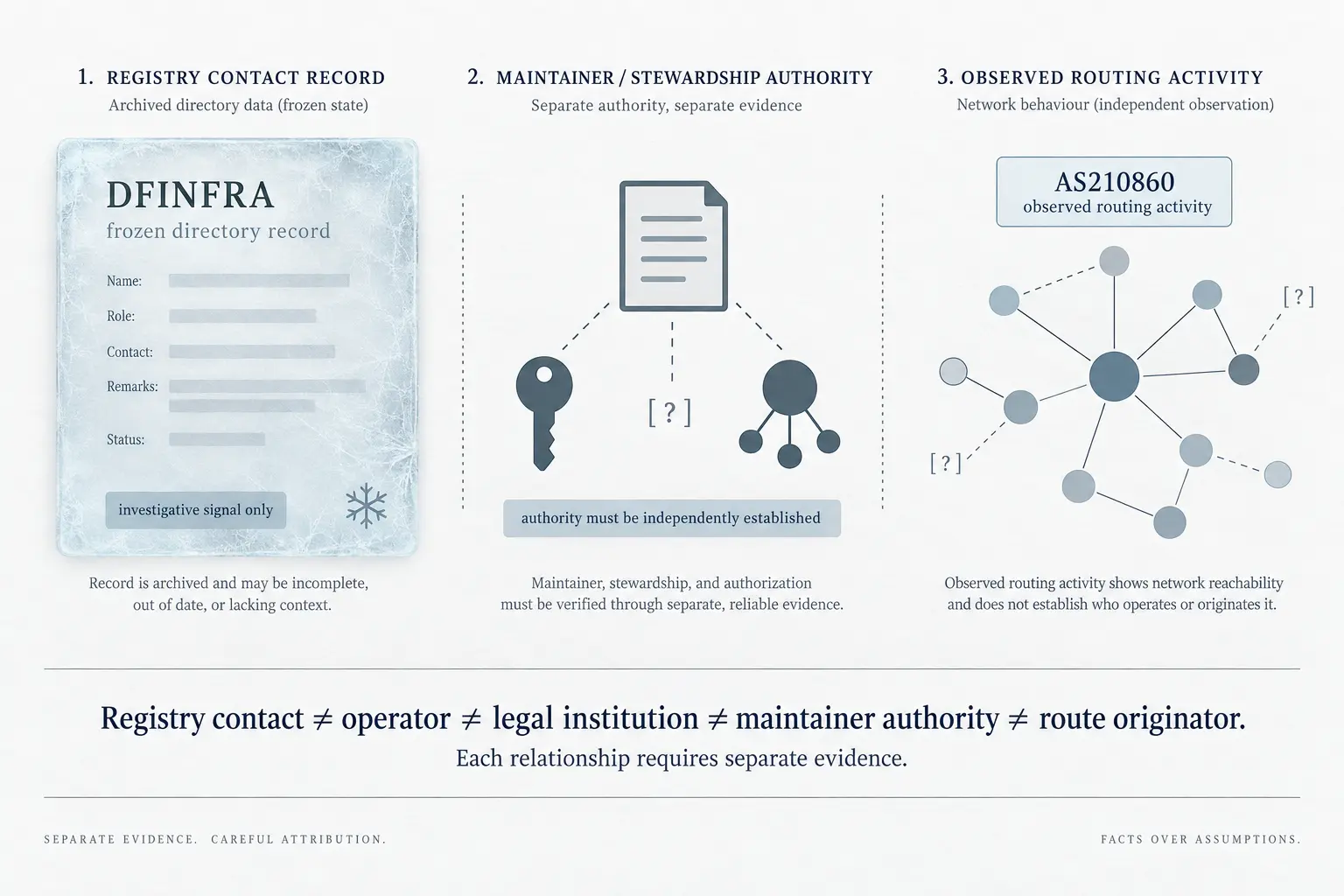
DFINFRA Is a Registry Signal, Not Yet Proof of an Operator
DFINFRA Is a Registry Signal, Not Yet Proof of an Operator intelligence summary explains the development, the public evidence available to readers, the organisations involved, the regional context, market exposure, and the infrastructure consequences that may follow. The Europe…

Global Institutional Trends
Who can challenge ISC’s practical authority?
ISC’s public pages show where its stewardship matters. They do not, by themselves, show who can contest consequential decisions or what remedy follows.

IETF
A migration measured in readable objects
Moving an old MIB into YANG can make a device easier to observe without moving the obligations attached to changing it. RFC 6643 makes that limited bargain explicit. The risk begins when a migration programme buys the first capability and declares the second complete.

Europe and Middle East Regional ISP Trends
AS210837’s Continuity Gap: What the Routing Record Can—and Cannot—Show
A documented historical network footprint has become a continuity question. For ROYA Communications and Internet Services Company Ltd, the difference between registry identity, historical routing visibility and current route evidence is more important than any single prefix…

Story
DATAMATIX and AS210973: What Public Routing Evidence Can—and Cannot—Prove
DATAMATIX and AS210973: What Public Routing Evidence Can—and Cannot—Prove intelligence summary explains the development, the public evidence available to readers, the organisations involved, the regional context, market exposure, and the infrastructure consequences that may…

IETF
Factory defaults can remove the way back
A factory reset can do precisely what its specification requires and still leave an operator unable to manage the device. RFC 8808 separates a return to preset configuration from two outcomes that the phrase “back to factory” tends to imply: a usable route back in, and data that…

IETF
A Cleared Incident Does Not Prove Which Command Cleared It
An incident client sends one `incident-resolve` request containing several incident numbers. Later, separate notifications arrive. Two records now say `cleared`; another remains `updated`. The network view is useful, but the decisive question has vanished between the command and…

IETF
The old address plan survived the IPv6 launch
6rd let an operator introduce IPv6 without first replacing its IPv4 access network. The shortcut also gave an older address plan a continuing say over the size, lifetime and eventual migration of the new service.

IETF
A Capability Menu Is Not a Subscription Decision
An orchestrator sees a tidy answer before it opens a notification stream: this device supports HTTPS, XML or JSON, and two TLS versions. The discovery is valuable precisely because it is compact. It becomes dangerous only when a control system silently turns “listed” into…

IETF
The second login changes the security bargain
Keeping an IMAP connection open can save repeated setup work. It also removes a convenient security boundary: the assumption that one connection belongs to one user. The price of reuse is a complete account of what must be reset, what deliberately survives and who checks the next…

Story
RIPE Database 1.124.1 Fixed Certificate Selection. Its “No Evidence” Finding Needs a Search Boundary
RIPE NCC was right to ship a reported authentication vulnerability without waiting for a routine test interval. The next duty is different: show members what time, traffic and registry history were actually examined before “no evidence of exploitation” became the public…

IETF
Who pays to keep a search alive?
A mailbox search can finish correctly while its request for continuing updates is refused. IMAP makes that distinction explicit. The harder question is whether the product, its resource budget and its promises to users do the same.

IETF
An Enrollment Voucher Arrives After Identity Leaves the Device
A constrained device can withhold its operational identity and still disclose enough to be enrolled. In Lightweight Authorization using EDHOC, that disclosure is deliberate: an authenticated domain authenticator receives the device’s enrollment identity and sends it to a trusted…

IETF
The deadline arrived before permission to send
A scheduled email can ask a server to keep it still while a second instruction demands that it arrive sooner. SMTP's answer is not a faster queue. It is a refusal to accept incompatible obligations—and a careful division of responsibility for the promises that remain.

IETF
A Cryptographic Malfeasance Report Cannot Revoke Trust
Three time servers sign answers that cannot all be true in the order they were received. Roughtime lets a client preserve that contradiction as portable cryptographic evidence. Yet the proof does not name the guilty server, appoint the reviewer, alter a trusted-server list or…

IETF
The fallback folder was not an overflow bin
A mail filter can name both a preferred role and a default folder. Sieve does not treat that pair as a licence to put mail wherever storage happens to work. The distinction protects placement consistency—and leaves someone responsible for restoring the destination that failed.

Story
A LACNIC Telecom Essay Moves Voice to IP. It Leaves Backup Power Unassigned.
A new LACNIC Blog essay catches the most consequential detail in the retirement of traditional telephony: the call may look unchanged, but its power supply has moved. That observation deserves a more exact public answer about who keeps an IP call alive when the lights go out.