
Summary
- Public RIPE Database, RIPEstat and routing-observation records concern AS211867 and related person or organisation namespaces, but the current research receipts do not verify the exact fields needed to establish a specific personal role or control surface. [https://rest.db.ripe.net/ripe/aut-num/as211867.json] [https://stat.ripe.net/data/whois/data.json?resource=as211867] [https://stat.ripe.net/data/as-overview/data.json?resource=as211867]
- Routing visibility is evidence of observed network behaviour, not by itself evidence of legal ownership, personal operational control or authority to transfer an autonomous system. [https://stat.ripe.net/data/announced-prefixes/data.json?resource=as211867] [https://bgp.tools/as/211867] [https://bgp.he.net/as211867]
The registry association is real as a research object, not yet a complete biography
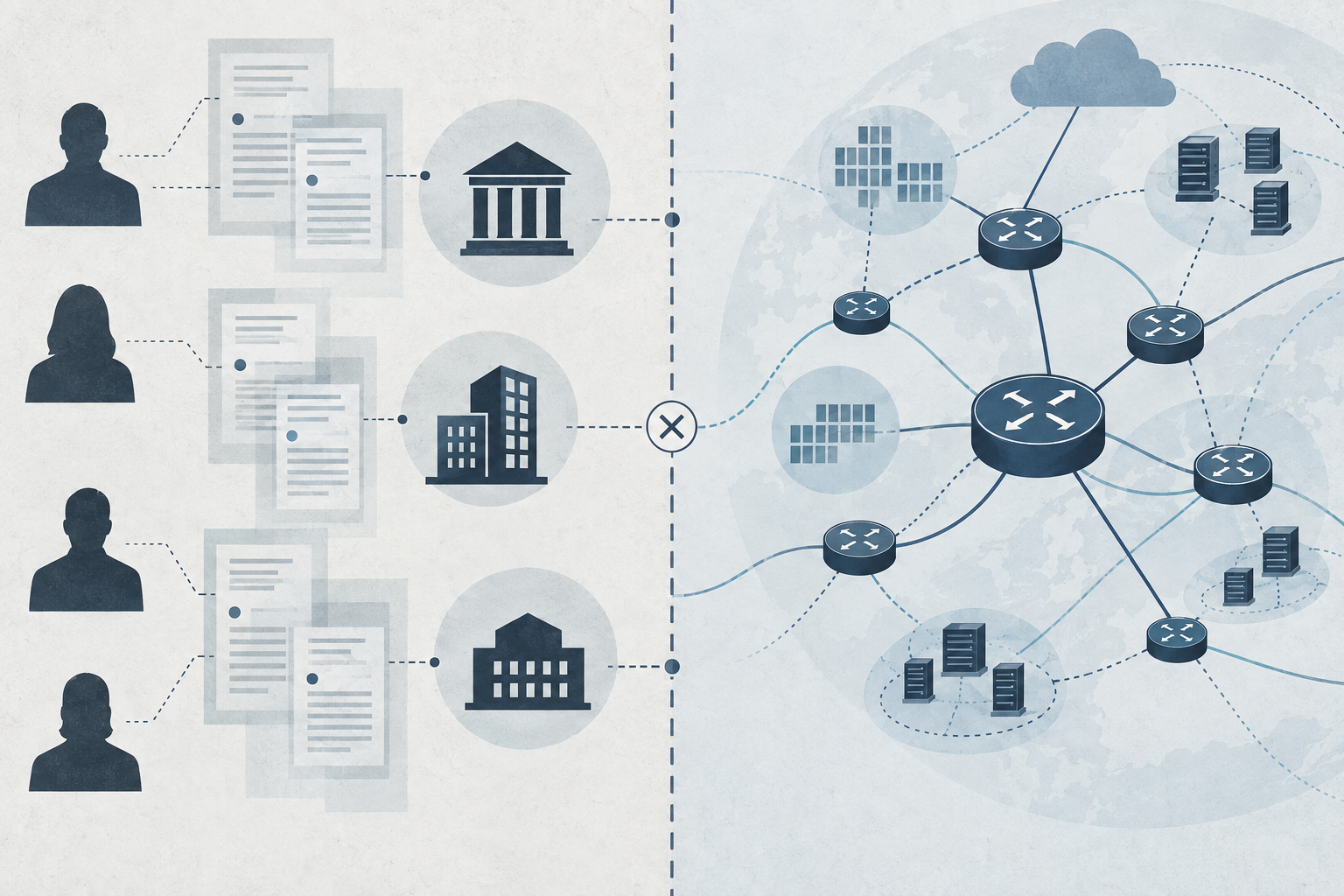
The public record around Osipenko Alexander Nikolaevich is best understood as a set of linked but non-identical scopes. One scope is the person named in the directory. Another is AS211867, an autonomous-system identifier. A third may be an organisation or contact object referenced by registry data. A fourth is the observed routing behaviour associated with the number. These scopes can overlap in the source material without becoming interchangeable.
That distinction matters because registry systems are designed to attach contacts, organisations and administrative responsibilities to resources. They are not necessarily biographies, employment records or operational logs. The fact that a person’s name appears in a resource record can support a claim that the person is named in, or associated with, that record. It cannot automatically answer what decisions the person made, which systems they operated, whether they acted alone, or whether their role continued after a particular date.
The current evidence package contains runtime-issued snapshots corresponding to the RIPE Database REST record for AS211867, RIPEstat Whois and overview endpoints, announced-prefix data, and independent routing pages from bgp.tools and the Hurricane Electric BGP Toolkit. [https://rest.db.ripe.net/ripe/aut-num/as211867.json] [https://stat.ripe.net/data/whois/data.json?resource=as211867] [https://stat.ripe.net/data/as-overview/data.json?resource=as211867] [https://stat.ripe.net/data/announced-prefixes/data.json?resource=as211867] [https://bgp.tools/as/211867] [https://bgp.he.net/as211867] Those sources are appropriate for investigating the boundary between registration and operation. They are not, on the evidence available in this run, sufficient to supply a verified chronology of personal decisions.
What the records can establish
The records identify AS211867 as the central technical object under review. RIPE Database and RIPEstat are the relevant registry and registry-derived sources for determining how that autonomous system is represented in public number-resource data. Routing services provide a separate view: they can show whether an autonomous system or associated prefixes were visible in routing observations at a given time, subject to the collector, timestamp and methodology of each service.
This produces a useful evidence chain, but not a single conclusion. A registry record can show an assigned or maintained object and its listed contacts. A routing observation can show that routes attributed to an autonomous system were visible from particular vantage points. Neither observation alone proves that the named individual personally configured routers, negotiated transit, approved route announcements, controlled credentials, or exercised authority over the organisation connected to the record.
The research receipts explicitly warn that the exact current field values of the cited public endpoints were not retrieved in this run. [https://apps.db.ripe.net/db-web-ui/query?searchtext=as211867] As a result, this article does not assert a particular organisation handle, contact role, prefix count, routing duration or last-modified date as an established fact. That restraint is not a technical footnote. It determines the proper scale of the article’s conclusion.
The difference between an administrative contact and an operator
Internet-number registries often contain several kinds of relationship: a resource may be linked to an organisation, and that organisation may list administrative, technical or abuse contacts. The meanings of those fields are not identical. An administrative contact may be responsible for registration matters without making day-to-day routing decisions. A technical contact may provide a point of operational communication without being the sole operator. A role mailbox may represent a team rather than an individual.
For this reason, any claim about Osipenko Alexander Nikolaevich must be attributed to the exact record that supports it. If the name appears in a RIPE object, the safe formulation is that the RIPE record names or references the person in that object. The unsafe formulation is that the record proves the person owned, operated or controlled all infrastructure associated with AS211867.
The same boundary applies to the organisation namespace. The current source set includes the RIPE organisation namespace and person namespace as candidate locations for linked objects, but it does not establish an exact linked identifier or verify the relevant fields. [https://rest.db.ripe.net/ripe/person/] [https://rest.db.ripe.net/ripe/organisation/] Until that linkage is directly checked, the person, organisation and autonomous system should remain separate analytical objects.
Routing footprint is not a transfer record
A routing table or BGP observation answers a limited question: was a route associated with an autonomous system visible to the service’s measurement system? RIPEstat announced-prefix data, bgp.tools and the Hurricane Electric toolkit can help compare observations and identify changes in visibility. [https://stat.ripe.net/data/announced-prefixes/data.json?resource=as211867] [https://bgp.tools/as/211867] [https://bgp.he.net/as211867] But a change in visibility has multiple possible explanations. It may reflect a routing-policy change, an upstream decision, maintenance, a withdrawn announcement, a measurement gap, a reconfiguration, or a change in the organisation’s operating arrangement.
None of those explanations should be assigned to a person without evidence that identifies the decision-maker or the mechanism. A route announcement is not a signature. A prefix count is not a management chart. A registry timestamp is not a personnel succession record.
This is the central finding beyond the prior profile coverage. The new review does not add a verified transfer narrative. It adds a clearer account of why the transfer question remains open and which evidence would be needed to answer it responsibly: an exact linked registry object, a dated change record, a contemporaneous statement by a named participant, a transaction or governance document, an operational handover record, or another artifact that directly connects a change in authority or practice to identifiable people.
What cannot fairly be personalised
Network operations are usually distributed. Even a small autonomous-system holder may depend on an upstream provider, a data-centre or hosting company, contractors, a technical team, registry administrators and external peers. The public routing footprint therefore reflects a chain of institutions and technical dependencies, not necessarily one person’s continuous action.
A person-centred article should still ask what the named individual demonstrably controlled. The answer, on the present record, is limited. The evidence supports attention to a documented association with the AS211867 research object and to the public infrastructure context surrounding that object. It does not support a claim that Osipenko Alexander Nikolaevich was the sole decision-maker, that he personally originated observed announcements, or that he transferred the relevant capability to a successor.
This limitation also protects against a common error in infrastructure reporting: turning contact data into a character judgment. A listed name can be important for accountability and follow-up while remaining insufficient for claims about motive, competence or personal ownership.
What evidence would change the assessment
The assessment could become more specific if future research retrieves the exact current RIPE aut-num object and its linked organisation or person objects, with field values, identifiers and dates preserved in source snapshots. [https://rest.db.ripe.net/ripe/aut-num/as211867.json] [https://rest.db.ripe.net/ripe/person/] [https://rest.db.ripe.net/ripe/organisation/] A contemporaneous technical or governance record could then be compared against routing observations from RIPEstat and independent BGP services.
The strongest evidence of transfer would be direct rather than inferential: a dated handover announcement, a transaction or corporate filing, a signed operational agreement, a named successor’s account, a documented change in administrative authority, or a technical record showing a capability moving between identifiable teams. Routing continuity alone would not meet that standard. Nor would a person’s continued appearance in a database prove that operational authority remained unchanged.
Until such evidence is available, the responsible conclusion is bounded. Public records make AS211867 and its associated registry and routing context relevant to the study of Osipenko Alexander Nikolaevich. They do not yet provide a verified account of personal operational control or capability transfer.
Conclusion: accountability requires scope discipline
The public record is valuable precisely because it makes infrastructure relationships inspectable. But inspectability is not the same as completeness. RIPE records can identify a resource and named contacts; RIPEstat and BGP services can provide time-dependent observations of routing visibility. [https://rest.db.ripe.net/ripe/aut-num/as211867.json] [https://stat.ripe.net/data/whois/data.json?resource=as211867] [https://stat.ripe.net/data/as-overview/data.json?resource=as211867] [https://stat.ripe.net/data/announced-prefixes/data.json?resource=as211867] [https://bgp.tools/as/211867] [https://bgp.he.net/as211867]
For Osipenko Alexander Nikolaevich, the current evidence supports a registry-association thesis, not a biography of command. The practical implication is that future monitoring should track exact object changes, dated routing events and named institutional participants. If a transfer of authority occurred, it should eventually leave a more direct artifact than chronology alone. If it did not, the absence of such an artifact is itself a reason to avoid overstating what the public record says. Directory record
Member Briefing
Deeper Profile Context
Sign in with the right membership level to unlock the full briefing and source notes.
Only for Strategic Circle
Strategic Circle
Open to all readers. Unlock profile briefings after joining and signing in.
Join Strategic CircleOnly for Leadership Alliance
Leadership Alliance
For qualified IP-asset owners and management; sign in to unlock alliance briefings.
Join Leadership Alliance