
Content Type
Research
Within the Content Type facet, Research intelligence gathers BTW.MEDIA articles that share the same editorial format, helping readers compare briefings, profiles, risk notes, market analysis, and event coverage without mixing different kinds of evidence. The page explains how this content type frames internet infrastructure events, company movements, governance decisions, operational signals, and public evidence across the site. Readers can compare which actors or infrastructure systems appear most often, how source quality changes interpretation, and whether the material is a durable profile, a time-sensitive event, a strategic market signal, or a governance development. The result is a useful search page for operators, investors, customers, analysts, and policy stakeholders who need to understand the consequence, timing, and evidence behind similar article formats.

IETF
The recovered client that could not end everyone else's grace
After an NFSv4.1 server loses its lock state, the quickest client cannot decide when the slower ones have had enough time. Recovery completion is a withdrawal of its own remaining claims, not a command to reopen the whole service.
Story
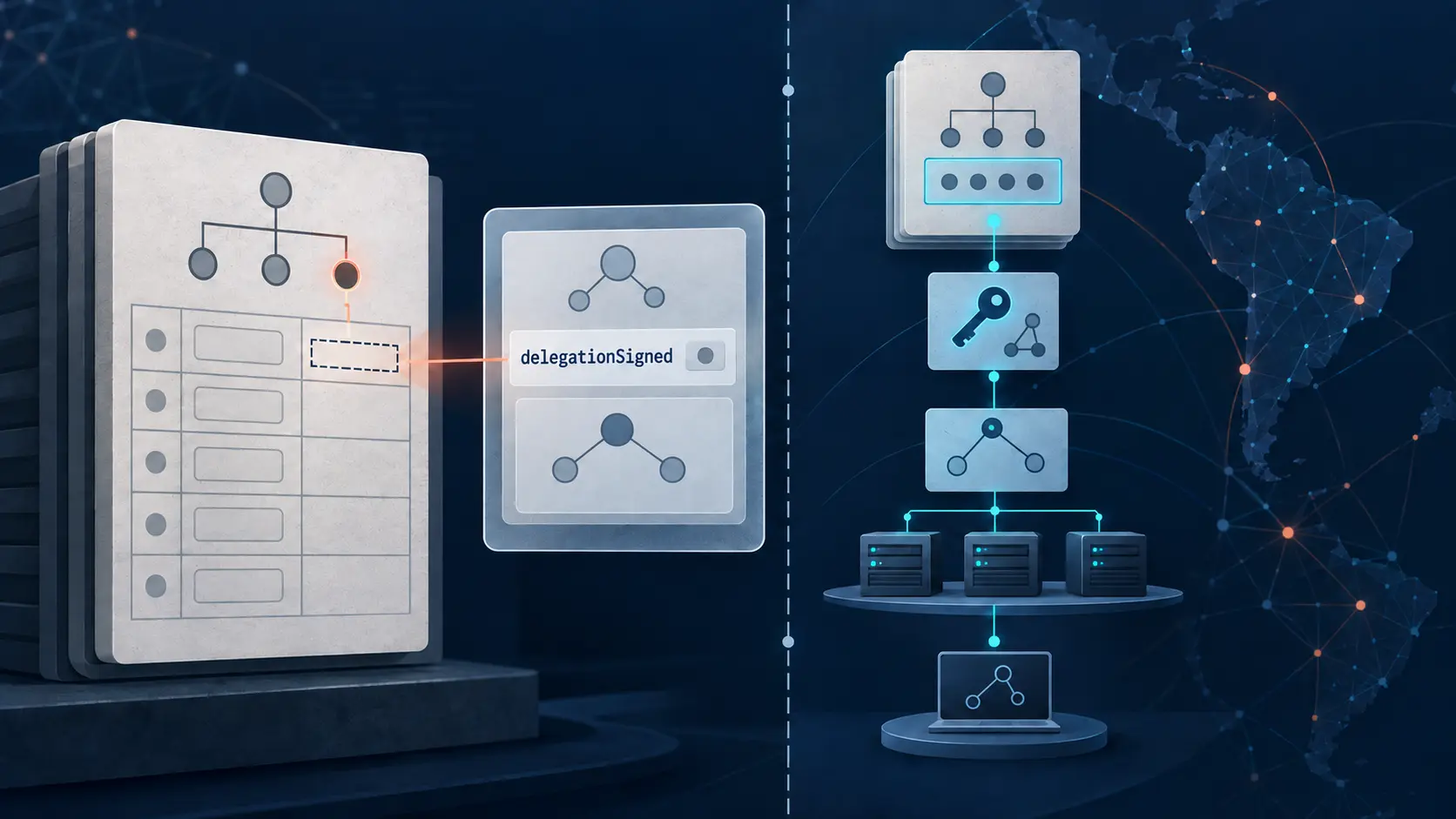
LACNIC's RDAP delegationSigned Records Parent DS Presence, Not DNSSEC Validation
A boolean in a registry response can look like a verdict on the security of a DNS chain. LACNIC's RDAP `delegationSigned` field answers a narrower question: whether the registration view reports DS records in the parent. It does not run a resolver, test the child keys or prove…

Global Institutional Trends
FreeBSD’s GRAND Work Shows Why a Faster Hello Needs Its Own Queue Rules
An account of proactive IPv6 discovery puts the less glamorous half of an optimisation in view: limiting announcements without treating ordinary replies as expendable duplicates.

IETF
A Private Candidate Does Not Explain Why One Intent Won
Two engineers are authorized to change the same router. Each works in a private configuration branch, so neither can accidentally commit the other’s unfinished commands. Then both change the same node. The server can identify the collision and offer disciplined ways to resolve…

IETF
The SCTP association that outlives its original socket
Peeling an established association out of a shared socket can contain buffer pressure. It also moves the place where that association must be controlled and closed.

IETF
MPTCP can keep the stream and lose the way back
After infinite-mapping fallback, regular TCP may keep carrying the bytes. The multipath capability cannot return on that same connection, leaving renewal to a different decision.

Global Datacenter Trends
NSD’s Second Certificate Rule Should Not Veto the First
NSD 4.15.2 repairs a zone-transfer check that could reject a legitimate client when another certificate identity was configured. The important unit of acceptance is the complete access rule, not the successful TLS handshake.

Global Datacenter Trends
FRRouting’s 34 Gbps Fix Makes Encoding Mode Part of the Upgrade Test
August maintenance releases correct the handling of large BGP bandwidth values. The useful acceptance question is not whether every peer now reports a bigger number, but whether each encoding produces the right one.

Story
ARIN Described a Two-Person Rule for AI Drafts. It Did Not Describe the Receipt
ARIN’s public answer was unusually concrete: generative AI may assist a narrow class of drafts, the drafter remains responsible, and a second person reviews the result before release. The missing piece is not another principle but the durable record that proves those decisions…

IETF
A YANG Minimum Version Is Not a Compatibility Floor
An importer asks for version 3.1.0 of a YANG module. On the shelf it finds 3.1.2 marked `_non_compatible` and 4.1.2, whose major number announces a breaking change. Both can satisfy the request. The result is not a loophole hidden in an implementation: it is the deliberately…

IETF
A second Netnews cancel lock can add another cancellation authority
A field that looks like extra protection can preserve a second actor’s ability to authenticate withdrawal. For an archive operator, the consequential questions are who retains the secret, which old articles it covers and what happens when the service relationship ends.

IETF
A guest TURN relay still needs an admission policy
Letting a visitor use a network’s communications relay without long-term credentials simplifies arrival. It does not decide whose capacity the visitor consumes—or who must return an allocation that the application never uses.

IETF
A Packet-Discard Counter Needs an Intent Epoch Before Automation Acts
At 02:14, an egress no-buffer counter starts climbing. The automation can move traffic in seconds. What it cannot see in the number is that a new service profile went live at 02:12, the line card restarted at 02:13, and the approved loss budget belongs to the configuration that…

Global Datacenter Trends
IEEE’s 200G MMF Review Puts One Unset Limit Behind Several Link-Budget Rows
A September contribution makes the dependence unusually clear: the optical budget and several acceptance conditions move with the same transmitter-quality limit. Buyers need a coherent test definition, not a collection of promising numbers.

IETF
When a credit-control timeout still permits service
A Diameter policy called RETRY_AND_TERMINATE can keep an established service running when one timer expires. The consequential boundary is the later request outcome—and who is accountable for consumption while that outcome remains unresolved.

IETF
One Shared Nameserver Is a Continuity Test, Not Proof of Delegation Control
A resolver looks again at a delegation it has cached. The parent now lists a mostly different set of nameservers, but one familiar name survives. That intersection can be enough to treat the delegation as continuous, provided any relevant signer overlap also holds. It is a useful…

Story
APNIC’s NIR SIG Asked Four Charter Questions. Its Deck Shows One Unlabelled Result
An APNIC 62 charter-review deck asks seven National Internet Registries four different questions, then places one 86% support chart beside them without saying which question it answers. The proposed charter may still deserve support. But if the NIR SIG is to consolidate views for…

IETF
An IPv4 lease has an IPv6 moving part
Dynamic softwire provisioning gives an IPv4 service more freedom over where it starts. The price of that freedom is a binding whose location, update rate and privacy properties cannot be read from the IPv4 allocation alone.

IETF
DNS GREASE Needs an Experiment Charter Before It Becomes a Default
A resolver deliberately puts a value with no useful meaning into a DNS query. A correct peer ignores it. A brittle peer may reject the query, stay silent or provoke a retry. The experiment protects tomorrow’s protocol by creating a small inconvenience today. That bargain is…

IETF
The repair window inside an EVPN address conflict
Removing a duplicate endpoint and releasing the network state it disturbed are different parts of recovery. Their separation exposes a decision that a closed incident ticket can easily conceal.