
Summary
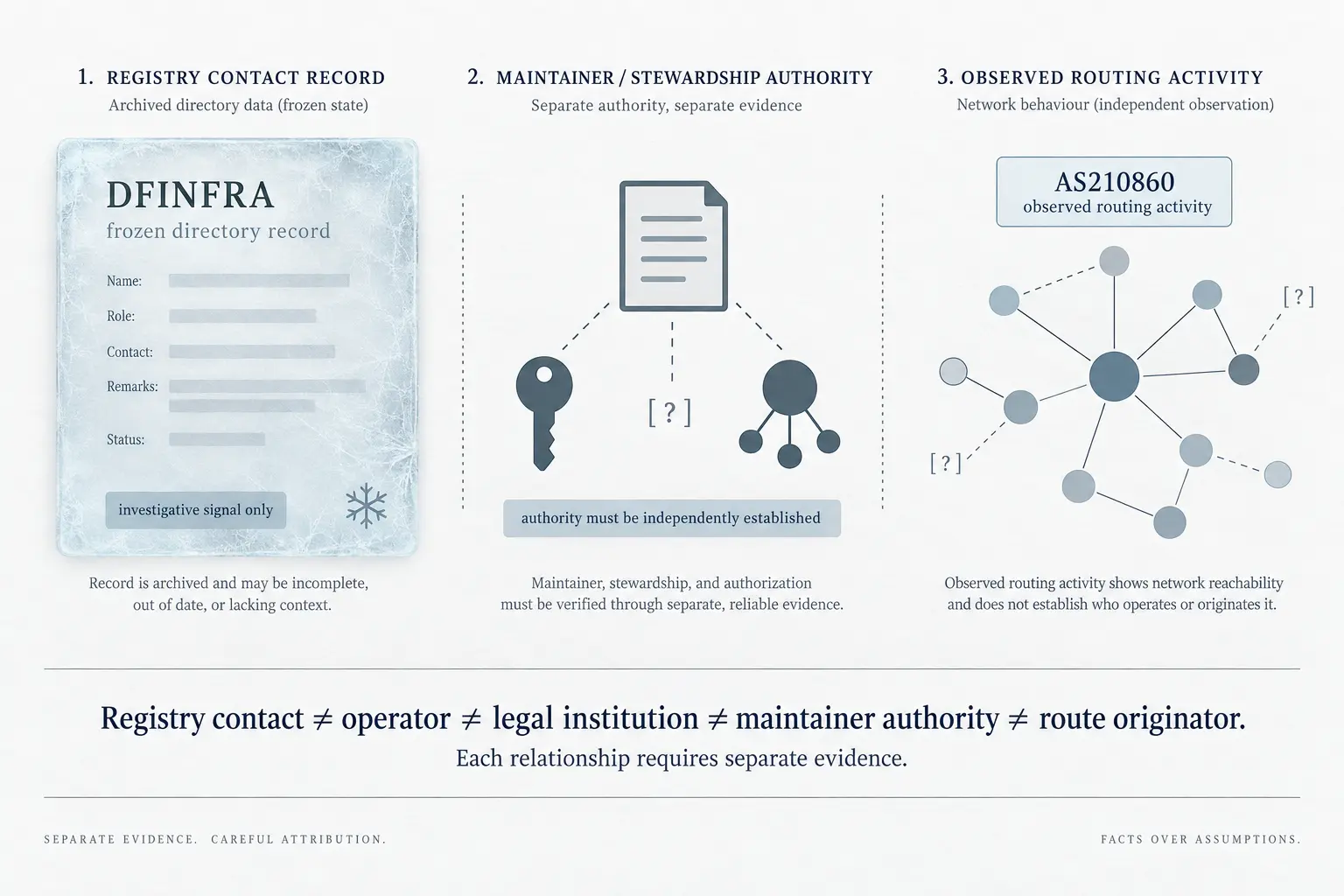
- DFINFRA is identified in the frozen directory profile as a public administrative and technical contact name associated with AS210860 in the RIPE Database, but the current run does not verify whether the underlying fields remain current. (RIPE Database aut-num record)
- The available record context points to a verification problem rather than a confirmed corporate or operational event: registry stewardship, maintainer authority and observed route origination must be established separately.
The meaningful state difference is evidentiary
DFINFRA is not interesting because a contact name automatically reveals a company. It is interesting because the name creates a plausible investigative lead while leaving the decisive questions unanswered.
The frozen directory profile associates DFINFRA with AS210860 through a public administrative and technical contact context. That is a bounded fact about how the subject is represented in a registry. The associated resource is AS210860, a number identified by the preserved RIPE Database aut-num endpoint. (RIPE Database aut-num snapshot)
The state difference is therefore not “DFINFRA became an operator” or “AS210860 changed hands.” No such change is established here. The defensible state difference is narrower: a registry-contact reference is available for investigation, while the evidence needed to convert that reference into an institutional or operational conclusion is not currently verified.
That distinction matters to executives, investors and policy readers because Internet infrastructure records sit at the intersection of identity, contractual administration and live operations. A contact may be responsible for maintaining information. A maintainer may have authority to create or alter certain registry objects. A network may originate routes under an autonomous-system number. Those roles can overlap, but a name in one field does not prove that they do.
What the registry context establishes—and what it does not
The RIPE Database aut-num record is the natural starting point for an inquiry into AS210860. Its endpoint is preserved in the current evidence set, and the frozen profile identifies DFINFRA as an administrative and technical contact name associated with that resource. (RIPE Database aut-num snapshot)
That evidence supports a limited proposition: DFINFRA appears in a registry-contact relationship connected to AS210860. It does not, on its own, establish that DFINFRA is a legal entity, a trading company, a telecommunications provider, a hosting business or the organisation that operates the autonomous system.
Nor does a registry contact necessarily answer the question of control. Registry data is designed to support coordination, accountability and resource administration. The operational chain may involve a holder, a sponsoring or maintaining organisation, technical staff, an outsourced provider, a reseller, a transit customer or a party acting under contractual authority. The contact reference can identify a point of accountability without describing the full economic arrangement behind the resource.
This is why institutional identity must be tested rather than inferred. The relevant evidence would include a current official registry response that identifies the legal holder or maintainer and clarifies the authority attached to that role. It could also include a corporate filing, an official website or an operator statement linking DFINFRA to a legal entity and network operation. None of those linking materials is established by the preserved record context in this run.
The distinction is particularly important when a directory profile is read as if it were a company profile. A company profile normally implies an identifiable organisation, business activity, jurisdiction and operating footprint. The evidence here does not support those assumptions. The bounded description is a registry-contact signal associated with AS210860, not a verified corporate identity.
The causal mechanism runs through separate control layers
The economic meaning of a contact record depends on what happens after the record is found. There are at least three control layers to test.
The first is registry stewardship. This asks who is recorded as the holder, administrative contact, technical contact or responsible organisation, and whether those fields are current. The preserved RIPEstat WHOIS endpoint was queried for AS210860, but the captured field values are not available for direct quotation in this run. (RIPEstat WHOIS snapshot)
The second is authority over registry objects. A maintainer relationship, where present, may indicate who can update or manage particular records. That is more informative than the mere presence of a name, but it still does not necessarily prove that the same party operates the network in commercial or technical terms. Authority to maintain data and authority to originate traffic are different propositions.
The third is operational activity. A network operator should normally leave observable traces in routing data: route objects, announced prefixes, routing status, historical visibility or RIS observations. The relevant RIPEstat endpoints for announced prefixes and routing status were queried for AS210860, but their captured values are unavailable for quotation. (announced-prefixes endpoint) (routing-status endpoint)
The mechanism can be stated plainly. A contact reference becomes evidence of institutional or operational control only when it is connected to independently verified stewardship, authority and activity. Without those links, the record remains an indicator of where to investigate. It does not support a complete conclusion about ownership, cash flow, customer obligations, pricing power or market position.
For an infrastructure investor, this prevents a category error. The presence of an autonomous-system number in a registry is not equivalent to revenue-generating network activity. For a policy reader, it prevents a second error: treating an accountability record as a complete statement of legal identity. For an operator or regulator, it clarifies what additional observation would make the record materially more useful.
Routing evidence is necessary, but not interchangeable with identity evidence
Routing observations answer a different question from registry records. They can show whether an autonomous system has been visible in the global routing system, which prefixes were associated with it at a given observation time, and whether that visibility changed. They do not automatically identify the legal or commercial party behind the activity.
The current evidence package includes preserved RIPEstat snapshots for announced prefixes, routing status, routing history, RIS first and last seen, and an AS overview. The announced-prefixes query identifies AS210860 as the resource being investigated, but the captured response values are not available for quotation. (announced-prefixes snapshot)
The routing-status query provides the same kind of bounded context: it is an official endpoint directed at AS210860, not evidence that the resource was or was not announcing routes at a particular time. (routing-status snapshot)
Historical routing evidence would be relevant to a question about persistence, interruption or a change in operational visibility. The preserved routing-history endpoint was queried for AS210860, but no directly observed values are available in the current run. (routing-history snapshot)
RIS first- and last-seen data could help establish the period during which the resource was observed by the RIPE Routing Information Service. Yet the preserved endpoint capture does not expose those values for quotation. (RIS first-last-seen snapshot) The AS overview endpoint is similarly relevant to a consolidated view of the resource, but its captured field values are not available here. (AS overview snapshot).
This absence must be described accurately. It does not mean that AS210860 has no route objects, has never announced a prefix, is currently inactive or has changed hands. It means that the current run cannot responsibly quote those fields from the preserved observations. A research-status limitation is not a negative operational finding.
That boundary is more than cautious wording. It changes the investment and policy conclusion. If routes are observed, that would establish operational visibility for the relevant observation period, not necessarily ownership by DFINFRA. If route visibility is absent, that would not by itself prove that DFINFRA is inactive or that the registry contact is obsolete. The interpretation must remain tied to the precise time, source and field observed.
Historical records could show change, but not all change is substantive
A historical WHOIS record can be useful for identifying when a contact, organisation or status field changed. The preserved historical WHOIS endpoint for AS210860 is part of the evidence package, but the captured values are not available for direct quotation. (historical WHOIS snapshot)
Even a verified field change would require interpretation. A new contact could reflect a staff change, a service-provider change, an administrative correction, a privacy decision or a transfer of responsibility. A changed organisation field could be significant, but it would still need to be connected to legal documentation or an operator statement before it could support a broader corporate conclusion.
The same logic applies to an ASN reallocation. Reallocation would be a meaningful registry event, but its economic effect would depend on the parties involved, the rights transferred, the operational migration and any customer or contractual obligations. The appearance of a new announced prefix could show a routing development without identifying the business model behind it.
The prior DFINFRA coverage correctly treated changes to contacts, ASN allocation and announced prefixes as signals that could appear in the records associated with the name. The distinct question here is how much inference those signals can bear. The answer is: enough to define a monitoring plan, not enough to declare an operator or corporate transaction without corroboration.
The monitoring plan should test falsifiable conditions
A useful monitoring plan begins with conditions that could change the conclusion.
The first condition is a current official registry response identifying DFINFRA as the legal holder or maintainer of AS210860, together with enough field detail to establish the authority attached to that relationship. This would strengthen the institutional interpretation, although it would still not automatically prove the existence of a commercial operating business.
The second condition is a route or routing-status response directly showing prefixes originated by AS210860, with an observation time. That would establish operational visibility for the resource at that time. To connect the activity to DFINFRA, investigators would still need a separate identity or operator link.
The third condition is an official corporate filing, official website or operator statement linking DFINFRA to a legal entity and to the operation of the network. That would address the identity gap more directly than a contact field alone.
The fourth condition is a documented historical change: a before-and-after comparison showing a new contact, a reallocation, a maintainer change, route emergence or a shift in observed visibility. The significance would depend on whether the change is accompanied by evidence of control, payment, customer obligations or operational migration.
These conditions create a disciplined sequence. First identify the record. Then establish who has authority over it. Then observe whether the associated resource is active in routing. Finally connect the resource to a legal and economic institution. Skipping the middle steps produces a profile that sounds more certain than the evidence allows.
Why the distinction matters for market analysis
The temptation to turn a thin infrastructure record into a company story is understandable. Autonomous-system numbers, registry contacts and routing data are searchable, concrete and often associated with real businesses. But the apparent precision of the data can hide a gap between administrative representation and economic control.
That gap matters because market analysis depends on the mechanism by which control produces consequences. A real operator may influence capacity, transit purchasing, customer access, peering, pricing and cash flow. A registry contact may influence only the accuracy or maintenance of the relevant record. Those are not equivalent positions in a market structure.
For DFINFRA, the present evidence does not establish a change in market power. It establishes a bounded lead for investigating whether such a change exists. The relevant next step is not to assign a business description to the name, but to seek the records that connect identity, authority and activity.
This approach also protects against false negatives. If the current endpoint captures cannot be quoted, the appropriate conclusion is not that nothing happened. A real change may exist outside the accessible observation. The appropriate conclusion is that the change remains unverified and that publication should separate “not observed in this run” from “does not exist.”
What would count as a substantive change
A substantive change would require more than a name appearing differently in a directory. The strongest version would combine three elements: a verified change in registry stewardship or authority, a contemporaneous change in route or routing visibility, and an independent link to the responsible legal or operating entity.
A weaker but still meaningful signal might be a documented registry transfer accompanied by an operator statement. Another could be persistent route origination by AS210860 combined with a credible official source identifying the operator. A contact update without either operational or legal corroboration would remain an administrative signal.
The test should therefore be temporal and comparative. What was the prior state? Which field changed, and on what date? Did route visibility change at the same time? Was a legal entity named? Were customers, contracts, capacity or payment obligations affected? If the evidence cannot answer those questions, the market consequence remains conditional.
Conclusion
DFINFRA is best read as a bounded registry-contact signal associated with AS210860, not as confirmed proof of an operator, legal institution or network controller. The preserved RIPE evidence shows where the investigation should begin, while the unavailable endpoint field values leave current stewardship, maintainer authority, route objects, announced prefixes, routing visibility and historical changes unverified.
The next observable condition is a current, quotable record that links the contact to authority, activity or a legal entity. Until that condition appears, the economically honest conclusion is limited but useful: DFINFRA may identify an accountability path, yet the chain from registry reference to operational control remains unproven.
Member Briefing
Deeper Profile Context
Sign in with the right membership level to unlock the full briefing and source notes.
Only for Strategic Circle
Strategic Circle
Open to all readers. Unlock profile briefings after joining and signing in.
Join Strategic CircleOnly for Leadership Alliance
Leadership Alliance
For qualified IP-asset owners and management; sign in to unlock alliance briefings.
Join Leadership Alliance