
Summary
- A 26 August LACNIC Blog essay by César Díaz notes that copper fixed telephony could, under some conditions, draw power from the exchange, while IP voice depends on locally powered modems, routers and terminals.
- The piece is Díaz's attributed analysis, not LACNIC policy — and LACNIC is a registry, not the telephone regulator for the countries it serves. It names the new dependency without assigning it to anyone.
- Operators and regulators owe the public a jurisdiction-specific migration receipt: the devices required, the backup promise, the emergency-routing and location path, the fallback tests, the exceptions and a named restoration owner.
For most of a century, the telephone exchange quietly paid for your dial tone. It pushed a little current down the copper, and the handset — dumb, unpowered, obedient — came alive. Then the industry moved the power supply into your hallway and called the result progress.
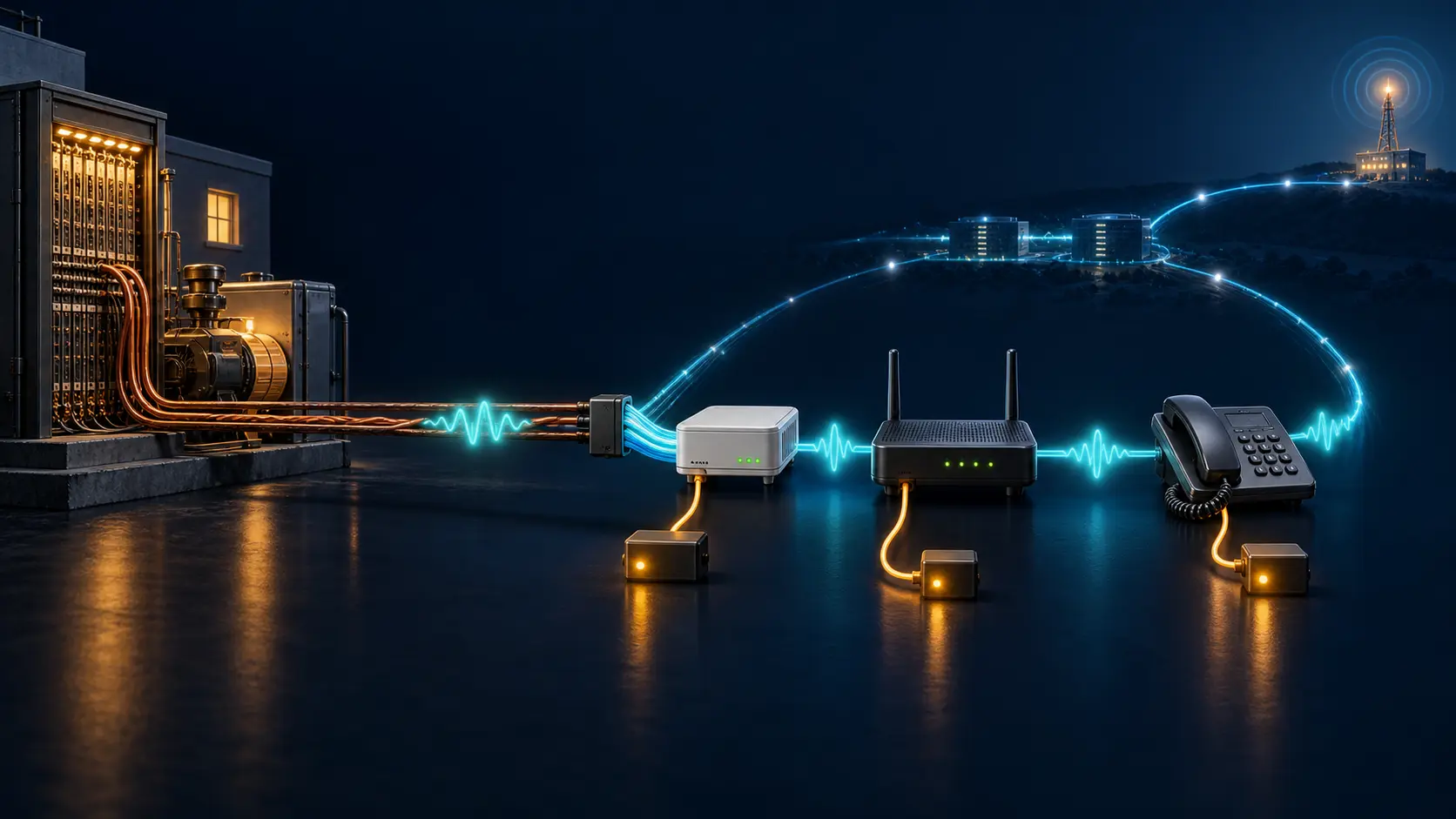
That is the observation at the centre of César Díaz's 26 August essay on LACNIC Blog, and it is the one sentence in the entire All-IP literature worth taping to a regulator's wall. A copper line could, under the right conditions, keep working through a blackout because the exchange was still standing. An IP service works because a modem, a router and a terminal in your home are still standing.
That is the point at which a network migration becomes a responsibility migration.
Handle the sourcing carefully, because the industry does not. Díaz writes as LACNIC's Head of Telecommunications Affairs, but the page carries the standard caveat that authors' views are their own. This is an essay, not a policy. And LACNIC is a registry: it records, it does not regulate. Asking it to fix national backup rules would be as misplaced as asking a librarian to rewire the building.
Nor was copper a miracle. Cordless handsets, powered street cabinets, water in the joints and flat central batteries all broke the old promise in their own time. A well-built fibre or wireless network with real batteries, generators and diverse access beats neglected copper every day of the week.
None of that rescues the word "backup" from the question the essay puts to it. Backup for what, exactly, for whom, and until when?
One call, four power clocks
At the premises, an IP call may need a handset or analogue adapter, a router, and an optical-network terminal or modem. Their batteries have different capacities, different ages and — crucially — different owners. Beyond the front door, an access cabinet, radio site or passive optical network leads to aggregation and the operator's voice platform. An emergency call then depends on number recognition, caller-location information, service-boundary mapping, SIP signalling, interconnection and the public-safety answering point.
The IETF's emergency-calling work makes the division visible. RFC 5012 treats emergency service as an end-to-end IP problem and identifies location both as an input to routing and as information for the call taker. RFC 6881 distributes the work across devices, access networks, service providers and emergency infrastructure. Dial tone at the handset therefore proves far less than a completed emergency path under outage conditions.
Every link can belong to a different operator and run on a different recovery clock. A customer believes the battery shipped with the router protects the service, while the optical terminal has none. An access provider keeps the broadband path alive while a separate voice provider loses its session platform. The voice platform hums along while an address change leaves emergency location stale. A mobile fallback gets named in the brochure without anyone checking indoor coverage, congestion, disability access, or whether the user owns a charged compatible handset.
This is not an argument for freezing the public switched telephone network. It is an argument against letting the architectural label "All-IP" stand in for the service promise.
No single battery rule — and that is precisely the point
There is no sensible one-size battery rule for Latin America and the Caribbean. The region holds dense fibre markets, islands, mountain communities, long distribution feeders, places where mobile is the practical fallback and homes where it is not. Electricity reliability, storm exposure, equipment ownership, emergency numbering and consumer-protection powers differ by jurisdiction. Publishing exact site autonomy or exploitable topology would be irresponsible anyway.
The UK example is useful precisely because it is an example, not a model law for the region. Ofcom tells consumers that digital landlines need mains power unless backup is available, requires providers to assess vulnerable users, and describes free backup solutions with stated duration expectations. Its 2026 resilience material also concedes that migration from the PSTN changes inherited power resilience. The lesson is not "copy one hour" or "copy seven hours". The lesson is that the responsible party, the eligible user, the promised duration and the fallback can all be written down.
What a migration receipt must actually say
A public migration receipt would do exactly that without pretending every network is identical. For each material service design it should state which premises devices are necessary; who supplies, owns, maintains and replaces them; who qualifies for backup; what runtime is promised and under what load; whether the promise covers ordinary calling, emergency calling or both; how caller location is obtained and updated; what access and core fallbacks exist; and what the customer must do before an outage.
The receipt also needs evidence, not just nouns. Operators should record representative tests with ageing batteries, realistic voice and data load, loss of utility power, congested fallback, and a completed emergency-routing test where law and safety procedures permit. Public reporting can aggregate results and exception volumes. Protected diagrams, personal data and exact vulnerabilities stay private.
Finally, the receipt must name who owns restoration. If a supplied battery has expired, if an optical terminal and a router have mismatched autonomy, or if the emergency-location record is wrong, the customer should not have to arbitrate among an equipment vendor, an access provider and a voice reseller while the line is down. A named escalation path and a dated correction history are part of the product, not a courtesy.
None of this proves that a particular operator or regulator lacks such controls. Díaz's essay is explanatory, not an audit. Its value is that it drags the changed power boundary into public view. The next step is to give that boundary an owner and a test.
Sources
- LACNIC Blog, 26 August 2026: English, Spanish and Brazilian Portuguese.
- IETF RFC 5012, Requirements for Emergency Context Resolution with Internet Technologies.
- IETF RFC 6881, Best Current Practice for Communications Services in Support of Emergency Calling.
- ETSI TR 102 445 V1.2.1, emergency communications over IP networks.
- Ofcom: digital-landline transition, 2026 network and service resilience guidance and emergency access during a power cut, used only as UK comparisons.
Member Briefing
Read the full trend briefing
Members read the full briefing with the source notes behind every finding.
Strategic Circle
A daily briefing in your language, built from changes we have verified.
Join for USD 20/monthCancel anytime.
Members also get the full research library, a daily briefing on the networks they follow and the private forum.




