
Content Type
Research
Within the Content Type facet, Research intelligence gathers BTW.MEDIA articles that share the same editorial format, helping readers compare briefings, profiles, risk notes, market analysis, and event coverage without mixing different kinds of evidence. The page explains how this content type frames internet infrastructure events, company movements, governance decisions, operational signals, and public evidence across the site. Readers can compare which actors or infrastructure systems appear most often, how source quality changes interpretation, and whether the material is a durable profile, a time-sensitive event, a strategic market signal, or a governance development. The result is a useful search page for operators, investors, customers, analysts, and policy stakeholders who need to understand the consequence, timing, and evidence behind similar article formats.

IETF
A Deprecated TLS Suite Is Not a Disabled TLS Endpoint
RFC 10015 changes what compliant TLS 1.2 and DTLS 1.2 implementations may offer or select. It does not reach into a listener, rewrite a proxy policy, reload a process or prove what was negotiated yesterday. Closing that gap requires evidence from the registry all the way to the…

Europe and Middle East Regional ISP Trends
Digi Portugal’s market test has moved beyond launch — but not yet beyond proof
Digi’s Portuguese entry now has an operating platform, an acquired customer base and a mechanism for putting pressure on the country’s established telecom groups. The harder question is whether that mechanism has produced measurable, durable market change.

Europe and Middle East Regional ISP Trends
ROYA Communications and AS210837: How to Test Network Continuity Without Mistaking Visibility for Proof
ROYA Communications and AS210837: How to Test Network Continuity Without Mistaking Visibility for Proof intelligence summary explains the development, the public evidence available to readers, the organisations involved, the regional context, market exposure, and the…

IETF
Fresh Entropy Entered the Session. Recovery Still Needed Proof in Both Directions
TLS 1.3's ordinary KeyUpdate advances a secret already known to the current chain. The active Internet-Draft for Extended Key Update proposes something stronger: rerun the negotiated key exchange inside a live session and mix fresh input into the next traffic secrets. That can…

IETF
A `_for-sale` Record Is a Listing Signal, Not Proof of Seller Authority
RFC 10023 gives a domain holder a public, machine-readable way to say that a name is available. The signal can open a negotiation; it cannot establish who may bind the seller, whether the stated price still applies, or whether a registrar will complete the transfer. Those states…

CASE FILE
Sirius Telecom’s missing operating chain
The public record places Sirius Telecom in the Directory as a global network operator and links the name to PeeringDB network 1283. It does not yet establish the chain that would turn that label into an independently verifiable operating business: a legal entity, a functioning…

Global Institutional Trends
Utherverse Network Operations: What AS33169 Can—and Cannot—Show About Continuity
A forensic examination of the public record around Utherverse Network Operations finds a network identity, but not yet an auditable picture of who controls prevention, detection, response or durable repair.

ICANN
ICANN’s Remedies Are Not One Appeal: Who Can Stop, Review or Reverse a Decision?
ICANN’s accountability system does not place every objection on one appellate ladder. It distributes authority among the Board, the Empowered Community, ICANN’s staff-facing reconsideration process and an independent review panel. The practical question is therefore not simply…

IETF
Standards Become Infrastructure When Operators Must Carry Their State
IETF standards do not operate networks. They define the state machines, security dependencies and recovery procedures that networks must implement if they are to interoperate. That distinction matters when a protocol becomes part of the Internet’s operating surface: continuity no…

History
RFC 10028 and the Institutional Boundary of IPv6 Multicast
RFC 10028 did more than tidy an IPv6 registry. It shows how an IETF decision becomes operational authority: a standards document changes the allocation map, and IANA gives that decision a durable administrative surface. The result is a cleaner boundary between multicast uses—but…

Story
A Scan Found 4,611 Exposed BGP Routers in APNIC. It Cannot Say Why They Were Open
At APNIC 62, researchers put a regional number on a quiet control-plane problem: 4,611 routers across 1,343 APNIC-region autonomous systems answered an unsolicited BGP OPEN exchange in a February IPv4 scan. That is firmer evidence than a port banner, but it is neither a breach…
Number Resource Society
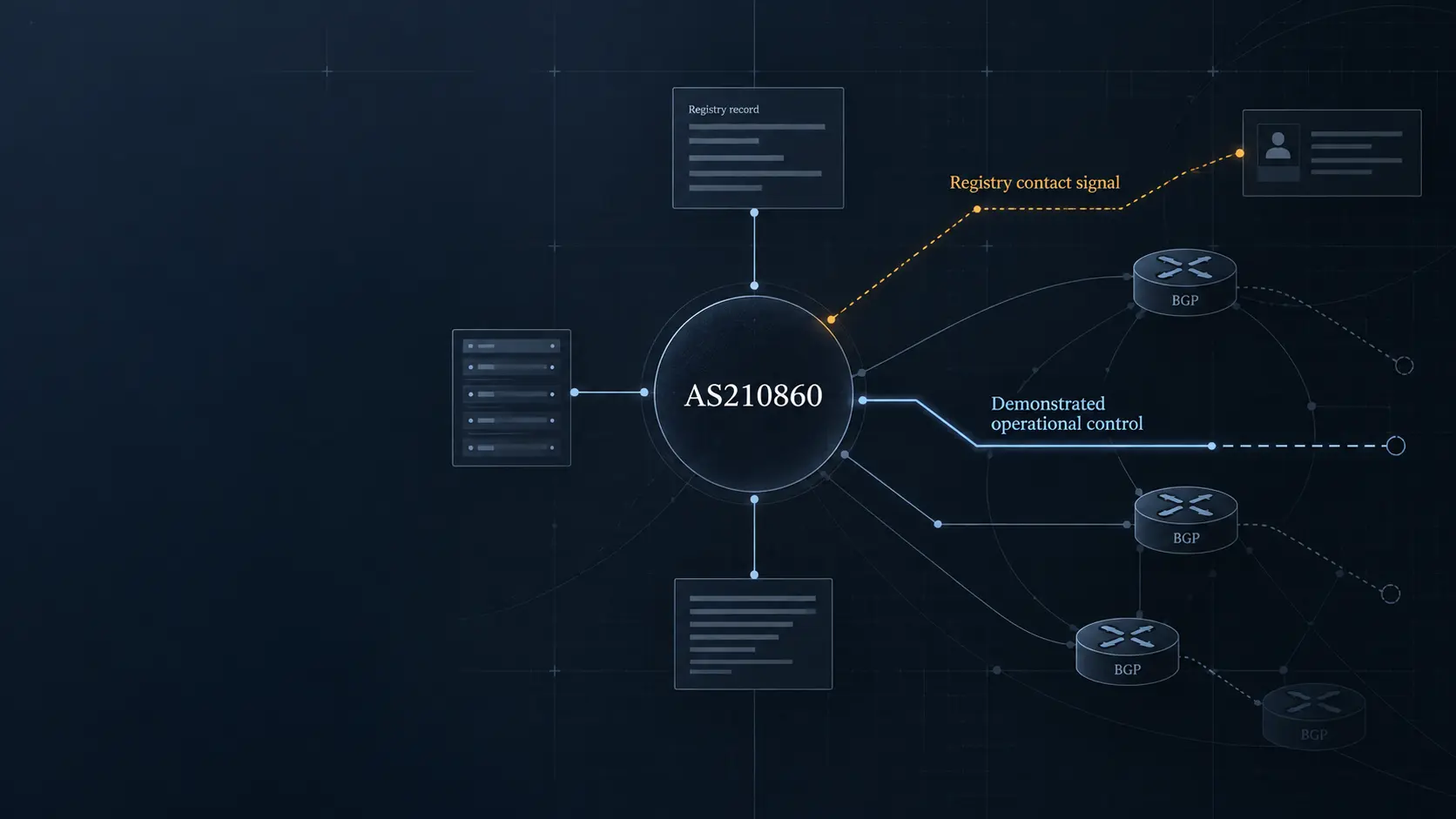
DFINFRA and AS210860: the registry signal still stops short of operational control
DFINFRA and AS210860: the registry signal still stops short of operational control intelligence summary explains the development, the public evidence available to readers, the organisations involved, the regional context, market exposure, and the infrastructure consequences that…

IETF
A D-PATH Stops Loops Only When Gateways Agree on the Domain
A BGP attribute can carry a domain history, but it cannot decide what a domain is. RFC 10039 makes that prior decision operationally consequential: the same configured identifier that lets a gateway reject a returning route can also discard a legitimate route when the gateways…

Leaders
Osipenko Alexander Nikolaevich: The Control Question the Public Record Still Cannot Answer
Osipenko Alexander Nikolaevich: The Control Question the Public Record Still Cannot Answer intelligence summary explains the development, the public evidence available to readers, the organisations involved, the regional context, market exposure, and the infrastructure…

IETF
The Route Carried a Domain Path. The Tenant Still Needed Proof: RFC 10039
RFC 10039 arrives with a practical answer to a dangerous ambiguity: when tenant reachability is re-originated between EVPN and IPVPN domains, redundant gateways need a way to recognize that a route has come back. Its new D-PATH attribute records the declared domain sequence and…

IETF
RFC 7506 Is Historic. Router Alert 69 Can Still Be on the Wire
A standards register can retire a behavior without touching a single router. RFC 7506 is now Historic, its MPLS OAM Router Alert value is deprecated, and RFC 9570 says new LSP Ping implementations must not set it. None of those facts proves that value 69 has disappeared from an…

IETF
A NAT64 Mapping Is Not a Filtering Policy
A repeatable public tuple can prove how a stateful NAT64 translator allocates an address and port. It cannot prove which IPv4 sources are allowed to use that state on the way back. Treating those two facts as one control turns an interoperability test into a security verdict it…

IETF
The disclosure rule that does not travel alone
An incident report can inherit its sharing conditions from the structure around it. Turning that report into a convenient extract is therefore a policy decision, even when none of its factual fields changes.

Story
AFRINIC's 8 September Snapshot Returned Four Old Resources to “Allocated.” It Cannot Say Why
Three ASNs and one /19 crossed AFRINIC’s public boundary together between two signed daily files. Their 2006 dates came back with them. That is evidence of a current state change, not evidence of a new allocation—and the distinction deserves a small public receipt.

Leaders
Osipenko Alexander Nikolaevich: What the Registry Shows—and What It Does Not
Osipenko Alexander Nikolaevich: What the Registry Shows—and What It Does Not intelligence summary explains the development, the public evidence available to readers, the organisations involved, the regional context, market exposure, and the infrastructure consequences that may…