
Summary
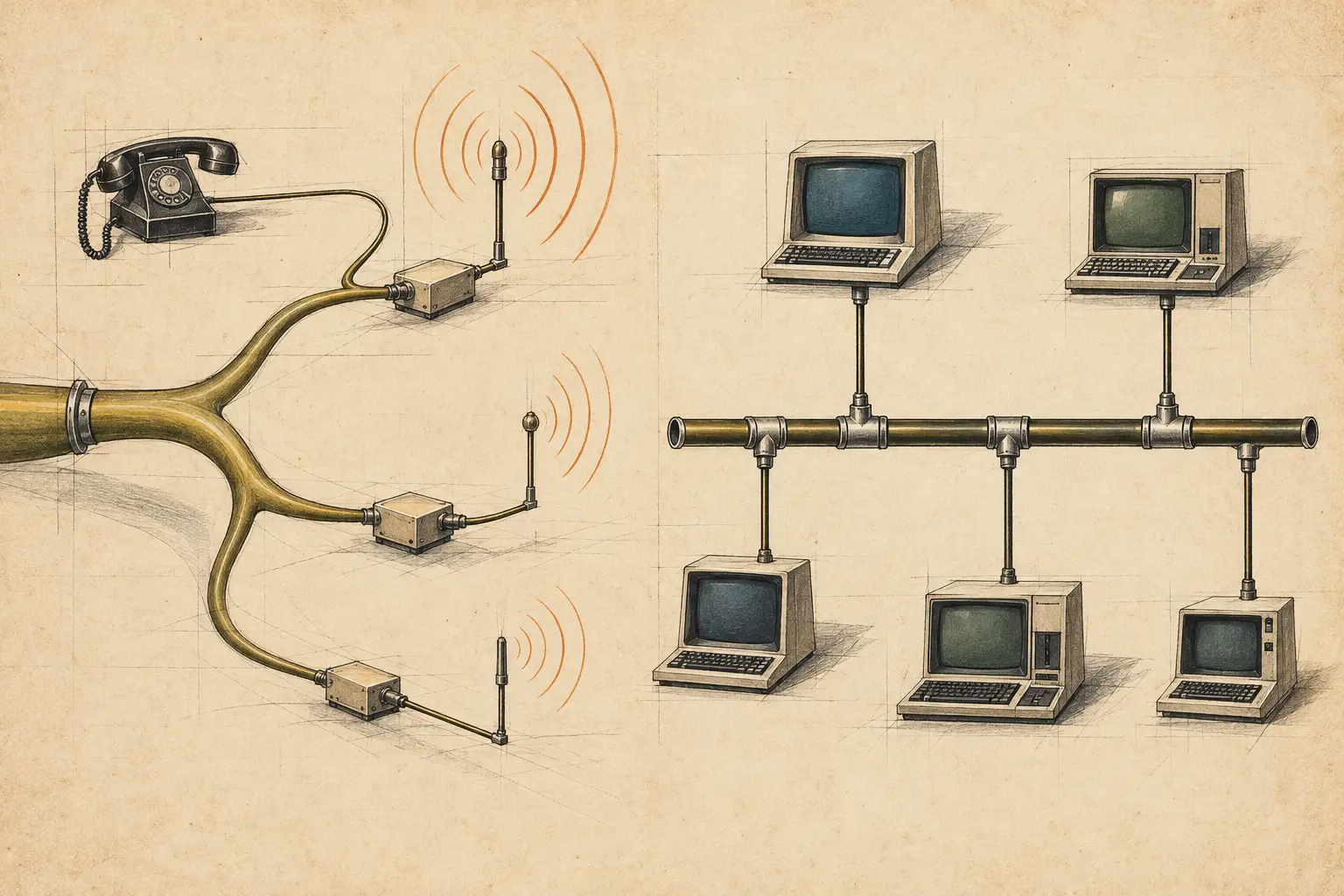
- The 1973 Ethernet proposal diagram reached across branched cable, telephone and radio media; the 1980 DIX document instead specified a local data-link and physical service.
- Its authors wanted compatible implementations, while explicitly declining to warrant that products would work as intended or interoperate. A goal and a guarantee are different things.
One drawing, several kinds of “ether”
On 22 May 1973, Xerox PARC researcher Robert Metcalfe wrote a memo proposing Ethernet. The Computer History Museum’s record of the preserved document describes a hand-drawn figure in which “boosters” interconnected branched cable, telephone and radio “ethers.” The drawing is striking because its network boundary is still open: it treats distinct transmission media as parts that might be joined into a wider communication system.
That is a proposal, not a diagram of a network already operating across those media. It is also not a blueprint for the Internet. A contemporary document makes the distinction visible. The December 1974 TCP specification describes an internetwork packet carried inside a local packet and explains how a gateway unwraps one local format before forwarding the packet into another network. Its authors list Metcalfe among people who helped clarify early design questions. The overlap shows that contributors to local networking also helped clarify a broader Internet architecture; it does not make Ethernet itself the protocol for linking networks.
DIX made the boundary implementable
The September 1980 Version 1.0 specification names Digital Equipment Corporation, Intel Corporation and Xerox Corporation as its joint authors. Its cover does not call the document a general Internet architecture. It calls Ethernet “A Local Area Network” and specifies the data-link and physical layers. The preface describes a collaborative effort built on several years of Xerox work on an earlier experimental Ethernet, and says the document is a design reference for implementers.
The distinction matters in the introduction. Ethernet is presented as a communication facility for computers and other digital devices in a moderate-sized area. The specification places that service between long-distance, lower-speed networks and very short, high-speed interconnections. It also makes its own limit explicit: it defines the lowest two layers, but does not define the higher-level protocols required for a complete network architecture, including internetwork communication.
That is not a missing chapter the reader should silently fill in. It is the seam that lets different work proceed at different layers. Ethernet could define how a local frame used its channel and reached another station; other protocols could define how data moved between networks or what an application did with it. The 1987 Assigned Numbers RFC shows how named protocols met that link boundary: its Ethernet Numbers section records type assignments, including 0x0800 for IP, and its references identify DIX’s 1980 Version 1.0 document as well as a 1982 revision. This is evidence of a protocol-reference system, not a count of deployed machines.
The careful difference between a goal and a warranty
The DIX specification calls compatibility one of its main objectives. It says implementations are intended to exchange data with one another. Yet an opening disclaimer says Digital, Intel and Xerox did not warrant that the specification or products made in conformance with it would work as intended or be compatible with other products.
Those statements operate at different levels. One describes the technical outcome the specification was designed to make possible; the other limits what its publishers promised or assumed responsibility for. The disclaimer does not prove that implementations failed, and it does not cancel the engineering value of a common design reference. It does mean that “the specification intended compatibility” cannot safely be rewritten as “every compliant product was guaranteed to interoperate.”
The next institutional milestone was not a magical resolution of that distinction. IEEE’s catalogue records IEEE 802.3-1985, a CSMA/CD access-method and physical-layer standard, as published on 31 December 1985. The catalogue entry establishes a later IEEE standardization stage; it alone does not document every step from the DIX effort or certify individual products.
Ethernet’s lasting historical role is therefore more precise than the familiar claim that one 1973 memo invented the Internet. A broad sketch became an engineered local link with an explicit edge. That edge let Ethernet carry protocols whose authors could work above it, while preserving the fact that link compatibility, network-to-network communication and real-world product behavior were separate questions. The Internet was not inside the Ethernet drawing. One of its durable building blocks was.
Sources
Member Briefing
Deeper Profile Context
Sign in with the right membership level to unlock the full briefing and source notes.
Only for Strategic Circle
Strategic Circle
Open to all readers. Unlock profile briefings after joining and signing in.
Join Strategic CircleOnly for Leadership Alliance
Leadership Alliance
For qualified IP-asset owners and management; sign in to unlock alliance briefings.
Join Leadership Alliance