
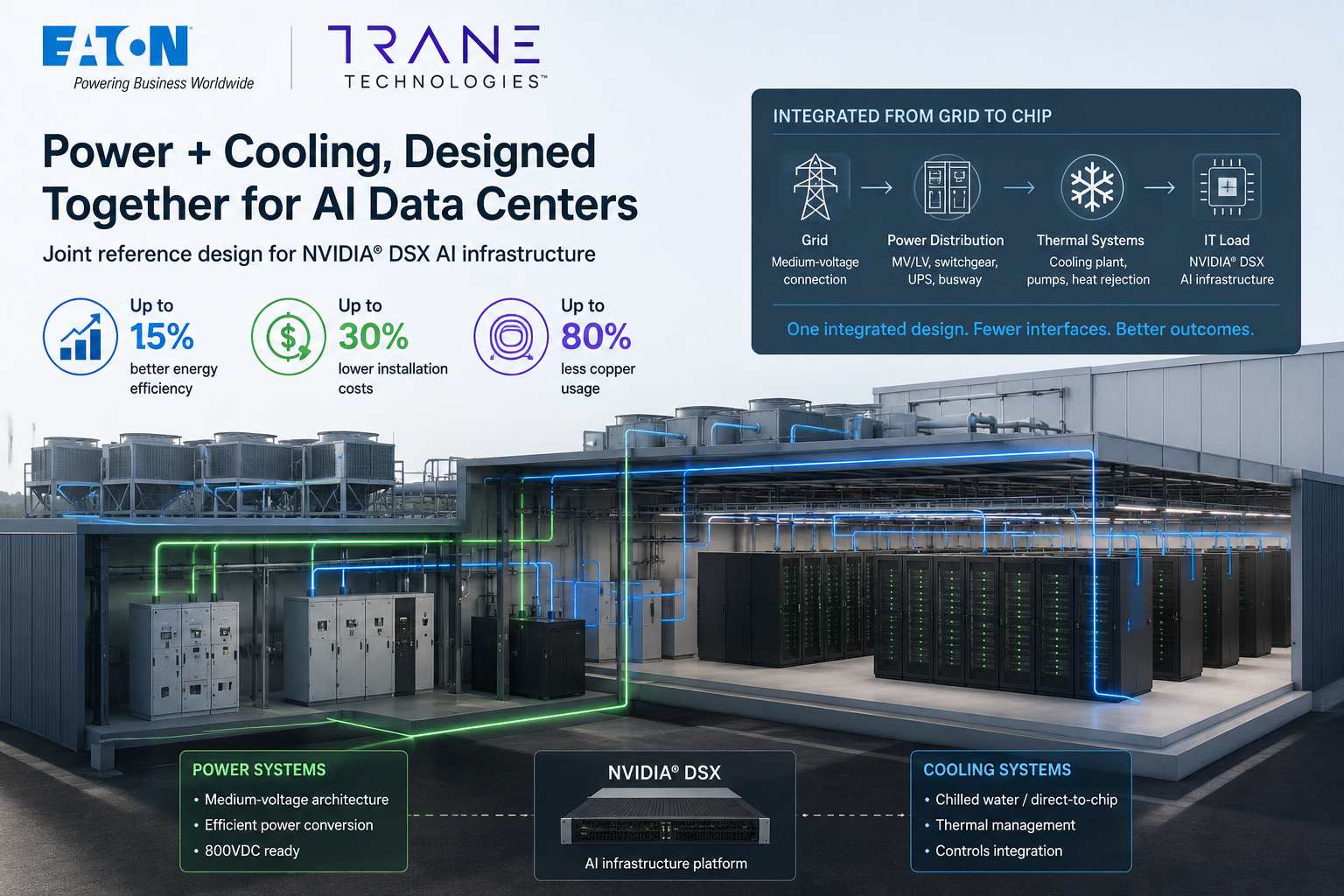
- Eaton and Trane Technologies have introduced a joint reference design that coordinates medium-voltage power, cooling and controls for NVIDIA DSX-based AI data centres
- The companies claim up to 15% better energy efficiency, 30% lower installation costs and 80% less copper than conventional low-voltage designs, but no named deployment has been disclosed
The fact
Eaton and Trane Technologies have introduced a joint reference design that brings electrical and thermal systems together for high-density AI data centres. The architecture is aligned with NVIDIA's DSX platform and is included in Eaton's Beam Rubin DSX and Trane's Continuum Rubin DSX platforms.
The design uses medium-voltage electrical infrastructure and coordinates power distribution, cooling and digital controls from the grid through to the equipment inside the data hall. Eaton and Trane say the systems can exchange operating information rather than being designed and managed as separate packages.
Compared with conventional low-voltage designs, the companies estimate that the architecture could improve combined energy efficiency by up to 15%, reduce installation costs by up to 30% and cut copper use by as much as 80%. These are vendor estimates. Eaton and Trane have not identified a data centre using the complete joint architecture or published operating results from a completed deployment.
The assessment
In an AI data centre, power and cooling have to work together, but they are often designed by different teams. As rack densities rise, a change to the electrical system can affect cooling, space and equipment elsewhere in the building. Eaton and Trane are trying to deal with those connections earlier, before procurement and installation begin.
That could reduce the amount of redesign needed later, although the savings Eaton and Trane have published are still estimates. Every site will have its own power supply, redundancy requirements, building layout, cooling system and IT load, so the final design may differ considerably from the reference architecture.
For BTW readers, the next step is to see the design used in a real data centre. A named project, followed by construction and commissioning results, would show whether bringing power and cooling planning together actually makes delivery simpler.
What to watch
Watch for the first named operator using the joint design, followed by construction and commissioning data. Equipment counts, cable volumes, installation time and measured energy use would allow the vendor estimates to be tested against a real project. Changes required for local utility, redundancy or cooling conditions would also show how much of the reference design survives site-specific engineering.
Member Briefing
Deeper Profile Context
Sign in with the right membership level to unlock the full briefing and source notes.
Only for Strategic Circle
Strategic Circle
Open to all readers. Unlock profile briefings after joining and signing in.
Join Strategic CircleOnly for Leadership Alliance
Leadership Alliance
For qualified IP-asset owners and management; sign in to unlock alliance briefings.
Join Leadership Alliance