Summary
- At 30 September 2026, Equinix had about $6.4 billion of contractual capital-expenditure commitments for work and equipment not yet accrued, chiefly unfinished IBX expansions. Most is payable within the following twelve months, according to its Form 10-Q.
- Equinix spent $4.392 billion on capital projects in the first nine months and expected $5 billion to $6 billion for all of 2026. Those are spending measures for a different window. The $6.4 billion is a stock of work already contracted at quarter-end, not a second 2026 capex forecast.
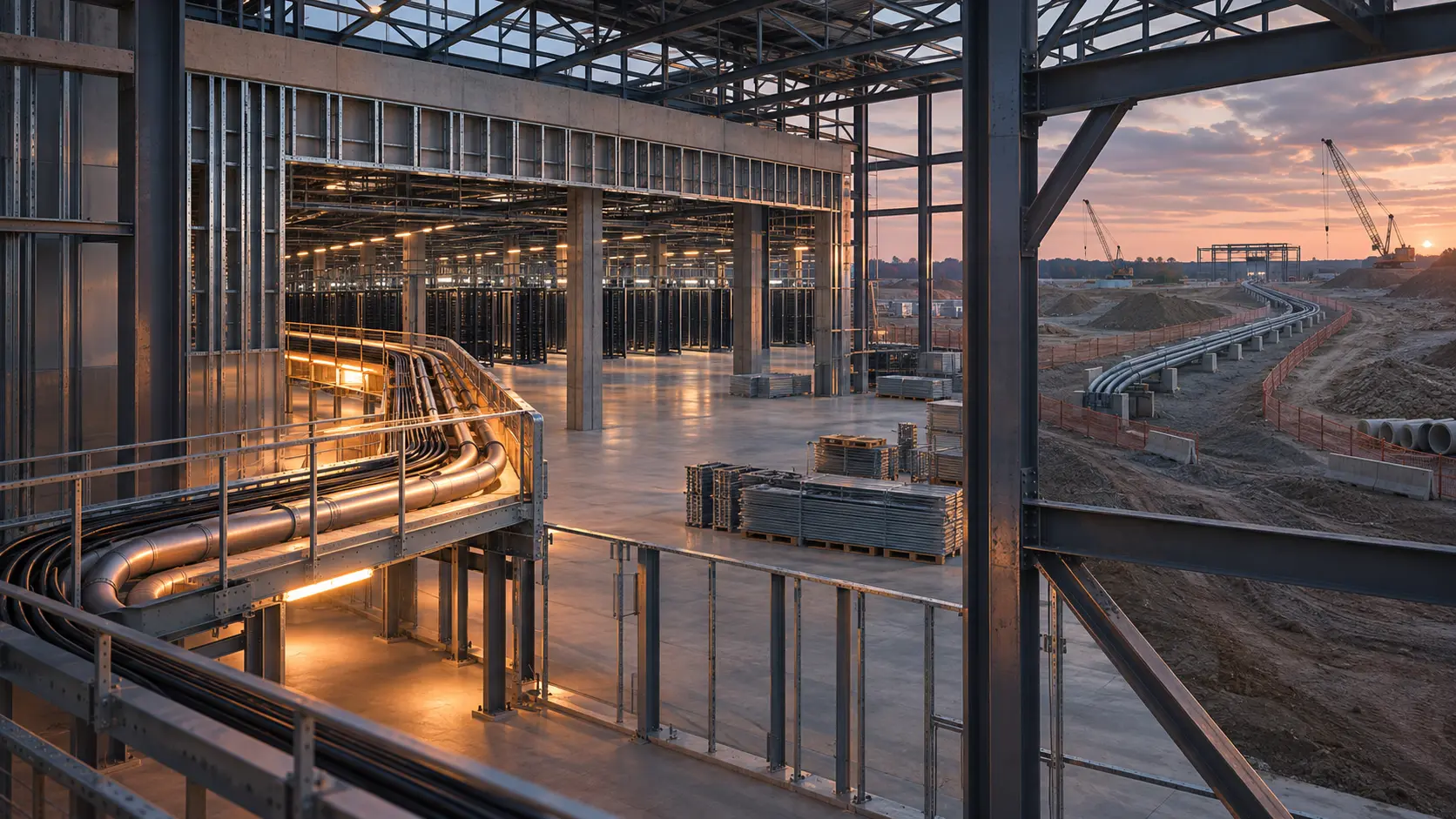
The build arrives before the customer
An empty rack is easy to photograph. A purchase commitment for the rack, the switchgear and the crew is easier to bury in a footnote. Equinix's September filing does the reader a favour: it puts a number on the work still moving from contract to installed asset. About $6.4 billion of capital expenditure was contractually committed but unaccrued on 30 September. The underlying equipment had not been delivered and much of the labour had not been provided. Most of the amount falls due within twelve months.
The figure is large because Equinix builds before a customer can install equipment. It does not mean $6.4 billion was overdue, that the whole sum will be paid in the fourth quarter, or that a new $6.4 billion obligation appeared in September. The 2025 annual filing already showed approximately $6.3 billion of similar unaccrued capital commitments at year-end. Equinix has been paying for one cohort of projects while another cohort enters the queue.
This is a different clock from the company's earnings headline. Through September it recorded $4.392 billion of capital expenditures, up from $2.875 billion in the first nine months of 2025. Its third-quarter results put full-year 2026 total capex at $5 billion to $6 billion. The contracted but unaccrued work can be delivered, recorded and paid across later periods. Adding it to the annual guidance as if both were fresh 2026 cash outlays would double the drama and spoil the arithmetic.
The filing also lists $2.4 billion of other purchase commitments, including power in some locations. Its schedule of $8.759 billion in future purchases combines capital and non-capital commitments: $2.211 billion falls in the remaining three months of 2026 and $3.409 billion in 2027. Equinix says some multiyear power purchases cannot be priced into that schedule because prices or minimum volumes are unspecified. The schedule is a payment map, not a complete power bill.
Money has its own queue
For the first nine months, operations produced $3.027 billion in cash while investing used $4.876 billion. Financing supplied a net $2.433 billion; Equinix said the rise from the prior year was driven mainly by more net proceeds from senior notes. At quarter-end it held about $3.6 billion in cash and short-term investments and reported $5.5 billion of unused revolving-credit capacity. The latter is permission to borrow, not money already sitting in a bank account. Total indebtedness, including finance leases, was about $25.2 billion.
Equinix says its liquidity sources can meet the commitments. The filing does not assign a particular bond issue, customer prepayment or credit draw to each unfinished hall. That allocation matters because the market rewards a booking immediately while a construction contract keeps asking for cash until the hall can be installed, powered and billed. The company's own risk section says it may commit money before securing customer contracts and may build capacity that later demand does not fill. These are the same projects on two different timetables.
The next useful disclosure is not another photograph of a cabinet. It is how much of this contracted build has arrived, what portion is attached to paying customers, and which financing source carried it from order to service. Equinix has supplied the aggregate commitments and liquidity. It has not supplied that project-by-project bridge.
Member Briefing
Deeper Profile Context
Sign in with the right membership level to unlock the full briefing and source notes.
Only for Strategic Circle
Strategic Circle
Open to all readers. Unlock profile briefings after joining and signing in.
Join Strategic CircleOnly for Leadership Alliance
Leadership Alliance
For qualified IP-asset owners and management; sign in to unlock alliance briefings.
Join Leadership Alliance