
Summary
- In 1991, Portugal’s RCCN carried IP across a mixed backbone: direct lines served some Lisbon links, while public X.25 connected other institutions and carried international IP.
- The FCCN project report says periodic dynamic-routing updates nearly consumed public X.25 bandwidth. Because the logical network was star-shaped, the team moved to static routing.
The network did not begin with a single clean leap from Portugal to “the Internet.” The FCCN execution report, prepared in January and revised in March 1992 about work during 1991, describes a national academic project still assembling its links, route policy, names and operating rules. Its most revealing passage is not a national speed figure. It is a routing problem encountered on the links that the project actually had.
In 1990, university researchers gathered as Forum-IP to propose TCP/IP services for RCCN, the National Scientific Calculation Network. FCCN sponsored the proposal and sought equipment funding through the Ciência programme. The report says the award covered equipment, not operating costs. A small technical group began the pilot in January 1991 anyway, to get experience before the foundation defined broader service rules. That sequence matters: the people writing the rules first had to make a network run.
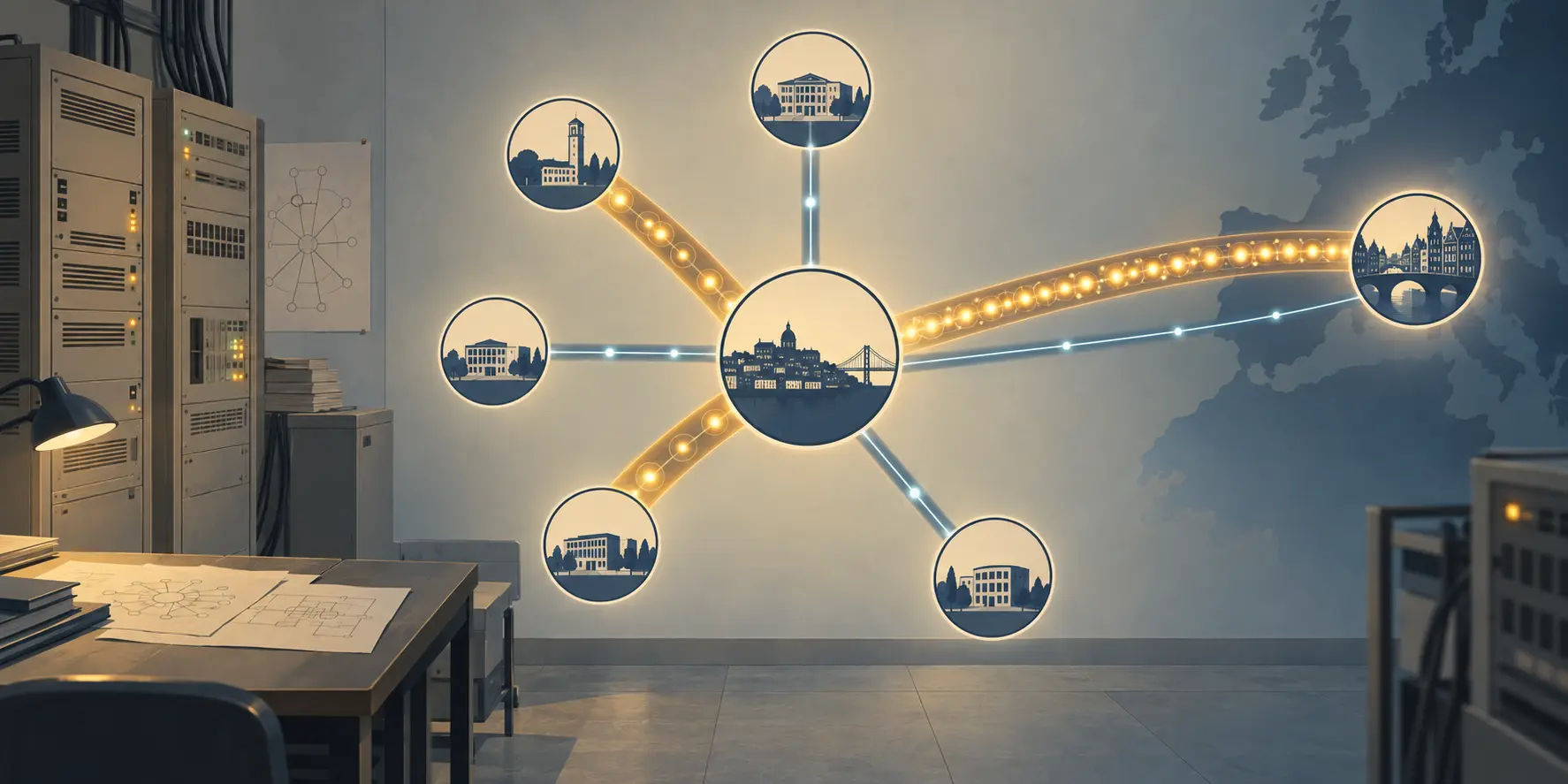
The backbone was arranged as a star around gtrccn1 in Lisbon. Some university links in Lisbon used direct lines. Institutions outside the city reached the central router over public X.25, carrying IP inside X.25; some Lisbon links used the same approach because there were not enough direct circuits. The report’s December 1991 network map offers a snapshot, not a complete account of every live route or institution.
The team tested dynamic routing over the public X.25 network. The report says periodic updates from each router almost used all available bandwidth, making dynamic routing “practically impossible” in that environment. The group then switched to static routes. That decision fitted the logical shape: edge routers sent destinations they did not know toward the central backbone and told it about networks directly attached to them. The change is evidence of engineers adapting a protocol’s operating cost to the transport they had, not evidence that static routing was universally superior or that X.25 capacity increased.
International reach was a separate layer. The report says RCCN established IP connectivity through access to the European IXI network, with IP carried over X.25. EUnet’s Amsterdam router connected that service to other European IP networks. Earlier relationships involving INESC and PUUG helped the team select EUnet as a partner. For transcontinental access, the report says participating Portuguese networks could use EUnet and PUUG’s path toward NSFnet; it lists “NSF connect status” for specified FCCN, Porto, Aveiro and INESC networks. This was not a claim that every campus or resident had the same global route.
The project also put conditions around international use. Institutions had to submit a formal request to FCCN, meet technical and formal requirements, and agree to contribute to service costs. A 2021 interview with project coordinator José Legatheaux Martins recalls an EU-subsidized X.25 line via INESC to Amsterdam being reconfigured for Internet protocols. That memory is useful context; the contemporary report provides the more detailed distinction between IXI access, EUnet’s European role and the specified routes toward NSFnet. A later interview with teammate João Neves emphasizes the geographically spread group and the work of joining university networks.
The route was therefore both a technical arrangement and a managed service: a star-shaped academic backbone, mixed direct and X.25 links, a static-routing choice, an international handoff, and rules for who could use it. The archive does not establish household access, universal X.25 use or the savings from the routing change. It does show why “Portugal connected in 1991” leaves out the engineering decisions that made a path usable.
Sources
Member Briefing
Deeper Profile Context
Sign in with the right membership level to unlock the full briefing and source notes.
Only for Strategic Circle
Strategic Circle
Open to all readers. Unlock profile briefings after joining and signing in.
Join Strategic CircleOnly for Leadership Alliance
Leadership Alliance
For qualified IP-asset owners and management; sign in to unlock alliance briefings.
Join Leadership Alliance