
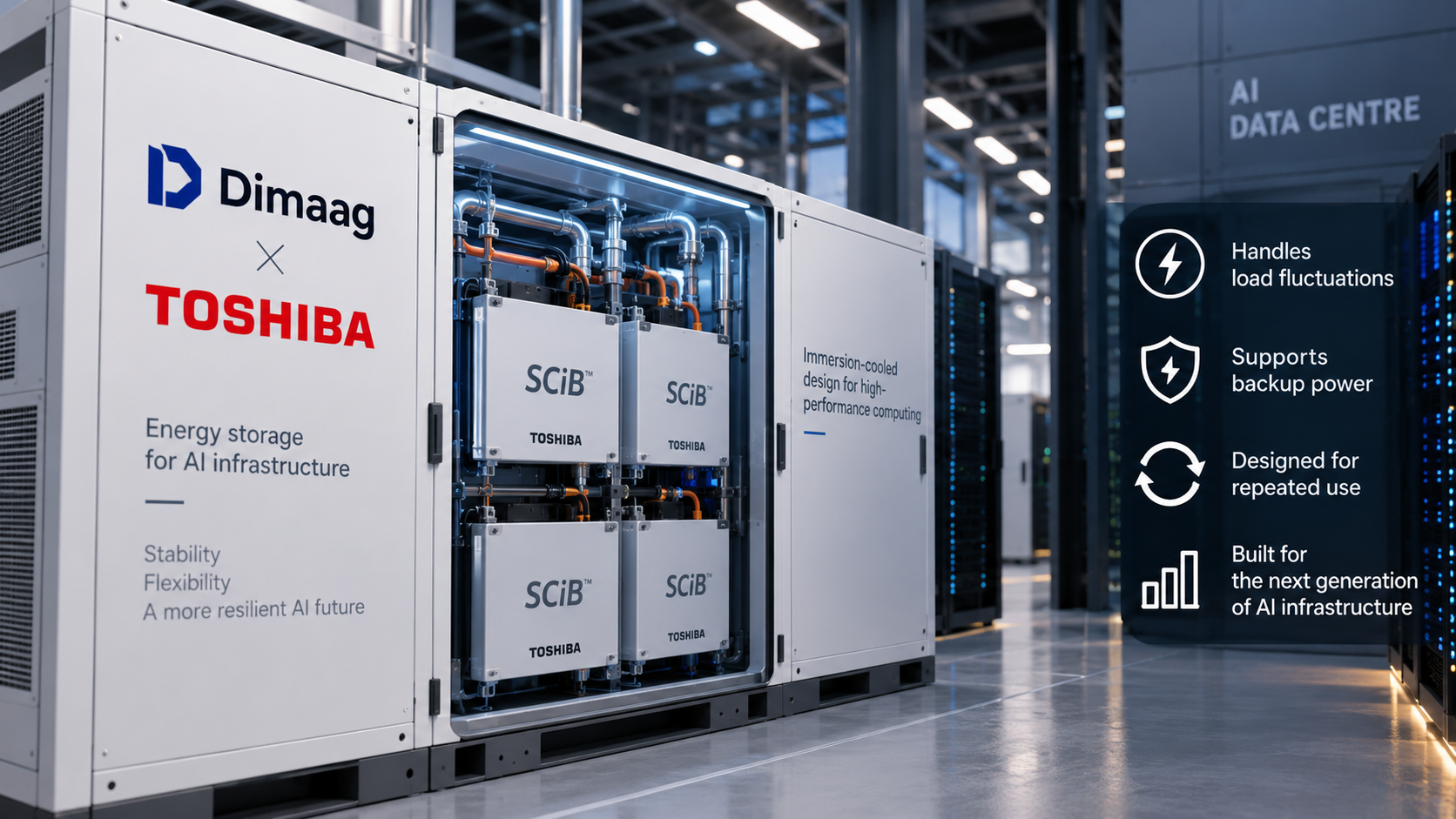
- Dimaag and Toshiba are developing battery storage designed to respond repeatedly to changing AI data-centre loads as well as power interruptions
- The system targets more than ten years of service, but the companies have not disclosed results from an operating customer installation
The fact
Dimaag and Toshiba announced a collaboration on 9 September to develop battery storage for AI data centres that can respond to changes in computing demand and provide backup power. The system will combine Toshiba's SCiB lithium titanium oxide batteries with Dimaag's active-flow immersion-cooled battery design. The companies said the intended uses include smoothing changes in electricity demand, supporting equipment during brief voltage drops and responding to electricity-network requirements.
Dimaag plans to integrate the batteries with power-conversion equipment and real-time controls as part of its modular ZettaWatt platform, which uses an 800-volt direct-current architecture. Toshiba will supply the battery cells, while Dimaag will design, manufacture and integrate the wider storage system. The platform is designed so that additional battery modules can be added as a data-centre campus expands.
The companies said the system is being designed for frequent high-rate charging and discharging and a service life of more than ten years. The announcement did not identify a customer installation or provide field operating data, warranty terms, replacement schedules or measured whole-site energy savings.
Toshiba separately markets SCiB battery storage for conventional uninterruptible-power-supply applications, including a 480-volt system for large data centres. Its published product information covers backup operation, cabinet expansion and monitoring.erform.
The assessment
Data-centre batteries are usually associated with backup power during an outage. Dimaag and Toshiba want this system to do more than that, using it throughout normal operations as AI workloads rise and fall. If the battery is charging and discharging more often, buyers will need to know how well it holds up under that repeated use, not just how long it can keep equipment running in an emergency.
That also changes how the system should be tested. A data-centre operator would need to see how it responds to everyday changes in demand while still keeping enough capacity in reserve for a power failure. The cooling and control systems matter here too, because the battery has to perform consistently even when it is being used far more often than a conventional standby system.
For BTW readers, the stronger evidence will come from an operating data centre. A named customer, results from repeated cycling and warranty terms that cover this type of use would show whether the system can reliably handle both routine load changes and backup power. Until then, the proposed ten-year service life remains a design target rather than a proven result.
What to watch
Watch for a named data-centre installation and published tests showing how the system responds to repeated load changes while preserving backup capacity. Warranty terms covering that pattern of use, together with measured cooling demand and electrical losses, would provide a clearer picture of how the system performs in practice.
Member Briefing
Deeper Profile Context
Sign in with the right membership level to unlock the full briefing and source notes.
Only for Strategic Circle
Strategic Circle
Open to all readers. Unlock profile briefings after joining and signing in.
Join Strategic CircleOnly for Leadership Alliance
Leadership Alliance
For qualified IP-asset owners and management; sign in to unlock alliance briefings.
Join Leadership Alliance