Summary
- China Telecom and the Ministry of Emergency Management built a public direct-to-satellite emergency mechanism on Tiantong-1, per a current report citing China Telecom Satellite.
- It targets the triple failure of floods and landslides: cut fibre, dead base-station power, and no public 4G or 5G.
- A Huizhou trial preceded nationwide rollout; the mechanism was reportedly used in the Dingxi and Guangxi floods.
- Trapped Dingxi users sent their position and party size; rescuers arrived about 1.5 hours later — real operational use, not proof the satellite call set that clock.
- Supply figures: terminals in 123,000 high-risk villages, tens of millions of compatible handsets, 48 listed models.
- Still undisclosed: active subscriptions, successful-session rates, traffic, coverage, gateway capacity and rescue outcomes.
Ninety minutes after the ground went quiet
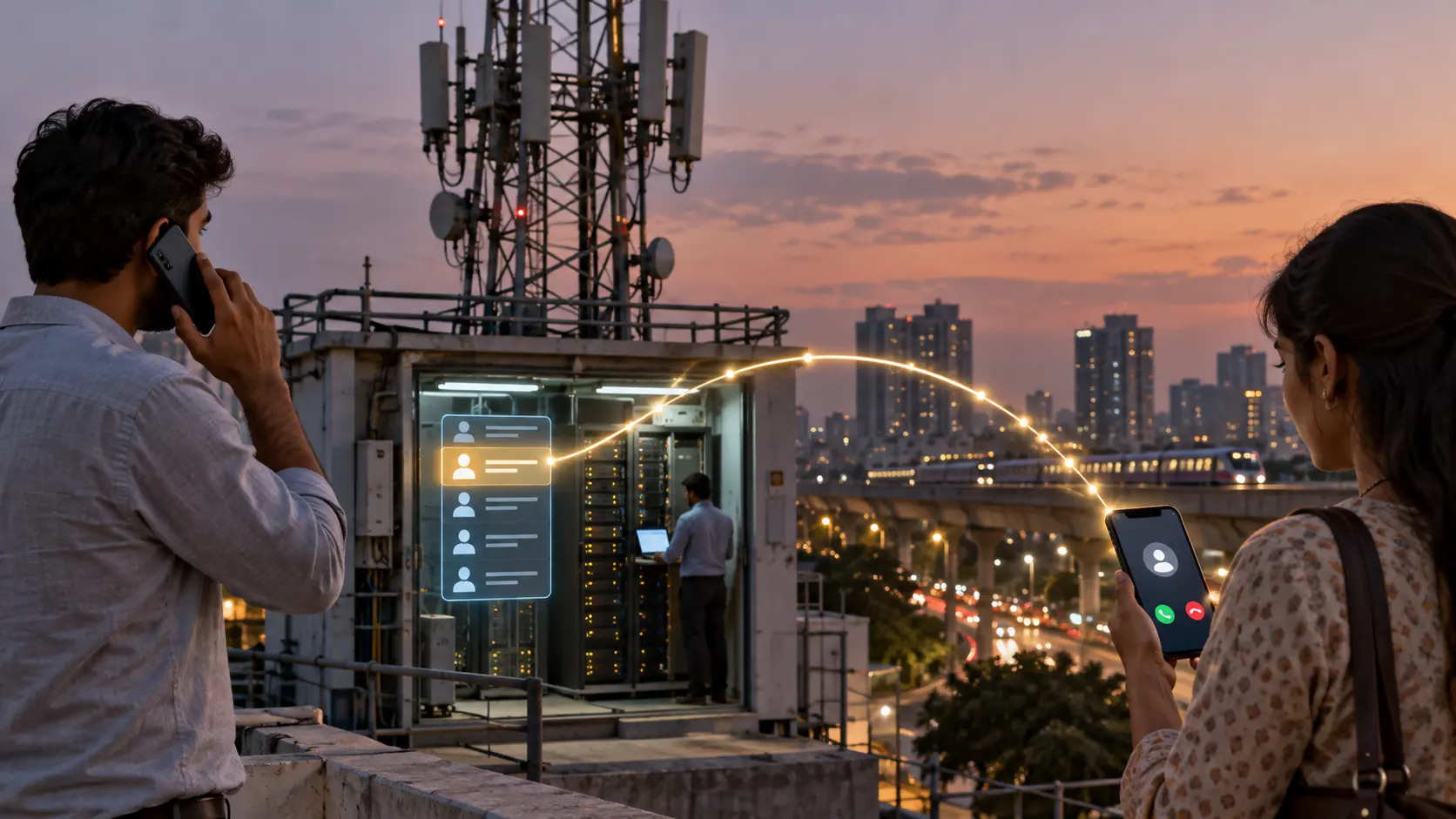
Somewhere on 26 July, the ordinary mobile network around Dingxi stopped being a network and became a rumour. Fibre gone, base stations dark, no bars. What came back instead was a position fix and a headcount, pushed up to a satellite and down into a dispatch room — and roughly ninety minutes later, people with ropes and boots arrived.
That is the story in miniature, and it is worth being precise about what it proves. It proves the channel carried actionable information when nothing else did. It does not prove the satellite shaved ninety minutes off the clock; dispatch decisions, where the teams already stood, and whether the road still existed all had a vote. The defensible claim is narrower and stronger: the fallback worked when the primary failed.
The failure mode is three failures wearing one coat
Floods and landslides do not politely break one thing. They take the fibre, they take the power at the base station, and they take the public 4G and 5G radio at the same time — three layers, one afternoon. A handset that talks directly to Tiantong-1 sidesteps the local radio site entirely, which is precisely the layer that drowned.
It does not sidestep physics. The phone has to support the function and have it switched on. The user needs a usable slice of sky and the patience to acquire it. Satellite and gateway capacity have to be free at that moment. And someone at the far end has to read the message and act on it. Continuity is a chain, and the weakest link sets its length.
Huizhou first, then a national promise
The mechanism was trialled in Huizhou, Guangdong, under landslide risk during the dragon-boat rains, then extended nationwide. That is a genuine transition — from a local experiment to a standing public arrangement between the Ministry of Emergency Management and China Telecom.
Nationwide, though, is a word about intent, not a coverage map. No province-by-province availability table, activation rate, acquisition-success figure or capacity plan for simultaneous disaster demand has been published.
Three numbers, three different questions
The programme reports dedicated satellite terminals in 123,000 high-risk villages. It reports satellite-capable handsets in the tens of millions. A July guide lists 48 compatible models.
These are not three views of one thing. Village terminals measure institutional kit placed on the ground. Compatible handsets measure potential hardware reach. Model count measures product variety. None of them counts enabled subscriptions, trained users, completed emergency sessions, or people actually reached on a bad night. A compatible handset is a promise; a session is a delivery.
Free 119 removes one toll booth, not the wall
During flood season, China Telecom users can reportedly dial 119 or local emergency duty numbers over the satellite route at no charge. That matters more than it sounds: the moment a person is weighing whether to spend money to shout for help is the moment they hesitate.
The boundaries remain. It does not make all satellite use free, does not make every handset version compatible, and does not make activation automatic. The public guide tells users to check hardware support, switch the function on, and practise acquisition before they need it — advice that is easy to give and hard to follow in a hurry.
Guangxi: the fallback becomes a field radio
In badly hit parts of Guangxi, where roads, electricity and communications went down together, civilian relief volunteers reportedly used satellite links to relay road conditions, supply shortages and shelter information to a rear command function, and to send messages home to families.
That widens the mechanism from a distress channel into a coordination layer — a different product with different demands. Message volumes, delivery rates, terminal concurrency and operational availability were not published, so treat it as a reported case, not a measured network result.
Protect the message, not the masthead
Here is the trap that catches every emergency programme. The rollout becomes the story: the terminals, the model list, the announcement. But continuity belongs to the function, not to the institution that announces it. What has to survive a flood is a message that gets acknowledged and acted on — not a press release about hardware that could, in principle, send one.
The scorecard should start with enabled users, successful acquisition, and completed call and message rates by disaster area. Then dispatcher acknowledgement, rescue dispatch, arrival and outcome — without pretending connectivity alone produced the save.
And then the question nobody has answered: capacity under concentration. A fallback that works for scattered users has not been tested until thousands of terrestrial sites fail in the same hour and the gateway has to choose. Satellite channel availability, gateway load and priority rules decide whether tens of millions of compatible handsets are an emergency access layer or a very large installed base of potential.
Sources
Member Briefing
Read the full trend briefing
Members read the full briefing with the source notes behind every finding.
Strategic Circle
A daily briefing in your language, built from changes we have verified.
Join for USD 20/monthCancel anytime.
Members also get the full research library, a daily briefing on the networks they follow and the private forum.