Summary
- JPL's 1996 invitation required postcards and excluded email, even as it promoted the mission's internet homepage.
- Volunteers digitized the submissions before the Cassini DVD was made; ESA's separate Huygens campaign collected signatures and messages through the web.
Getting your signature to Saturn began with a decidedly terrestrial instruction: find a postcard.
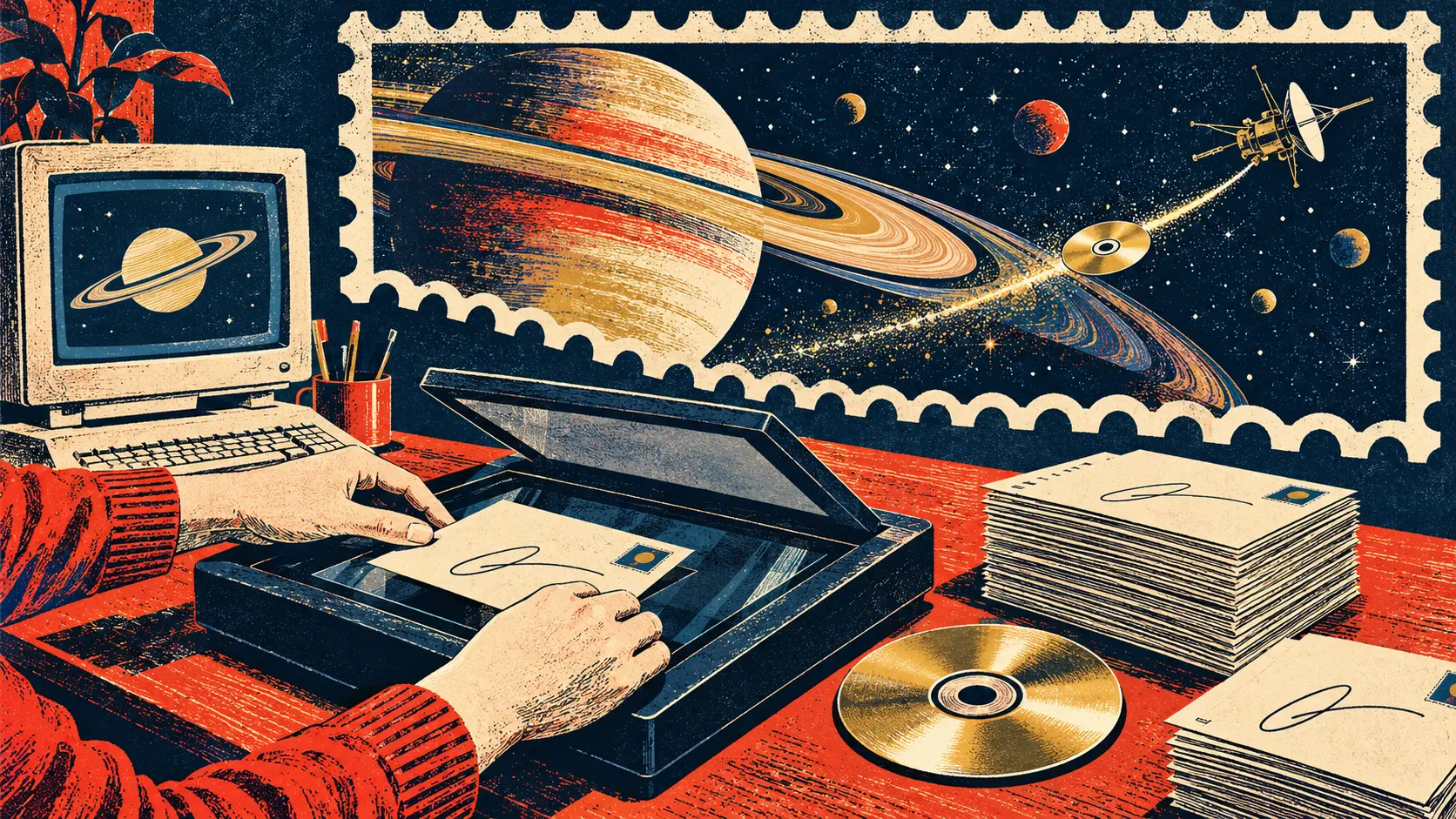
In JPL's invitation of 28 March 1996, the Cassini project offered to carry public signatures on digital storage aboard a spacecraft. It accepted several signatures on one plain postcard. It explicitly refused submissions by electronic mail. Anyone wanting confirmation had to supply a self-addressed, stamped envelope.
The same notice advertised Cassini's internet homepage. You could browse the mission online, then leave the computer and post your contribution. Deep space had a website; admission to this particular souvenir still involved the letterbox.
Before the disc, the mail
The closing rule was 1 January 1997, or earlier if the proposed storage filled. That put a boundary around the invitation. Someone had to receive the paper, prepare the signatures and finish the object that would travel.
NASA's August 1997 account describes that work: volunteers at The Planetary Society sorted and scanned submissions, recording them on data tapes. Families and schools sent signatures. Some people even sent pets' paw prints. The mail also carried poems, pictures and music, while the Cassini disc's content was limited to signatures.
This was participation with an editor and a production schedule. The public could send a small piece of itself; the project defined which part belonged on the final disc.
The signatures were recorded on DVD in May 1997. Ten copies were made, one intended for the spacecraft and the others for future museum display. NASA's later mission FAQ confirms that Cassini carried a DVD containing 616,400 digitized signatures from 81 countries. The humble postcard route produced a remarkably well-travelled collection.
Another spacecraft, another front door
The attached Huygens probe had its own contribution scheme. In February 1997, ESA announced a CD-ROM for European signatures and messages collected through a dedicated internet site. Media partners would direct their audiences there, including through links from their own websites.
ESA set 1 March as the collection deadline and said the information website would remain active afterwards. A site could continue telling the mission's story after the passenger list for its disc had closed.
The two arrangements sit neatly beside each other. Cassini's invitation specified postcards and a return envelope for acknowledgement. ESA's Huygens invitation used web links. Each project chose an intake channel, a cutoff and the material it would carry.
For internet history, the interesting machinery is on Earth. A mission homepage could reach curious readers immediately, while participation depended on a different chain of work. Volunteers supplied the conversion from handwriting to data; project decisions supplied the final boundaries. Before a signature could make its cosmic journey, somebody had to get through the post.
Member Briefing
Deeper Profile Context
Sign in with the right membership level to unlock the full briefing and source notes.
Only for Strategic Circle
Strategic Circle
Open to all readers. Unlock profile briefings after joining and signing in.
Join Strategic CircleOnly for Leadership Alliance
Leadership Alliance
For qualified IP-asset owners and management; sign in to unlock alliance briefings.
Join Leadership Alliance