
Summary
- Brazil’s second-generation research backbone extended domestic reach in 1992, but its initial project did not include international circuits. Michael Stanton’s history says traffic from RNP-connected states outside Rio de Janeiro flowed through ANSP’s São Paulo connection, while Rede-Rio used its own link.
- Rio-92 brought two separate 64 kb/s regional links into service for the Forum Global; RNP’s retrospective describes a later 1995 backbone with exits in Brasília and São Paulo. National coverage and international route diversity were separate stages.
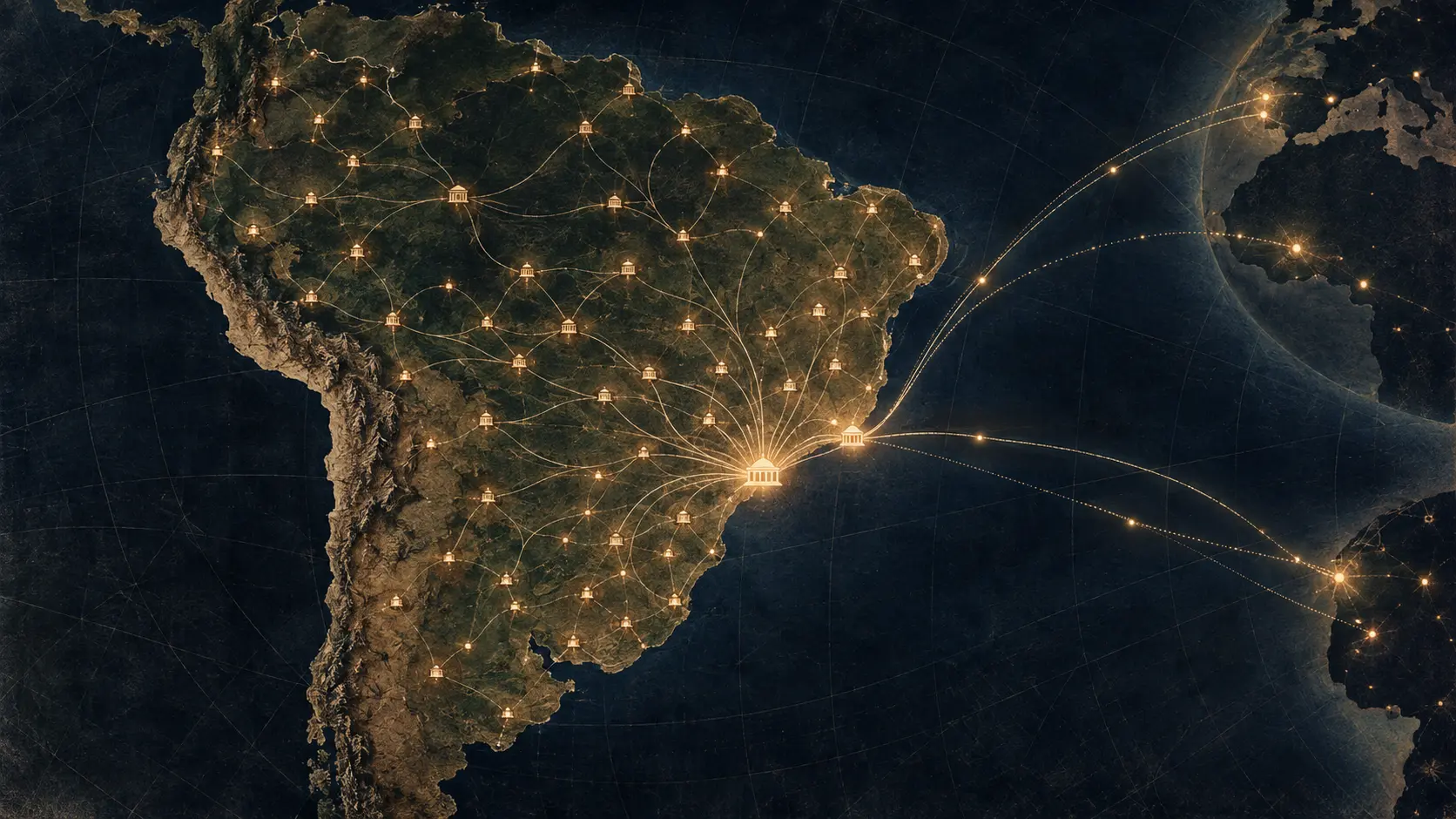
A national map, a regional way out
In the early 1990s, “the Brazilian network” was not one circuit with one start date. It was a set of institutional links, regional systems and a national backbone being assembled in stages. The distinction matters because a map of domestic reach does not show where traffic crosses a national boundary.
São Paulo’s Academic Network (ANSP) began in 1988 as a five-node system. FAPESP served as its international gateway; three state universities and the Institute for Technological Research completed the initial group. Fermilab recognized ANSP as a cooperating network and allowed access to BITNET, which carried email. In February 1991, according to Michael Stanton’s account, FAPESP raised its Fermilab link to 9,600 bits per second and began carrying IP alongside DECnet and BITNET. This was a specific connection changing protocol use, not yet a countrywide Internet backbone. FAPESP memory record; Stanton’s history.
At the end of 1991, connectivity was still organized cooperatively. Stanton writes that institutions paid for links to Rio de Janeiro or São Paulo, while the federal government financed a direct Rio–São Paulo link. A national design was taking shape around three layers: a federal backbone, state or regional networks, and institutional networks. In that design, international connections were expected to attach to the national backbone. That expectation should not be mistaken for an installed route.
The RNP backbone began to take shape during the second half of 1992. It connected points of presence in Brasília and ten state capitals. Its first intercity circuits ran at 9,600 b/s, with some later upgraded to 64 kb/s as telecommunications infrastructure became available. Stanton describes the project’s priority as “capillarity”: bringing network access to more states. The initial RNP project did not include international circuits. It used Sun and Digital workstations for routing rather than investing first in dedicated routers and overseas links.
That choice produced an important separation. The national backbone could carry traffic among regions, while its international path remained concentrated elsewhere. Stanton says that, for several years, international traffic from RNP states other than Rio de Janeiro flowed through ANSP’s link. Rio’s Rede-Rio used its own international connection. This is a bounded account of the research networks in question, not a complete routing table for every Brazilian institution, provider or packet.
Two regional links for Rio-92
The international connections that came online around the 1992 United Nations environment and development conference were regional links with distinct endpoints. They were arranged initially to support the parallel Forum Global, where nongovernmental organizations gathered. The Rio connection ran from an Embratel point of presence to UFRJ and linked Rede-Rio to CERFnet in San Diego, providing a path to NSFNET. The São Paulo connection continued from FAPESP to Fermilab, which then provided access to ESnet. Both were 64 kb/s, but they were not one RNP circuit duplicated at two sites. They belonged to different regional network arrangements. Stanton’s network history; RNP’s Rio-92 retrospective.
This period is sometimes compressed into an argument about when Brazil “first had the Internet.” The records use different definitions. Stanton says IP traffic began on the FAPESP–Fermilab link in February 1991. RNP’s later account calls Rio-92 the first officially realized connection and describes the national reach of the 1992 network. The sources do not establish a single shared test for “first.” The useful point here is narrower: a conference accelerated working infrastructure, and the routes it required were not the same thing as the emerging national backbone.
By 1995, RNP’s retrospective describes a different backbone state: two international exits, in Brasília and São Paulo, with capacity reaching 2 Mb/s. That account marks a later phase of the academic TCP/IP network. It should not be conflated with the pair of 64 kb/s regional links associated with Rio-92. The available records do not include utilization series or a full set of routes showing how traffic was split across the 1995 exits. RNP’s 20-year retrospective.
The architecture therefore changed in layers. ANSP provided an early overseas gateway. The national backbone widened domestic connectivity without initially owning international circuits. Rede-Rio had a separate route; international traffic from other RNP states converged on ANSP for a period; later, RNP’s account places exits in Brasília and São Paulo. The evidence supports a shift from concentration toward a more distributed arrangement, though it does not quantify reliability, congestion, price or the effect of any outage.
The episode is a reminder that “national” can describe one layer while leaving another unresolved. A network can reach many cities yet depend on few external paths. To understand its actual operating surface, one must follow the circuits and routing arrangements that carry traffic beyond the domestic backbone—not infer them from the network’s name or map.
Sources
- Centro de Memória FAPESP, “Rede ANSP conecta universidades paulistas ao Fermilab”
- Michael Stanton, “A Evolução das Redes Acadêmicas no Brasil: parte 1 — até 1993”
- RNP archival copy of Stanton’s history
- RNP, “Como a Rio-92 possibilitou a primeira rede de internet do país”
- RNP, “A história por trás dos 20 anos da internet comercial no Brasil”
Member Briefing
Deeper Profile Context
Sign in with the right membership level to unlock the full briefing and source notes.
Only for Strategic Circle
Strategic Circle
Open to all readers. Unlock profile briefings after joining and signing in.
Join Strategic CircleOnly for Leadership Alliance
Leadership Alliance
For qualified IP-asset owners and management; sign in to unlock alliance briefings.
Join Leadership Alliance