
Summary
- The government says the UOMO bill passed Parliament; its outdoor SMS-and-voice obligation is expected by default to begin on 1 December 2027, subject to market developments.
- Senate amendments establish a distinct path for terrestrial mobile performance and reliability standards, with the ACCC inquiry findings and consultation relevant to that process.
- Neither the new standards nor the ACCC’s possible wholesale remedies should be treated as already settled outcomes.
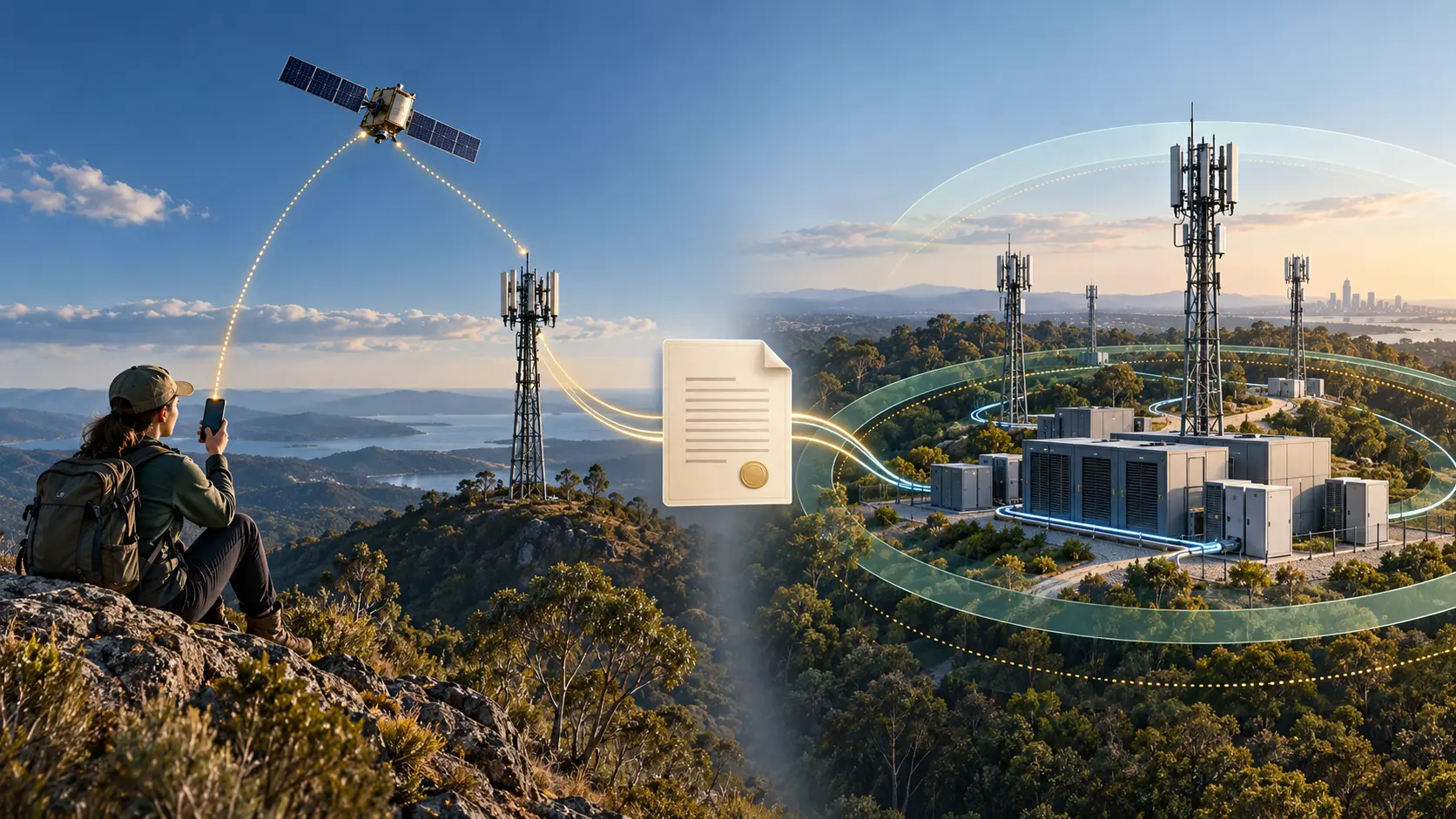
The practical change is not simply that Australia has adopted a more ambitious coverage slogan. It is that the policy now contains several instruments with different purposes, decision makers and clocks. The government’s 16 October statement says the Universal Outdoor Mobile Obligation (UOMO) bill passed Parliament. It describes an outdoor voice-and-SMS obligation for Telstra, Optus and TPG, using terrestrial infrastructure and low-Earth-orbit direct-to-device technology, with a default start on 1 December 2027 subject to market developments. That is an access commitment. It does not, by itself, define a measurable standard for the reliability or quality of every terrestrial mobile service. Minister for Communications, 16 October
The Senate debate added a second track. Amendments provide for terrestrial network performance and reliability standards to be made by legislative instrument, with regard to the ACCC’s mobile-services inquiry findings, consultation with relevant regulators, carriers and affected representatives, and a deadline linked to the inquiry’s final report. The transcript also records amendments concerning broader service standards, compensation pathways, affordability and compatible devices. These are instructions for future rulemaking and implementation; they are not evidence that a completed set of standards, compensation rates or service outcomes already exists. The official Senate transcript is the controlling source for amendment detail; the 15 October Hansard record was not retrievable by this research browser, so the text was cross-checked against a transcript mirror. The government and ACMA separately confirmed passage.
The ACCC process is not the same instrument. Its 2026–27 mobile-services inquiry is consulting on domestic roaming and wholesale radio-access-network services. The regulator said it had formed no view on declaration when consultation opened on 15 October. Submissions on its discussion paper are due 26 November 2026 and the consumer survey closes 10 December. A finding that supports wholesale access would address competitive availability of network inputs; a reliability standard would specify expectations for services and operators. Either may affect investment, but one does not predetermine the other. ACCC consultation notice
Disaster roaming is another separate control. The Senate record ties temporary roaming arrangements to whether voluntary arrangements prove sufficient, with a reporting route if no instrument is made. The ACCC says emergency roaming is constrained by available coverage and capacity. It cannot be assumed to create a second network where no usable radio access exists, nor can it substitute for day-to-day resilience obligations. ACCC mobile-services inquiry
There is also a legal-status boundary. “Passed Parliament” is the government’s description of the bill’s progress. A Commonwealth bill becomes an Act only after passage in identical form by both Houses and Royal Assent; the Federal Register check on 18 October did not establish an assented UOMO Act. The APH bill page appeared stale, so it is not used to override the government’s statement or the Senate record. The appropriate account is therefore passage, followed by remaining assent and commencement questions—not an in-force obligation today. Federal Register guidance
This division matters for operators and buyers. A coverage duty asks whether a person outdoors can obtain specified basic contact. Reliability rules can ask how often terrestrial service works, how outages are handled, how quickly faults are repaired, and what evidence supports a claim of continuity. Wholesale access asks whether rivals can obtain network inputs on workable terms. Disaster roaming asks how capacity is shared in an emergency.
Treating these as one promise would make both compliance and public accountability harder: a coverage map cannot prove resilience, and a roaming agreement cannot show that a network meets normal service standards.
The bill’s passage therefore opens an implementation phase, not a conclusion. The next public evidence should be the final inquiry findings, the resulting standards instrument, the methods for measuring performance, and clear allocation of responsibilities among carriers and regulators. A future default date is not a present service result; a legislative power is not a standard until exercised; and a consultation is not a market remedy until the ACCC reaches and implements a decision. Two sources require a careful boundary. The Parliamentary Library’s 28 January Bills Digest describes the introduced bill, before Senate amendments; it supplies design history, not the final text. ACMA’s October release confirms passage but mainly discusses a separate consumer-safeguards bill, so its penalty provisions must not be attributed to UOMO. Parliamentary Library digest · ACMA release
Member Briefing
Deeper Profile Context
Sign in with the right membership level to unlock the full briefing and source notes.
Only for Strategic Circle
Strategic Circle
Open to all readers. Unlock profile briefings after joining and signing in.
Join Strategic CircleOnly for Leadership Alliance
Leadership Alliance
For qualified IP-asset owners and management; sign in to unlock alliance briefings.
Join Leadership Alliance